
DIGITAL MARKETING


LED Video Walls in Dubai, UAE
Looking for an LED video wall supplier in Dubai? EDS provides seamless, large-format LED video wall solutions for corporate offices, boardrooms, meeting rooms, retail stores, shopping malls, showrooms, hotels, control rooms, reception areas and commercial spaces across Dubai, Abu Dhabi and the UAE.
LED video walls combine multiple LED modules or cabinets into a single continuous digital display surface. Unlike conventional multi-panel LCD video walls, direct-view LED technology creates large display surfaces without visible LCD bezel lines, making it suitable for presentations, advertising, brand communication, live video, dashboards and digital information.
Available in pixel pitches such as P0.9, P1.2, P1.5, P1.8, P2 and P2.5, LED video walls can be configured according to screen dimensions, viewing distance, resolution, aspect ratio, brightness and installation requirements.
Established in Dubai in 2006, EDS FZCO provides LED display screen solutions in Dubai, including technical planning, equipment supply, installation, configuration and maintenance support, depending on the agreed project scope.
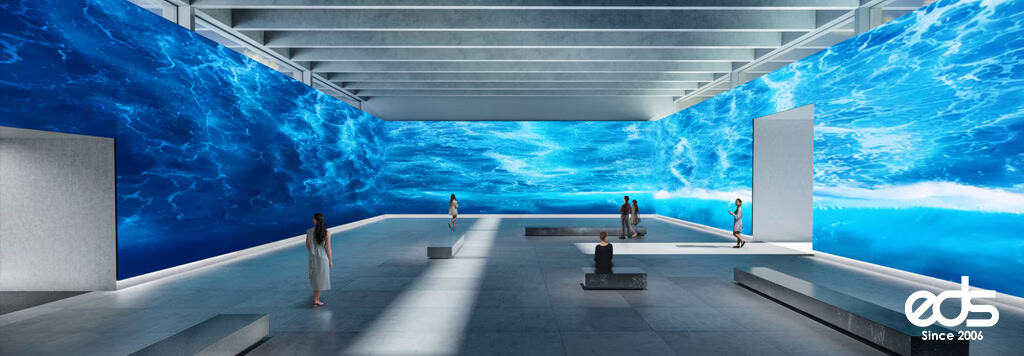
WHAT IS AN LED VIDEO WALL?
An LED video wall is a large digital display created by connecting multiple LED modules or cabinets to form one continuous viewing surface.
Each module contains LED pixels that contribute to the complete image. A controller or video processor distributes content across the entire display so that viewers see a unified digital canvas rather than separate individual screens.
LED video walls can display presentations, videos, images, dashboards, maps, operational information, corporate branding, advertisements, live camera feeds and other compatible digital content.
Because the technology is modular, video walls can be configured in different physical dimensions and aspect ratios, subject to the selected cabinet and module system.
HOW DOES AN LED VIDEO WALL WORK?
An LED video wall consists of several integrated components.
LED Modules & Cabinets
LED modules contain the individual pixels that produce the image. These modules are assembled into cabinets or supporting configurations to create the complete display surface.
LED Controller & Video Processor
The controller and video processor manage how digital content appears across the screen.
Depending on the system, they may handle multiple input sources, image scaling, switching, synchronisation and content distribution.
Supporting Structure
The LED cabinets are installed on an appropriate mounting or supporting structure.
Correct alignment is important because even small installation inaccuracies can affect the appearance of the continuous display.
Content Source
Content can originate from computers, presentation systems, media players, cameras, video conferencing systems or other compatible devices.
Calibration & Configuration
After installation, the display requires configuration and, where applicable, calibration to achieve consistent brightness, colour and image alignment.
LED VIDEO WALL APPLICATIONS IN DUBAI
LED video walls are used across corporate, retail, hospitality, commercial and specialised environments.
| Location | Common LED Video Wall Applications |
|---|---|
| Corporate Offices | Presentations, corporate branding, communication |
| Boardrooms | Meetings, video conferencing, detailed presentations |
| Reception Areas | Welcome messages, brand videos, digital artwork |
| Control Rooms | Dashboards, monitoring systems, maps, operational data |
| Retail Stores | Product campaigns, promotions, digital merchandising |
| Shopping Malls | Advertising, events, entertainment, destination information |
| Showrooms | Product demonstrations, launches, visualisations |
| Hotels & Resorts | Guest information, events, conference presentations |
| Auditoriums | Presentations, live feeds, multimedia content |
| Experience Centres | Interactive brand presentations and immersive visuals |
| Educational Institutions | Lectures, presentations and information |
| Commercial Spaces | Digital information and promotional content |
Different applications can require significantly different screen specifications.
LED VIDEO WALLS FOR CORPORATE OFFICES
Corporate offices use LED video walls for presentations, company videos, video conferencing, dashboards, announcements and internal communication.
Common installation locations include boardrooms, meeting rooms, reception areas, executive spaces and auditoriums.
For corporate applications, image detail can be particularly important because audiences may be seated close to the display.
A fine-pitch LED video wall may therefore be appropriate depending on the room dimensions and content requirements.
LED VIDEO WALLS FOR BOARDROOMS & MEETING ROOMS
Boardrooms often require large displays capable of presenting detailed information.
Typical content includes spreadsheets, presentations, documents, charts, video conferences and corporate videos.
A boardroom LED video wall should be specified according to the closest seating position, screen dimensions, content detail and room layout.
For example, a display viewed from two metres may require a finer pixel pitch than a large presentation wall viewed from ten metres.
The selected technology should support the required text readability and image resolution rather than simply provide the largest possible screen.
LED VIDEO WALLS FOR RECEPTION AREAS
Reception areas can use LED video walls for corporate branding, welcome messages, announcements, product presentations, company videos and digital artwork.
In these environments, the screen may become an architectural feature.
Planning should therefore consider both technical display performance and how the screen integrates with the reception design.
Wall dimensions, viewing distance, brightness, screen depth and maintenance access should be evaluated before installation.
LED VIDEO WALLS FOR CONTROL ROOMS
Control rooms can require large displays for operational monitoring, dashboards, data visualisation, maps, camera feeds and multiple information sources.
The technical specification depends on the type and detail of information displayed.
Important considerations include native resolution, viewing distance, number of content sources, operating hours, screen dimensions and processing requirements.
Where detailed text or data is displayed continuously, pixel density should be selected according to what operators need to read rather than screen size alone.
LED VIDEO WALLS FOR RETAIL STORES
Retail businesses use LED video walls for product campaigns, promotional offers, brand videos, seasonal content and new product launches.
Displays may be installed at store entrances, feature walls, promotional zones or branded product areas.
The screen specification should reflect customer movement and viewing distance.
A video wall positioned across a large store may require a different pixel pitch from one that customers approach closely.
For other retail display formats, EDS also provides indoor LED display screens in Dubai.
LED VIDEO WALLS FOR SHOPPING MALLS
Shopping malls use large LED video walls for advertising, promotions, events, entertainment and destination information.
Common installation environments include atriums, retail areas, promotional zones and information spaces.
Screen dimensions and pixel pitch should be selected according to the surrounding architecture and expected viewing distance.
Businesses seeking advertising space on existing screens can also explore shopping mall advertising opportunities in Dubai.
LED VIDEO WALLS FOR SHOWROOMS
Automotive, property, technology and other commercial showrooms can use LED video walls for product presentations, brand films, launches, promotional campaigns and visual demonstrations.
Large LED displays can create an engaging presentation environment while allowing content to change according to the product, customer or campaign being presented.
For real estate showrooms, LED video walls can display project renderings, architectural visualisations, location maps and property presentations.
LED VIDEO WALLS FOR HOTELS & HOSPITALITY
Hotels and hospitality businesses can use LED video walls in lobbies, ballrooms, conference areas, restaurants and entertainment spaces.
Typical applications include event presentations, brand content, guest information, promotions and multimedia displays.
The appropriate screen specification depends on ambient lighting, viewing distance, installation position and content.
For permanent hotel installations, the screen should also integrate with the interior architecture and maintenance requirements.
FINE-PITCH LED VIDEO WALLS
Fine-pitch LED video walls use displays with relatively small distances between neighbouring LED pixels.
Smaller pixel pitch generally provides greater pixel density, making it useful for applications where audiences view the screen from shorter distances.
Fine-pitch LED video walls are commonly considered for boardrooms, corporate offices, control rooms, premium retail environments, showrooms, reception areas and experience centres.
Common configurations include P0.9, P1.2, P1.5, P1.8, P2 and P2.5, depending on the selected technology and project requirements.
Fine-pitch technology should be selected according to the actual viewing environment rather than assuming that the smallest available pixel pitch is always the best option.
WHAT IS PIXEL PITCH IN AN LED VIDEO WALL?
Pixel pitch is the distance between the centres of neighbouring LED pixels, normally measured in millimetres.
For example, P1.2 means approximately 1.2 mm between neighbouring pixel centres.
A smaller pixel pitch generally provides greater pixel density and can improve image detail at shorter viewing distances.
However, finer pixel pitches can materially increase project cost.
LED Video Wall Pixel Pitch Guide
| Pixel Pitch | Typical Application |
|---|---|
| P0.9–P1.2 | Premium close-viewing and detail-intensive applications |
| P1.2–P1.5 | Boardrooms, control rooms and premium corporate environments |
| P1.5–P1.8 | Corporate offices, retail, showrooms and presentation applications |
| P1.8–P2.5 | General indoor commercial video walls |
| P2.5–P4 | Larger indoor displays viewed from greater distances |
These are general planning guidelines rather than fixed technical rules. The appropriate specification depends on screen dimensions, viewing distance, content and required resolution.
HOW DO I CHOOSE THE RIGHT PIXEL PITCH?
Pixel pitch selection should begin with the expected viewing distance.
A boardroom screen viewed from two metres requires different pixel density considerations from a large shopping mall display viewed from considerably farther away.
The main factors include closest viewing distance, typical viewing distance, screen dimensions, content detail, required resolution and budget.
Selecting a finer pixel pitch than necessary may increase cost without delivering a meaningful improvement for the intended viewing environment.
LED VIDEO WALL RESOLUTION
Resolution is particularly important when planning an LED video wall.
The native resolution of the complete display is determined by the physical screen dimensions and pixel pitch.
Two LED video walls measuring exactly the same width and height can have significantly different native resolutions if they use different pixel pitches.
Higher pixel density can be especially important when displaying small text, spreadsheets, dashboards, maps, documents and detailed graphics.
For applications primarily displaying large-format video and branding, resolution requirements may differ.
PHYSICAL SCREEN SIZE VS RESOLUTION
A physically larger LED video wall does not automatically provide higher resolution.
Resolution depends on the number of pixels contained across the display surface.
For example, a 4-metre-wide screen with a P2 pixel pitch has approximately 2,000 horizontal pixels, while the same width with P1 pixel pitch has approximately 4,000 horizontal pixels.
This illustrates why screen dimensions and pixel pitch should be evaluated together.
CAN AN LED VIDEO WALL DISPLAY 4K CONTENT?
An LED video wall can receive 4K source content if the selected controller and processing system support it.
However, displaying a 4K video source does not automatically mean the physical LED wall has native 4K resolution.
A native 4K UHD display has 3,840 × 2,160 pixels.
The actual native resolution of an LED video wall depends on its physical dimensions and pixel pitch.
For example, a 4.8-metre-wide by 2.7-metre-high display using P1.25 technology would have approximately 3,840 × 2,160 pixels, subject to the exact module configuration.
If native 4K resolution is required, it should be established during the technical design stage because it can materially influence screen dimensions, pixel pitch, processing requirements and project cost.
LED VIDEO WALL ASPECT RATIO
Aspect ratio describes the relationship between the width and height of the display.
A 16:9 aspect ratio is commonly used for video, presentations and video conferencing.
However, modular LED technology also allows custom display proportions.
The appropriate aspect ratio depends on available wall space, content, architecture and intended application.
Custom-shaped video walls may require specially prepared content to use the available display area effectively.
LED VIDEO WALL BRIGHTNESS
The required brightness depends on the installation environment.
A video wall inside a controlled boardroom may require different brightness levels from a display installed in a brightly illuminated shopping mall.
Factors include ambient lighting, nearby windows, viewing distance, screen position, content and operating hours.
For close-viewing indoor environments, excessively high brightness can be uncomfortable and unnecessary.
Brightness should therefore be selected according to the actual application.
LED VIDEO WALL VIEWING DISTANCE
Viewing distance is one of the most important considerations when specifying an LED video wall.
Both the closest viewer and the typical viewer should be considered.
For a boardroom, this may involve the first and last rows of seating.
For a retail store, it may involve the main customer pathway and the closest point customers can approach the screen.
For a reception area, it may involve the distance from which visitors normally enter or wait.
These distances help determine the appropriate combination of pixel pitch, screen dimensions and resolution.
CHOOSING THE RIGHT LED VIDEO WALL SIZE
A larger LED video wall is not automatically better.
The appropriate dimensions depend on room size, viewing distance, available wall area, content, audience size and architecture.
A display that is too large for a small room may be uncomfortable to view.
A display that is too small for a large environment may not provide sufficient visual presence.
Custom-Size LED Video Walls
Modular LED technology allows screens to be configured in different dimensions.
Depending on the selected LED cabinet or module system, EDS can evaluate configurations based on available width, height, required aspect ratio, native resolution and architecture.
However, not every arbitrary dimension is practical because cabinet and module dimensions influence the final physical size.
SEAMLESS LED VIDEO WALLS
The term seamless LED video wall refers to the visual continuity created when LED modules or cabinets are correctly aligned.
Unlike conventional multi-panel LCD video walls, direct-view LED displays do not require LCD bezels between individual screen sections.
However, achieving a consistent display depends on cabinet alignment, module flatness, calibration, installation accuracy and LED consistency.
An LED video wall should therefore be evaluated as a complete installed system rather than simply a collection of LED modules.
LED VIDEO WALL INSTALLATION METHODS
LED video walls can be installed using different methods depending on the building, screen dimensions and intended application.
Wall-Mounted LED Video Walls
LED video walls can be mounted onto suitable walls using appropriate supporting structures.
Planning should consider wall strength, screen weight, supporting frames, flatness, power, data connectivity, ventilation and maintenance access.
Recessed LED Video Walls
Recessed installations integrate the LED display into the surrounding wall or interior design.
This can create a clean architectural finish.
However, recessed installations require careful consideration of opening dimensions, screen depth, supporting structures, ventilation, cabling and front-service access.
The LED system should ideally be selected before the final wall opening is constructed.
Freestanding LED Video Walls
Where wall mounting is not practical, an LED video wall may be installed on a suitable freestanding structure.
This can be relevant for commercial spaces, showrooms, experience centres and selected temporary installations.
The structure must be designed according to the screen dimensions, weight and application.
FRONT-SERVICE VS REAR-SERVICE LED VIDEO WALLS
Maintenance access should be established during the technical design stage.
Front-Service LED Video Walls
Front-service systems allow selected components to be accessed from the front of the display.
This can be particularly useful for wall-mounted or recessed installations where little or no service space is available behind the screen.
Rear-Service LED Video Walls
Rear-service systems require suitable access behind the display.
They may be appropriate for installations with sufficient rear clearance and safe maintenance access.
The appropriate configuration depends on the installation environment, cabinet design and supporting structure.
LED VIDEO WALL CONTROLLERS & VIDEO PROCESSORS
An LED video wall requires a compatible controller or video processor to manage how content appears across the display.
Depending on the system, compatible content sources may include computers, media players, presentation systems, cameras and video conferencing equipment.
The required controller should be selected according to screen resolution, number of inputs, content sources, switching requirements and scaling requirements.
For applications requiring multiple inputs or complex content layouts, video processing capability becomes an important part of the specification.
MULTIPLE CONTENT SOURCES ON AN LED VIDEO WALL
Some LED video wall applications require more than one source to be displayed.
For example, a control room may need dashboards, camera feeds, maps and operational information.
A corporate environment may switch between presentations, video conferencing and corporate videos.
The required processing and source-management architecture should be established during project planning.
LED VIDEO WALL CONTENT MANAGEMENT
For digital signage applications, content can be managed through a media player, LED controller, content management system, local network or remote management platform.
Depending on the system, businesses may be able to update content, schedule campaigns, create playlists, change content remotely and manage multiple displays.
For businesses requiring original corporate videos, promotional films or presentation content, EDS also offers video production and photography services.
LED VIDEO WALL VS LCD VIDEO WALL
LED and LCD video walls can both create large displays, but they use different technologies.
| Factor | LED Video Wall | LCD Video Wall |
|---|---|---|
| Display Technology | Direct-view LED modules | Multiple LCD panels |
| Visible Panel Borders | No conventional LCD bezel lines | Bezel lines between panels |
| Custom Dimensions | Highly configurable | Based on fixed panel dimensions |
| Pixel Pitch | Varies by LED specification | Determined by LCD panel |
| Close-Viewing Detail | Depends heavily on pixel pitch | Can provide very high pixel density |
| Brightness | Depends on LED specification | Depends on LCD panel |
| Maintenance | Module/cabinet-based | Panel-based |
| Typical Application | Seamless custom large displays | Applications where LCD characteristics suit the requirement |
Neither technology is automatically better for every project.
For very close viewing where detailed text is important, the required LED pixel pitch should be evaluated against suitable alternative display technologies.
LED VIDEO WALL VS PROJECTOR
LED video walls and projection systems serve different requirements.
An LED video wall produces the image directly from the display surface and does not require a projector beam.
Projection may be appropriate for certain applications where budget, temporary use, room configuration and screen size make it practical.
LED video walls can be particularly useful for businesses requiring permanent digital displays with integrated screen technology, suitable brightness, modular sizing and no projector shadow.
The correct solution depends on the application rather than technology alone.
LED VIDEO WALL VS STANDARD INDOOR LED SCREEN
Both technologies use LED display systems.
The term LED video wall generally describes a large modular display designed to operate as one continuous visual canvas.
A standard indoor LED screen can describe a broader range of indoor LED applications.
For wider indoor display applications, see Indoor LED Display Screens in Dubai.
PERMANENT LED VIDEO WALL VS RENTAL LED WALL
Permanent LED video walls are generally appropriate for corporate offices, retail stores, showrooms, hotels, control rooms, reception areas and long-term commercial installations.
Rental LED systems are more appropriate for conferences, exhibitions, product launches, temporary events and short-term activations.
| Factor | Permanent LED Video Wall | Rental LED Video Wall |
|---|---|---|
| Duration | Long-term installation | Temporary use |
| Applications | Offices, retail, hospitality, control rooms | Events, exhibitions, conferences |
| Structure | Permanent mounting arrangement | Temporary supporting structure |
| Maintenance | Long-term servicing | Event-specific technical support |
| Content | Ongoing business content | Event-specific content |
| Commercial Model | Equipment purchase and installation | Rental charges |
For temporary requirements, EDS also provides LED screen rental solutions in Dubai.
LED VIDEO WALL INSTALLATION IN DUBAI
A permanent LED video wall project may involve a site survey, screen specification, supporting structure, electrical supply, data connectivity, LED cabinets, controllers, installation, alignment, configuration, calibration and testing.
The exact scope depends on the installation.
For permanent architectural installations, the LED screen and supporting wall should ideally be planned together.
The installation should account for screen flatness, structural support, maintenance access, ventilation, cabling and electrical safety.
LED VIDEO WALL RATES & COST IN DUBAI, UAE
The cost of an LED video wall in Dubai depends on screen dimensions, pixel pitch, native resolution, LED technology, cabinet design, video processor, supporting structure and installation requirements.
Fine-pitch LED video walls generally cost more per square metre than standard indoor LED displays because of their higher pixel density.
Estimated LED Video Wall Prices in Dubai
| LED Video Wall Type | Indicative Equipment Cost (AED/m²) | Typical Application |
|---|---|---|
| P2.5–P4 LED Video Wall | 2,500–4,500 | Retail, commercial displays |
| P2–P2.5 LED Video Wall | 3,000–5,500 | Offices, reception areas, showrooms |
| P1.8–P2 LED Video Wall | 4,000–6,500 | Corporate presentations, premium retail |
| P1.5–P1.8 Fine-Pitch LED Wall | 4,500–8,000 | Boardrooms, corporate offices |
| P1.2–P1.5 Fine-Pitch LED Wall | 5,000–10,000+ | Control rooms, premium close-viewing displays |
| P0.9–P1.2 Ultra-Fine-Pitch LED Wall | 8,000–16,000+ | Specialist high-resolution applications |
Important: These are indicative equipment-only budgeting estimates, not verified current EDS quotations or fixed UAE market prices. Actual pricing can fall outside these ranges. Installation, supporting structures, controllers, electrical work, delivery, maintenance and VAT are generally additional.
LED Video Wall Installation & Additional Costs
| Component | Indicative Cost (AED) |
|---|---|
| Basic LED Video Wall Installation | 2,000–6,000+ |
| LED Video Processor / Controller | 1,500–8,000+ |
| Supporting Structure & Mounting | Based on project requirements |
| Electrical & Data Cabling | Based on installation |
| Content Management System | Based on software and licensing |
| Calibration & Configuration | Based on project scope |
| Annual Maintenance Contract | Based on screen size and service requirements |
Installation costs depend on screen dimensions, wall construction, accessibility, electrical infrastructure and project complexity.
Example: Cost of a 4m × 2.25m LED Video Wall
| Description | Estimated Cost |
|---|---|
| Screen Dimensions | 4m × 2.25m |
| Total Display Area | 9 m² |
| Pixel Pitch | P1.8 |
| Indicative Equipment Rate | AED 4,500–8,000/m² |
| Estimated Equipment Cost | AED 40,500–72,000 |
| Installation & Supporting Structure | Additional |
| Video Processor & Accessories | Additional |
| Total Project Cost | Subject to final specification |
This example is for initial budgeting only and is not a fixed project quotation.
WHAT AFFECTS LED VIDEO WALL PRICES?
The main cost factors include total display area, pixel pitch, native resolution, LED technology, cabinet design, video processor, supporting structure, installation method, maintenance access and content management requirements.
Two LED video walls with identical physical dimensions can have substantially different prices if one uses a much finer pixel pitch.
Quotations should therefore be compared using equivalent technical specifications and project scope rather than price per square metre alone.
LED VIDEO WALL MAINTENANCE & TECHNICAL SUPPORT
Permanent LED video walls require suitable maintenance arrangements to support reliable operation.
Depending on the system, maintenance may include module inspections, power supply checks, controller checks, cleaning, calibration, software support and replacement of defective components.
For control rooms and other critical installations, maintenance planning should also consider operating hours, spare components, service access and response requirements.
LED VIDEO WALL INSTALLATION RULES & SAFETY REQUIREMENTS IN UAE
LED video wall installations in Dubai and the UAE must comply with applicable building, electrical, fire safety and property requirements.
The approval process depends on the installation location, screen dimensions, supporting structure and intended use.
Projects in shopping malls, hotels, commercial buildings and public-facing interiors may require property management or landlord approvals.
Large suspended or freestanding installations may require additional structural assessments.
Electrical connections, ventilation, supporting structures and maintenance access should be considered during the design stage.
For permanent installations, relevant permissions and technical requirements should be confirmed before equipment procurement and installation.
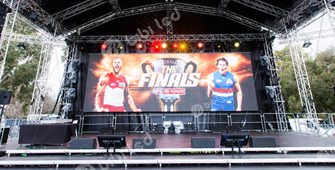
Partner with Us
At EDS, we are committed to delivering premium LED video walls in Dubai, UAE. Whether you’re enhancing event experiences, upgrading retail displays, or transforming corporate environments, our LED video wall solutions offer unparalleled visual impact and versatility. Contact us today to discover how our LED video walls can elevate your space and captivate your audience with cutting-edge visual displays.
LED VIDEO WALLS IN DUBAI & UAE – FAQ
What is an LED video wall?
An LED video wall is a large digital display created by connecting multiple LED modules or cabinets into one continuous viewing surface. It can display videos, presentations, advertisements, dashboards, live feeds and other digital content. LED video walls are commonly used in corporate offices, shopping malls, hotels, showrooms, boardrooms and control rooms.
How much does an LED video wall cost in Dubai?
Indicative equipment-only prices may range from AED 2,500–4,500 per square metre for standard P2.5–P4 LED video walls to AED 8,000–16,000 or more per square metre for ultra-fine-pitch displays. Actual costs depend on screen size, pixel pitch, controller, installation and supporting equipment. These figures are budgeting estimates rather than fixed quotations.
What is the best pixel pitch for an LED video wall?
The appropriate pixel pitch depends on viewing distance, screen dimensions and content. P1.2–P1.8 displays may suit close-viewing corporate applications such as boardrooms and control rooms, while P2–P4 configurations may be suitable for larger commercial displays viewed from farther away.
Can an LED video wall display 4K content?
Yes, if the controller supports the source format. However, displaying a 4K source does not automatically mean the LED wall has native 4K resolution. Native resolution depends on screen dimensions and pixel pitch. A native 4K UHD display contains 3,840 × 2,160 pixels.
What is the difference between an LED video wall and an LCD video wall?
An LED video wall uses modular direct-view LED displays to create a continuous surface without conventional LCD bezel lines. An LCD video wall combines multiple LCD panels, which may have visible borders between them. The appropriate technology depends on resolution, viewing distance, screen dimensions, content and budget.
Are LED video walls suitable for corporate boardrooms?
Yes. LED video walls can be used in boardrooms for presentations, video conferencing, corporate videos, spreadsheets, dashboards and other business content. The pixel pitch and resolution should be selected according to the closest seating position, screen dimensions and level of content detail.
Can LED video walls be customised to different sizes?
Yes. Modular LED technology allows video walls to be configured in different dimensions and aspect ratios. Final dimensions depend on the selected cabinet system, available space, required resolution and installation conditions. Custom configurations are commonly used in reception areas, retail stores, showrooms and corporate environments.
Can an LED video wall be recessed into a wall?
Yes. Recessed LED video walls can be integrated into architectural interiors to create a clean, built-in appearance. Planning should account for opening dimensions, screen depth, supporting structure, ventilation, cabling and maintenance access. Front-service LED systems may be particularly suitable where limited space is available behind the display.
Can LED video walls display multiple content sources?
Yes. Depending on the video processor and control system, LED video walls can display content from computers, cameras, presentation systems, dashboards and other compatible sources. Some systems support multiple sources simultaneously, making them suitable for control rooms, corporate presentations and monitoring environments.
What maintenance does an LED video wall require?
Maintenance may include cleaning, LED module checks, power supply inspections, controller checks, calibration, software support and component replacement. Requirements depend on the screen technology, operating hours and installation environment. Appropriate service access and preventive maintenance can help maintain display performance.
Is an LED video wall better than a projector?
An LED video wall may be preferable for permanent installations requiring direct-view digital displays, modular dimensions and suitable brightness. Projection may be more practical for some temporary or budget-sensitive applications. The appropriate choice depends on the environment, viewing distance, screen size and intended use.
Does EDS supply and install LED video walls in Dubai and UAE?
Yes. Established in Dubai in 2006, EDS provides LED video wall solutions for businesses across Dubai, Abu Dhabi, Sharjah and other UAE emirates. Depending on the project scope, services can include screen selection, technical planning, equipment supply, installation, configuration, calibration and maintenance support.