DIGITAL MARKETING

DIGITAL OUT-OF-HOME ADVERTISING (DOOH) IN DUBAI, UAE
Digital Out-of-Home (DOOH) advertising in Dubai allows brands to reach motorists, commuters, shoppers, residents and tourists through digital billboards, LED advertising screens and electronic displays positioned across major roads, shopping malls, business districts, airports, public transport networks and lifestyle destinations.
Unlike traditional static billboards, DOOH advertising enables brands to display multiple creatives, update messages electronically and, on supported networks, schedule advertising at different times of day. Digital advertising screens typically operate on shared advertising loops, making spot duration, playback frequency and Share of Voice (SOV) important considerations when evaluating advertising opportunities.
Established in Dubai in 2006, EDS is an advertising and media-buying agency coordinating digital outdoor advertising opportunities across Dubai and the UAE through authorised media owners and operators.
WHAT IS DIGITAL OUT-OF-HOME (DOOH) ADVERTISING?
Digital Out-of-Home advertising refers to advertisements displayed on electronic screens in public spaces, commercial properties and other approved locations outside the home.
Unlike online display advertising, DOOH reaches audiences through physical advertising locations rather than advertisements delivered directly to their personal devices.
Common DOOH environments include roadside digital billboards, shopping mall screens, airport displays, Metro stations, business towers, residential communities, hotels and entertainment destinations.
Depending on the media network, DOOH advertising may support static digital artwork, video, animation, multiple creative versions, scheduled playback and dynamic content.
The capabilities, advertising frequency and commercial terms vary between individual screens and networks.
DOOH ADVERTISING COSTS & RATES IN DUBAI
Digital outdoor advertising rates in Dubai depend on the screen location, size, campaign duration, advertising frequency, number of screens and Share of Voice.
The following figures provide indicative planning budgets for different DOOH advertising environments.
| DOOH Format | Typical Environment | Indicative Cost (AED) | Typical Buying Basis |
| Community Digital Screens | Residential & community areas | AED 10,000 – 30,000+ | Campaign per monthly |
| Mall & Indoor Digital Screens | Shopping malls & retail environments | AED 15,000 – 50,000+ | Network / campaign |
| Digital Roadside Screens | Main roads & commercial districts | AED 30,000 – 100,000+ | Monthly / campaign |
| Premium Digital Billboards / Unipoles | Major Dubai road corridors | AED 60,000 – 200,000+ | Monthly / campaign |
| Landmark Digital Screens | Premium & high-profile locations | AED 100,000 – 300,000+ | Campaign / media package |
| Multi-Location DOOH Network | Multiple digital locations | AED 150,000 – 500,000+ | Network campaign |
Important: These are indicative market-planning ranges, not confirmed media-owner rate cards. Different rows represent different media packages and booking periods, so they should not be compared as equivalent per-screen monthly prices.
Actual rates depend on current inventory, advertising duration, number of plays, campaign dates and the selected media operator.
What Determines DOOH Advertising Costs?
Screen Location: Digital screens on major roads, premium commercial districts and high-demand destinations may command different rates from community-based displays.
Screen Size: Large-format digital billboards generally have different pricing structures from smaller indoor advertising screens.
Spot Duration: The number of seconds allocated to an advertisement influences its advertising presence.
Advertising Loop: The total duration of the advertising rotation determines how frequently a spot may appear.
Share of Voice: A greater proportion of advertising time generally provides more exposure within the available loop.
Campaign Duration: Booking periods, campaign dates and seasonal demand can affect pricing.
Number of Screens: Multi-location campaigns may involve different screen sizes, locations and advertising frequencies.
HOW DO DOOH ADVERTISING LOOPS & SHARE OF VOICE WORK?
Most digital outdoor advertising screens operate on a rotation in which advertisements from different brands appear at scheduled intervals.
An advertising loop is the complete sequence of advertisements before the sequence repeats. Share of Voice (SOV) represents the proportion of the available advertising time allocated to a particular advertiser.
For example, consider a screen operating on a 60-second advertising loop.
| Advertising Parameter | Example |
|---|---|
| Total Advertising Loop | 60 seconds |
| Advertisement Duration | 10 seconds |
| Advertisement Frequency | Once every 60 seconds |
| Plays Per Hour | 60 |
| Share of Voice | 16.67% |
| Advertising Time Per Hour | 600 seconds |
This example assumes continuous operation and one appearance in every complete loop.
A screen offering a 10-second advertisement every 60 seconds provides a different level of advertising frequency from a screen displaying the same advertisement every 120 seconds.
Advertisers should compare DOOH media using spot duration, loop length, plays per hour, Share of Voice and operating hours—not screen size alone.
TYPES OF DIGITAL OUT-OF-HOME ADVERTISING IN DUBAI
Digital Billboard Advertising
Digital billboards are large electronic advertising displays positioned at approved roadside and urban locations.
They allow advertisers to display different creative messages without physically replacing printed advertisements.
Digital billboards are commonly considered for brand awareness, product launches, automotive campaigns, real estate promotions and major consumer brands.
Actual exposure depends on the screen’s position, traffic direction, visibility and advertising frequency.
Digital Unipole Advertising
Digital unipoles are elevated roadside advertising structures incorporating LED display technology.
These screens may be positioned along major road corridors and commercial areas, subject to approved inventory.
Unlike a traditional static unipole, a digital unipole typically rotates advertisements between multiple brands.
Digital Bridge & Gantry Advertising
Selected bridge and gantry advertising assets incorporate electronic displays positioned above or alongside roads.
These formats can provide visibility to motorists travelling through specific corridors.
Screen availability, advertising dimensions, creative restrictions and technical requirements depend on the individual media asset.
Shopping Mall Digital Screen Advertising
Digital screens in shopping malls reach visitors within retail, dining and entertainment environments.
Potential placements include mall entrances, atriums, escalators, retail corridors, food courts, digital directories and entertainment areas.
The advertising value of a screen depends on its actual location and visitor circulation rather than the mall’s total annual footfall alone.
Airport Digital Advertising
Airport DOOH advertising uses electronic screens within approved passenger environments, including arrivals, departures and terminal circulation areas.
Depending on the airport and media network, available formats may include large LED displays, digital panels and other passenger-facing screens.
Advertising inside airport terminals should be distinguished from roadside screens along airport approach roads.
Dubai Metro & Transit Digital Advertising
Digital transit advertising reaches commuters and passengers through electronic displays within approved transport environments.
Potential formats include Metro station screens, transport-hub displays and selected digital advertising networks associated with buses, taxis and other mobility services.
Availability and media specifications depend on the relevant transport and advertising operators.
Indoor Digital Advertising Networks
Indoor DOOH advertising includes screens within commercial towers, residential buildings, hotels, retail properties and other approved indoor environments.
These screens may offer closer viewing distances than roadside displays.
Audience characteristics, operating hours and advertising frequency vary between individual networks.
Landmark & Special-Format Digital Screens
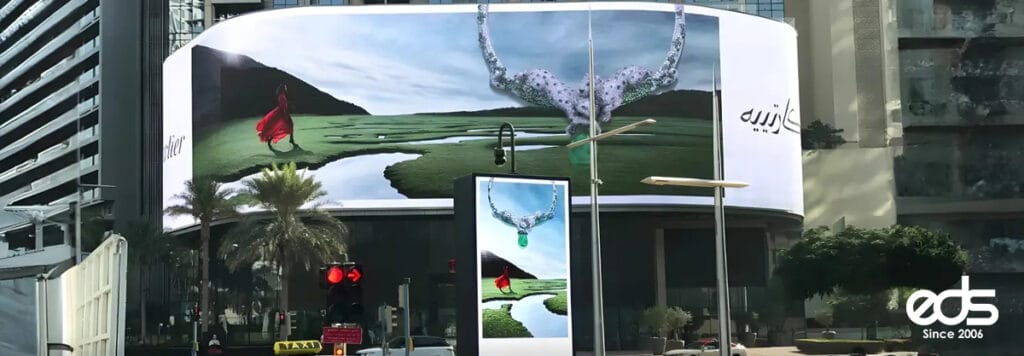
Selected premium digital displays offer unusually large dimensions, distinctive shapes or advanced creative capabilities.
These screens can be considered for major product launches, corporate branding, entertainment promotions and high-profile advertising campaigns.
Special-format availability, creative requirements and approvals must be confirmed individually.
MAJOR DOOH ADVERTISING LOCATIONS IN DUBAI
Dubai offers a range of roadside, retail, commercial and transport environments for digital advertising.
| Location / Environment | Advertising Relevance |
|---|---|
| Sheikh Zayed Road | Major commercial and commuter corridor |
| Al Khail Road | Residential and business traffic |
| Sheikh Mohammed Bin Zayed Road | Cross-city and inter-emirate connectivity |
| Dubai–Al Ain Road | Residential and intercity connections |
| Downtown Dubai | Tourism, retail and hospitality |
| Business Bay | Corporate and residential audiences |
| DIFC | Financial and professional audiences |
| Dubai Marina & JBR | Residential, tourism and leisure |
| Jumeirah Lake Towers | Office and residential communities |
| Dubai International Airport | International travellers |
| Shopping Malls | Retail, dining and entertainment audiences |
| Metro & Transit Networks | Commuters and public transport passengers |
| Residential Communities | Community-based audiences |
These are potential DOOH advertising environments. Specific screen availability and media rights must be confirmed before booking.
Sheikh Zayed Road Digital Advertising
Sheikh Zayed Road is one of Dubai’s most prominent commercial and transport corridors.
Selected digital billboards and LED advertising screens can reach motorists travelling between major business districts, residential communities and visitor destinations.
Advertisers should confirm the screen’s exact location, traffic direction, viewing distance and advertising frequency.
Al Khail Road Digital Advertising
Al Khail Road connects important residential and commercial districts, including areas around Business Bay, Al Quoz and Dubai Hills.
Selected digital advertising locations may be relevant for campaigns targeting motorists travelling between these communities.
Sheikh Mohammed Bin Zayed Road Digital Advertising
Sheikh Mohammed Bin Zayed Road connects numerous residential, commercial and industrial districts across Dubai and neighbouring emirates.
Available digital billboard locations depend on approved inventory and media-owner arrangements.
Downtown Dubai & Business Bay DOOH
Downtown Dubai and Business Bay contain offices, residential towers, hotels, retail destinations and entertainment venues.
Digital advertising opportunities may include approved roadside screens, commercial-property displays and destination-based media networks.
Dubai Marina, JBR & JLT Digital Advertising
Dubai Marina, JBR and Jumeirah Lake Towers combine residential, hospitality, business and leisure environments.
Depending on inventory, advertisers can explore selected roadside digital displays and indoor advertising networks.
STATIC OOH VS DIGITAL OOH ADVERTISING
Traditional Out-of-Home advertising and Digital Out-of-Home advertising provide different creative and commercial advantages.
| Advertising Feature | Static OOH | Digital OOH |
|---|---|---|
| Advertising Format | Printed / Fabricated | Electronic Display |
| Creative Changes | Physical Replacement | Digital Updates |
| Multiple Creatives | Limited | Supported |
| Animation | Not Available | Where Permitted |
| Advertising Rotation | Usually Dedicated | Often Shared |
| Daypart Scheduling | Not Applicable | Selected Networks |
| Production | Printing & Installation | Digital Artwork |
| Share of Voice | Usually Full Advertising Face | Depends on Advertising Loop |
| Primary Advantage | Continuous Physical Visibility | Flexible Creative & Scheduling |
Static billboards provide continuous visibility on a booked advertising face, while shared digital billboards display advertisements at scheduled intervals.
Neither format is automatically more effective. The appropriate choice depends on location, audience, campaign objectives and budget.
HOW TO COMPARE DIGITAL ADVERTISING SCREENS IN DUBAI
Two digital screens with similar dimensions can offer very different advertising opportunities.
| Evaluation Factor | What Advertisers Should Check |
|---|---|
| Exact Location | Physical screen position |
| Traffic Direction | Audience approaching the screen |
| Viewing Distance | Visibility from roads or pedestrian areas |
| Screen Dimensions | Width, height and orientation |
| Spot Duration | Seconds allocated per appearance |
| Advertising Loop | Total rotation duration |
| Plays Per Hour | Scheduled advertising frequency |
| Share of Voice | Percentage of available advertising time |
| Operating Hours | Daily screen operation |
| Number of Screens | Total assets included |
| Creative Specifications | Resolution, format and animation restrictions |
| Campaign Dates | Confirmed booking period |
The most expensive digital screen is not necessarily the most suitable option.
A smaller display positioned within a relevant audience environment may be more useful than a larger screen in an unrelated location.
DOOH ADVERTISING BY TIME OF DAY
Selected DOOH networks allow advertisers to schedule different advertisements according to the time of day, commonly known as dayparting.
| Time Period | Potential Campaign Applications |
|---|---|
| Morning | Breakfast, commuting and business services |
| Afternoon | Retail, restaurants and consumer promotions |
| Evening | Dining, entertainment and leisure |
| Weekends | Shopping, attractions and family activities |
Dayparting can allow brands to display messages that are more relevant to the audience and surrounding environment at particular times.
However, not every DOOH network supports this feature. Availability, scheduling and pricing depend on the media operator.
PROGRAMMATIC DOOH ADVERTISING IN DUBAI
Programmatic Digital Out-of-Home advertising uses technology platforms to facilitate the buying and delivery of advertisements across compatible digital screen networks.
Depending on the platform and available inventory, programmatic DOOH may support advertising based on location, time, audience-related information and contextual conditions.
Unlike conventional direct media bookings, programmatic DOOH can provide additional flexibility in campaign scheduling and inventory selection.
However, not all digital billboards or advertising screens in Dubai are available through programmatic platforms.
Premium roadside displays, landmark screens and destination-based advertising may still require direct bookings through authorised media owners.
3D & SPECIAL-FORMAT DOOH ADVERTISING IN DUBAI
Selected digital screens can support advanced creative executions, including anamorphic 3D advertising and specialised visual effects.
Anamorphic 3D advertising uses perspective-based creative to produce an illusion of depth when viewed from a suitable position.
These campaigns require screens with appropriate dimensions, viewing geometry and technical capabilities.
Not every LED screen supports effective 3D advertising, and a creative developed for one display may not work correctly on another.
Special-format campaigns must comply with the applicable technical, advertising and safety requirements.
WHICH INDUSTRIES BENEFIT FROM DOOH ADVERTISING?
Real Estate Developers
Property developers can use digital billboards and premium DOOH locations to promote residential communities, project launches and property exhibitions.
Automotive Brands
Automotive manufacturers and dealerships can use large-format digital screens for vehicle launches, promotional campaigns and brand awareness.
Retail & E-Commerce
Retailers and e-commerce businesses can promote seasonal sales, product collections, store openings and consumer offers.
Banking & Financial Services
Banks, insurance companies, payment platforms and financial institutions can use DOOH advertising for corporate branding and approved product promotions.
Tourism & Hospitality
Hotels, attractions, airlines and tourism destinations can use digital advertising to reach residents and international visitors.
Technology & Consumer Electronics
Technology brands can use digital displays for new product announcements, smartphone launches and consumer electronics campaigns.
Entertainment & Events
Concerts, exhibitions, cinema releases and entertainment platforms can use DOOH advertising to promote upcoming events and launches.
Food & Beverage
Restaurants, cafés and consumer food brands can use digital screens near relevant retail, dining and residential environments.
DOOH CREATIVE SPECIFICATIONS & DESIGN CONSIDERATIONS
Use Short, Readable Headlines
Roadside audiences generally have limited time to read advertising messages. Use concise headlines that can be understood quickly.
Prioritise Brand Recognition
Prominent logos, distinctive brand colours and recognisable product visuals help communicate the advertiser’s identity.
Design for the Actual Screen
Creative artwork should match the display’s resolution, aspect ratio, orientation and viewing distance.
Avoid Excessive Text
Detailed paragraphs, multiple offers and small disclaimers may be difficult to read on roadside digital screens.
Use Animation Where Permitted
Motion can support creative storytelling, but roadside digital advertising may be subject to restrictions on animation, transitions and other visual effects.
Prepare Multiple Creative Versions
Digital advertising can support different product messages, promotions or campaign phases without physically replacing artwork.
Confirm Technical Specifications
Before producing final creative, advertisers should verify file formats, resolution, duration, permitted motion and any media-owner requirements.
DOOH ADVERTISING CAMPAIGN DURATION & AVAILABILITY
DOOH campaigns can support short-term promotions, product launches, events, seasonal advertising and sustained brand-awareness campaigns.
However, minimum booking periods and inventory availability vary between media operators.
Some digital advertising networks may offer shorter campaigns, while premium roadside displays may require longer commitments.
Before confirming a campaign, advertisers should establish the exact screen locations, number of screens, campaign dates, spot duration, advertising loop, plays per hour, Share of Voice, operating hours and total advertising cost.
For campaigns using multiple screens, these details should be available for each media asset or network.
DOOH ADVERTISING RULES, PERMITS & APPROVALS IN DUBAI
Digital Out-of-Home advertising in Dubai is subject to applicable advertising regulations, permit requirements, technical standards and public-safety considerations.
Dubai’s Out-of-Home advertising framework includes requirements governing approved advertising locations, display structures, illumination, content and technical specifications.
Approved Advertising Locations
Digital advertising must be displayed on authorised media assets. Not every electronic screen is automatically approved for third-party advertising.
Road & Pedestrian Safety
Digital screens must comply with applicable safety requirements concerning road visibility, traffic signals, pedestrian movement and surrounding environments.
Brightness & Illumination
Screen illumination may be subject to technical requirements intended to prevent excessive glare and interference with nearby roads or properties.
Animation & Motion Restrictions
Permitted video, transitions and animation depend on the screen location and applicable regulations.
Advertising Content Approval
Advertising content must comply with UAE and Dubai requirements. Certain product categories, promotional claims or campaign materials may require additional approvals.
Special-Format Advertising
3D advertisements, unusual lighting and other advanced creative executions may require specific technical assessments.
Media-Owner & Property Permissions
Roadside billboards, shopping malls, airports, transit networks and private properties may have different approval procedures and commercial arrangements.
EDS operates as an advertising and media-buying agency, coordinating available DOOH advertising opportunities through authorised media owners and operators. Final inventory, advertising rates and approvals remain subject to the relevant stakeholders.
DIGITAL OUT-OF-HOME (DOOH) ADVERTISING FAQ
What is DOOH advertising?
DOOH stands for Digital Out-of-Home advertising. It uses electronic screens in roadside, retail, transit, airport and other approved public or commercial environments to display advertising messages.
What is the difference between OOH and DOOH advertising?
OOH includes all Out-of-Home advertising, including printed billboards, banners and digital displays. DOOH specifically refers to electronically displayed advertising that can support creative rotation and scheduling.
How much does DOOH advertising cost in Dubai?
Indicative budgets range from AED 10,000–30,000+ for selected community digital screens to AED 60,000–200,000+ for premium digital billboards or unipoles. Landmark displays and multi-location campaigns may cost more. Actual prices depend on the selected inventory and booking terms.
How are digital billboard advertising rates calculated?
Rates depend on the screen location, dimensions, campaign duration, spot duration, loop length, advertising frequency, Share of Voice and operating hours.
What is Share of Voice in DOOH advertising?
Share of Voice is the proportion of the advertising loop allocated to an advertiser. A 10-second advertisement appearing once in a 60-second loop represents approximately 16.7% of that loop.
What is a DOOH advertising loop?
An advertising loop is the complete sequence of advertisements and other scheduled content before the sequence repeats. Loop length influences how frequently an advertisement appears.
Is DOOH advertising available on Sheikh Zayed Road?
Digital outdoor advertising opportunities may be available along selected sections of Sheikh Zayed Road, subject to authorised inventory, availability and applicable approvals.
Can DOOH advertisements use video or animation?
Selected digital screens support animation or video, but permitted creative behaviour varies. Roadside media may have additional safety-related restrictions.
Can DOOH advertisements change according to the time of day?
Yes. Selected networks support dayparting, allowing advertisers to display different messages during morning, afternoon or evening periods.
Is programmatic DOOH advertising available in Dubai?
Programmatic buying is available on compatible digital advertising networks. Not every digital screen supports programmatic transactions, so availability must be checked for the selected inventory.
Can I run 3D DOOH advertising in Dubai?
Selected screens may support anamorphic 3D or other special-format advertising. Technical capabilities, viewing geometry and approvals must be confirmed before producing the creative.
Can EDS arrange DOOH advertising in Dubai?
Yes. EDS coordinates digital advertising opportunities with relevant media owners and operators, including roadside screens, digital billboards, mall media, transit networks and other available DOOH inventory.