DIGITAL MARKETING


Geofencing Advertising Company in Dubai & UAE
Geofencing advertising in Dubai allows businesses to reach relevant mobile audiences based on their proximity to selected geographic locations, including shopping malls, business districts, residential communities, retail outlets, exhibition venues and commercial areas.
Also known as geo-location advertising or location-based advertising, geofencing uses virtual geographic boundaries to identify eligible advertising audiences associated with specific physical locations. Depending on the advertising platform, location signals may come from GPS, mobile applications, Wi-Fi or other permitted location data sources.
Established in Dubai in 2006, Express Digital Systems FZCO (EDS) provides geofencing and location-based advertising services across Dubai, Abu Dhabi, Sharjah and the UAE, including proximity advertising, mobile display campaigns, location-based audience targeting, event advertising and retail footfall campaigns.
Geofencing is particularly relevant for businesses seeking to reach consumers around specific destinations rather than advertising to an entire city or emirate.
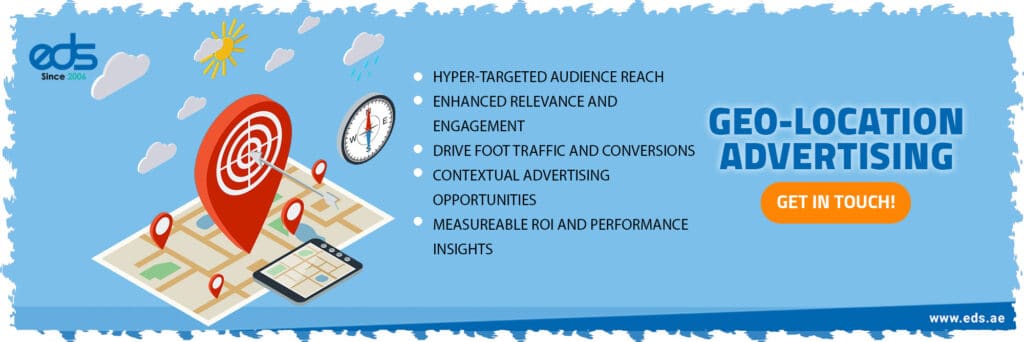
GEOFENCING ADVERTISING SERVICES IN DUBAI
Geofencing advertising can support several location-based marketing applications.
| Geofencing Advertising Service | Primary Application |
|---|---|
| Location-Based Mobile Advertising | Reach eligible mobile audiences around selected locations |
| Radius Targeting | Advertise within supported distances around a location |
| Polygon Geofencing | Define customised geographic boundaries |
| Retail Geofencing | Reach audiences around shopping and retail destinations |
| Competitor Location Targeting | Reach eligible audiences associated with competing commercial locations |
| Event Geofencing | Target audiences around exhibitions and event venues |
| Business District Targeting | Reach audiences associated with commercial areas |
| Residential Community Targeting | Promote relevant services in selected neighbourhoods |
| Location-Based Retargeting | Re-engage eligible audiences associated with previous location visits |
| Footfall Measurement | Evaluate estimated store visits where supported |
Actual targeting methods and measurement capabilities depend on the advertising platform, available location data and privacy requirements.
WHAT IS GEOFENCING ADVERTISING & HOW DOES IT WORK?
Geofencing advertising involves defining a virtual boundary around a selected physical location and using eligible location signals to reach relevant advertising audiences.
For example, a retailer may target supported mobile advertising inventory associated with people who have been near a shopping destination.
GEOFENCING TECHNOLOGIES
| Technology | How It Is Used |
|---|---|
| GPS Location Data | Determines device location where permission and data availability allow |
| Wi-Fi Location Signals | Helps estimate location through supported network signals |
| Cellular Location Data | Provides broader location estimates |
| Mobile Advertising Identifiers | May support eligible audience matching and measurement |
| IP-Based Geolocation | Estimates a device’s general geographic area |
| Bluetooth Beacons | Supports proximity interactions in compatible applications |
| Polygon Mapping | Defines geographic boundaries around selected areas |
Geofencing accuracy varies significantly between technologies.
Important: Creating a geofence does not automatically send advertisements or notifications to every smartphone entering that area. Advertising delivery requires eligible audiences, supported advertising inventory and applicable permissions.
TYPES OF GEOFENCING ADVERTISING
Radius-Based Geofencing
Radius targeting defines a circular geographic area around a selected point.
For example, a restaurant may advertise to eligible audiences within a supported radius around its location.
The minimum radius depends on the advertising platform and available geographic targeting capabilities.
Polygon Geofencing
Polygon geofencing uses customised boundaries instead of a simple circle.
It may be suitable for targeting large commercial complexes, exhibition grounds or defined business districts.
However, polygon targeting is not universally available across advertising platforms.
Location-Based Mobile Display Advertising
Mobile display advertisements can be delivered through eligible websites and applications using supported geographic audience data.
These campaigns may include static banners, responsive advertisements and rich-media creatives.
Location-Based Video Advertising
Mobile video advertisements can reach relevant audiences through supported applications and advertising networks.
Video advertising is suitable for product launches, hospitality promotions, automotive campaigns and brand awareness.
Historical Location Audience Targeting
Some advertising providers offer audience segments associated with previous visits to selected locations.
These campaigns depend on lawful data collection, available historical signals, retention limits and advertising platform policies.
GEOFENCING ADVERTISING LOCATIONS IN DUBAI
Businesses can consider different commercial areas depending on their target audience and campaign objectives.
| Dubai Location or Area | Potential Advertising Application |
|---|---|
| Downtown Dubai | Luxury retail, hospitality and lifestyle promotions |
| Business Bay | Corporate services, restaurants and business promotions |
| Dubai Marina & JBR | Dining, tourism, entertainment and lifestyle |
| Dubai Mall Area | Retail, luxury products and consumer promotions |
| Mall of the Emirates Area | Shopping, hospitality and nearby services |
| Dubai Internet City | Technology, software and B2B advertising |
| DIFC | Professional services and eligible financial products |
| Dubai Silicon Oasis | Technology, education and community services |
| Deira & Bur Dubai | Retail, trading and local business promotions |
| Expo City Dubai | Events, exhibitions and business promotions |
| Dubai South | Logistics, commercial and property advertising |
| Jumeirah | Retail, restaurants and neighbourhood services |
These locations are examples of potential campaign areas, not a confirmation that every location supports building-level geofencing.
GEOFENCING ADVERTISING FOR SHOPPING MALLS & RETAIL
Retail businesses can use location-based advertising to promote offers to audiences associated with selected shopping destinations.
| Retail Application | Campaign Example |
|---|---|
| Shopping Mall Promotions | Advertise seasonal retail offers |
| Store Launches | Promote newly opened outlets |
| Restaurants & Cafés | Advertise dining offers near commercial destinations |
| Fashion Retail | Promote collections and limited-time sales |
| Electronics | Advertise product launches and store promotions |
| Supermarkets | Promote eligible neighbourhood offers |
| Automotive Showrooms | Generate showroom visits and test-drive enquiries |
Location-based advertising can complement shopping mall advertising and other outdoor media by reaching eligible mobile audiences in relevant geographic areas.
GEOFENCING ADVERTISING FOR EVENTS & EXHIBITIONS
Geofencing can be relevant for trade exhibitions, conferences, product launches and business networking events.
Businesses may use eligible location-based campaigns around exhibition venues such as Dubai World Trade Centre or Expo City Dubai.
Potential applications include event awareness, booth visit promotions, product demonstrations and post-event remarketing where supported.
B2B GEOFENCING ADVERTISING
| Target Environment | B2B Advertising Application |
|---|---|
| Trade Exhibitions | Reach eligible audiences associated with industry events |
| Business Districts | Promote professional and corporate services |
| Commercial Zones | Reach relevant business audiences |
| Technology Districts | Advertise software and IT solutions |
| Industrial Areas | Promote eligible manufacturing and logistics services |
Being physically present at a commercial location does not establish a person’s profession, purchasing authority or employer. B2B campaign performance should therefore be assessed using qualified leads and actual business enquiries.
GEOFENCING VS GEO-TARGETING VS GEO-CONQUESTING
Although these terms are related, they describe different location-based advertising approaches.
| Advertising Method | Description | Typical Application |
|---|---|---|
| Geofencing | Defines a virtual boundary around a physical area | Shopping malls, events and commercial destinations |
| Geo-Targeting | Targets supported countries, cities, regions or geographic areas | Dubai-wide or UAE-wide campaigns |
| Geo-Conquesting | Targets eligible audiences associated with competitor locations | Automotive, retail and hospitality |
| Proximity Marketing | Communicates with audiences near a location | Nearby offers and store promotions |
| Location-Based Retargeting | Re-engages eligible audiences associated with previous locations | Retail and event follow-up campaigns |
Geo-conquesting and historical location targeting may be restricted by advertising network policies or applicable privacy rules.
GEOFENCING ADVERTISING VS GOOGLE ADS & MOBILE ADVERTISING
| Factor | Geofencing Advertising | Google Ads | General Mobile Advertising |
|---|---|---|---|
| Main Targeting Approach | Defined geographic areas and eligible location audiences | Search intent and supported audience/location settings | Mobile inventory and audience targeting |
| Custom Geographic Boundaries | Available on selected platforms | Not equivalent to unrestricted polygon geofencing | Platform-dependent |
| Mobile Display Ads | Supported | Supported through eligible inventory | Supported |
| Video Advertising | Supported | Supported | Supported |
| Historical Location Audiences | Selected providers only | Subject to Google’s own policies and products | Provider-dependent |
| Footfall Measurement | Available from selected providers | Available for eligible advertisers | Provider-dependent |
| Lead Generation | Supported | Supported | Supported |
Geofencing can complement Google Ads and mobile advertising when businesses need geographic relevance alongside broader digital advertising.
HOW MUCH DOES GEOFENCING ADVERTISING COST IN DUBAI?
Geofencing advertising costs depend on the selected locations, targeting precision, available audience size, advertising inventory, campaign duration and pricing model.
Some platforms charge for impressions or clicks, while specialist location-data providers may require additional fees or minimum spending commitments.
INDICATIVE GEOFENCING ADVERTISING COSTS IN UAE
| Advertising Metric | Illustrative Planning Range |
|---|---|
| Cost Per 1,000 Impressions (CPM) | AED 15–60+ |
| Cost Per Click (CPC) | AED 1–6+ |
| Cost Per Video View | AED 0.05–0.30+ |
| Cost Per Lead (CPL) | AED 40–200+ |
| Location Audience Data | Depends on provider and data availability |
| Footfall Attribution | May require additional measurement fees |
These are EDS reference planning rates, not guaranteed advertising results. Rates, targeting availability, campaign terms and media costs must be reconfirmed with EDS before booking.
SUGGESTED MONTHLY GEOFENCING ADVERTISING BUDGETS
| Monthly Advertising Budget | Typical Application |
|---|---|
| AED 5,000–10,000 | Initial location-based campaign testing |
| AED 10,000–20,000 | Selected retail or commercial areas |
| AED 20,000–40,000 | Multiple geofenced locations |
| AED 40,000–75,000 | Larger Dubai or UAE campaigns |
| AED 75,000+ | Extensive multi-location or regional campaigns |
These are reference campaign budgets. Specialist geofencing providers may have different minimum spends. Please reconfirm the applicable rates and inventory before booking.
Creative production, campaign management, location data and attribution services may be charged separately.
GEOFENCING ADVERTISING FORMATS & CREATIVE SPECIFICATIONS
| Advertising Format | Common Creative Size or Orientation |
|---|---|
| Mobile Banner | 320 × 50 pixels |
| Large Mobile Banner | 320 × 100 pixels |
| Mobile Rectangle | 300 × 250 pixels |
| Mobile Interstitial | 320 × 480 pixels or responsive |
| Vertical Mobile Video | 1080 × 1920 pixels |
| Square Video | 1080 × 1080 pixels |
| Responsive Display | Platform-specific asset requirements |
These are common creative dimensions, not universal technical specifications.
Advertisements should communicate the offer clearly and include relevant location information where appropriate.
For example, a restaurant advertising around Business Bay may highlight its location, dining offer and booking information.
GEOFENCING ADVERTISING PERFORMANCE & FOOTFALL MEASUREMENT
Geofencing campaigns can be evaluated using advertising reports and eligible location-based measurement tools.
| Performance Metric | What It Measures |
|---|---|
| Impressions | Number of advertisement displays |
| Reach | Estimated unique audience reached |
| Clicks | Advertisement interactions |
| CTR | Percentage of impressions resulting in clicks |
| CPC | Average cost per click |
| CPM | Cost per 1,000 impressions |
| Conversions | Recorded website actions |
| CPL | Cost per recorded lead |
| Estimated Store Visits | Modelled or attributed visits, where supported |
| Cost Per Attributed Visit | Advertising cost relative to attributed visits |
Store visits are generally estimated or modelled rather than individually verified purchases. Advertisers should distinguish between location-based attribution and confirmed sales.
GEOFENCING ADVERTISING RULES & UAE DATA PRIVACY REGULATIONS
Geofencing advertising must comply with applicable UAE advertising laws, data protection requirements and advertising platform policies.
Businesses and advertising providers should ensure that location information is collected and used lawfully, with appropriate transparency, consent or other valid legal grounds where applicable.
Precise location information can be sensitive because it may reveal personal behaviour and visits to particular places.
Campaigns involving healthcare facilities, religious locations, schools or other sensitive environments require particular care and may be restricted by platform policies.
Advertisers should not assume they can identify individual visitors, collect their phone numbers or send direct messages merely because those individuals entered a geofenced area.
REQUEST GEOFENCING ADVERTISING RATES IN DUBAI
Tell EDS your target locations, campaign objective, preferred advertising formats, duration and budget. We can review available targeting options, advertising inventory and current campaign rates.
Contact EDS: +971-4-5193444 | info@eds.ae | Enquire online
GEOFENCING ADVERTISING IN DUBAI – FREQUENTLY ASKED QUESTIONS
Answers to common questions about location-based targeting, geofencing costs, campaign formats, footfall measurement and UAE privacy requirements.
What is geofencing advertising in Dubai?
Geofencing advertising uses defined geographic boundaries and eligible location signals to reach relevant audiences associated with selected physical areas in Dubai.
How does geofencing advertising work?
An advertiser selects a geographic area. A supported platform uses lawfully available location signals and eligible advertising inventory to deliver ads to relevant audiences.
How much does geofencing advertising cost in Dubai?
Costs depend on the locations, audience size, targeting method, inventory, format and campaign duration. Refer to the rate and budget tables above and reconfirm pricing before booking.
Can geofencing target shopping malls in Dubai?
Selected platforms may support audiences around shopping malls and retail destinations. Exact boundaries, audience availability and accuracy vary by provider.
Can I target audiences near competitors?
Some providers support geo-conquesting around competing commercial locations, subject to data availability, platform policies and privacy requirements.
Can geofencing target a specific building?
Some platforms support polygon boundaries, but building-level accuracy and delivery cannot be guaranteed.
Can geofencing help increase retail footfall?
Campaigns can encourage store visits through relevant offers and nearby advertising. Results depend on the audience, creative, location and campaign execution.
Is geofencing suitable for exhibitions in Dubai?
Yes. Eligible campaigns may promote exhibitions, meetings, booth visits and event offers around venues such as Dubai World Trade Centre or Expo City Dubai.
What is the difference between geofencing and geo-targeting?
Geofencing focuses on defined geographic boundaries, while geo-targeting broadly covers countries, cities, regions and other supported geographic areas.
Does geofencing send notifications to every nearby phone?
No. Advertising requires eligible audiences, appropriate permissions, supported inventory and available location signals. A geofence alone does not trigger messages to every device.
Can geofencing reach previous visitors to a location?
Certain providers support historical location audiences, subject to lawful data collection, retention limits and platform restrictions.
What ad formats can be used for geofencing?
Depending on the platform, formats can include mobile display banners, responsive ads, rich media and video advertisements.
How are geofencing campaign results measured?
Typical measures include impressions, reach, clicks, conversions and cost per lead. Some providers also offer modelled store-visit attribution.
Is geofencing advertising compliant with UAE privacy rules?
Campaigns must follow applicable UAE data-protection requirements, advertising policies and appropriate location-data permissions. Sensitive-location targeting may be restricted.
Does EDS manage geofencing advertising across the UAE?
Yes. EDS helps plan and coordinate eligible location-based advertising campaigns in Dubai, Abu Dhabi, Sharjah and other emirates, subject to platform coverage and campaign requirements.