DIGITAL MARKETING


Outdoor Advertising on Al Ittihad Road (Dubai-Sharjah)
Outdoor advertising on Al Ittihad Road provides brands with visibility along one of the principal road corridors connecting Dubai and Sharjah. As part of the E11 corridor, the route serves regular inter-emirate movement between residential communities, commercial districts and employment areas across both emirates.
EDS provides access to Out-of-Home (OOH) and Digital Out-of-Home (DOOH) advertising opportunities along Al Ittihad Road, including roadside billboards, unipoles, digital screens, bridge banners, lamppost advertising, hoardings, building media and selected transit advertising.
Campaigns can focus on the Dubai section, the Sharjah section or potentially combine available media across both emirates. Because the route crosses two jurisdictions, inventory, rates and applicable approval requirements can differ according to the exact advertising location.
Established in Dubai in 2006, EDS works as an advertising and media-buying agency, coordinating with relevant media owners, operators and other stakeholders for available advertising opportunities.
WHAT IS OUTDOOR ADVERTISING ON AL ITTIHAD ROAD?
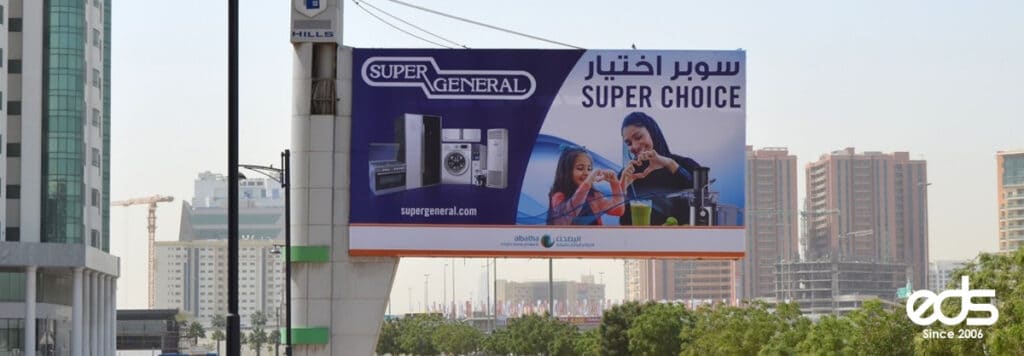
Outdoor advertising on Al Ittihad Road includes static and digital advertising media positioned along or visible from the Dubai–Sharjah road corridor.
The route is particularly relevant for advertisers seeking roadside visibility and repeated exposure among inter-emirate commuters, rather than primarily pedestrian audiences.
Depending on current inventory, advertising formats can include:
Roadside Billboards • Digital Billboards & DOOH • Unipoles • Bridge Banners • Lamppost Advertising • Hoardings • Building Media • Transit Advertising
Al Ittihad Road serves areas associated with Deira and the Dubai–Sharjah border as well as communities around Al Nahda, Al Taawun and other established residential and commercial districts.
This makes the corridor relevant to campaigns targeting audiences moving between Dubai and Sharjah for work, business, shopping, education and other daily activities.
OUTDOOR ADVERTISING COSTS ON AL ITTIHAD ROAD
There is no single fixed advertising rate covering the entire Al Ittihad Road corridor.
Pricing varies according to whether the advertising site is in Dubai or Sharjah, the media format, exact position, display dimensions, campaign duration and current availability.
The following figures can be used as initial planning guidance for relevant OOH formats:
| Media Format | Indicative Cost | Typical Booking Basis |
|---|---|---|
| Standard Static Billboard | AED 60,000–90,000 | Per month |
| Premium Highway Billboard | AED 45,000–120,000+ | Per month |
| Digital Billboard / DOOH | AED 30,000–200,000+ | Per month |
| Unipole Billboard | AED 50,000–150,000+ | Per month |
| Single-Sided Bridge Banner | AED 40,000–80,000 | Per month |
| Double-Sided Bridge Banner | AED 135,000–270,000 | Per month |
| Premium Highway Bridge Banner | AED 80,000–150,000+ | Per month |
| Full Bridge Wrap | AED 100,000–250,000+ | Per month |
| Main-Road Lamppost Campaign | AED 50,000–90,000 | 10 banners / month |
| Premium Highway Lamppost Campaign | AED 80,000–150,000+ | 10 banners / month |
| Large-Format Hoarding | AED 60,000–180,000+ | Per month |
| Building / Façade Advertising | Site Specific | Property / campaign |
These are indicative planning ranges rather than fixed Al Ittihad Road media-owner rates.
Actual pricing depends on the precise advertising asset, emirate, direction of travel, dimensions, number of advertising faces, campaign dates and commercial terms.
Production, printing, fabrication, installation and applicable approval-related charges may be additional.
OUTDOOR ADVERTISING FORMATS ON AL ITTIHAD ROAD
Al Ittihad Road is predominantly a road-based advertising environment. Formats should therefore be selected according to visibility from moving vehicles, direction of travel and the specific audience the campaign needs to reach.
Roadside Billboard Advertising
Billboards provide large-format visibility along selected sections of the Dubai–Sharjah corridor.
They can be relevant for:
Real Estate • Automotive • Banking • Telecommunications • Retail • Healthcare • Education • F&B • Government & Public Awareness • Consumer Brands
When evaluating billboard locations, advertisers should consider:
Direction of Travel • Viewing Distance • Billboard Dimensions • Road Position • Surrounding Structures • Current Availability
A strategically positioned billboard facing the required traffic direction can be more relevant than simply choosing the largest available structure.
Digital Billboards & DOOH Advertising
Digital Out-of-Home advertising provides an alternative to conventional printed billboards.
Depending on current inventory, digital roadside screens can support:
Multiple Creatives • Motion Content • Scheduled Messaging • Campaign Updates • Advertising Rotation
Advertisers should confirm the commercial structure of each digital screen, including:
Spot Duration • Advertising Loop • Share of Voice • Screen Dimensions • Operating Schedule • Viewing Direction
Digital advertising is particularly useful for campaigns requiring changing messages, multiple creatives or time-sensitive promotions.
Unipole Advertising
Unipoles are large freestanding roadside advertising structures designed for visibility from road traffic.
They can provide a strong advertising presence along major corridors where approved inventory is available.
Unipoles can be relevant for:
Property Launches • Automotive Brands • Financial Services • Telecommunications • Retail • Corporate Campaigns • Major Consumer Brands
Site selection should consider both the physical dimensions of the unipole and its orientation toward the required traffic flow.
Bridge Banner Advertising
Bridge advertising uses approved bridge structures to create large-format visibility across or alongside major roads.
Depending on available inventory, formats can include:
Single-Sided Bridge Banners • Double-Sided Bridge Banners • Premium Bridge Media • Full Bridge Branding
Bridge advertising can be particularly effective where the structure provides clear visibility to approaching traffic.
Availability, dimensions and installation specifications vary considerably between individual bridge sites.
Lamppost Advertising
Lamppost advertising uses a sequence of banners or approved displays positioned along a road.
Unlike a single billboard, a lamppost campaign can create repeated brand presence as motorists travel through a particular section of the route.
Campaigns can be relevant for:
Retail • Property • Events • Education • Healthcare • Hospitality • Telecommunications • Consumer Promotions
The number of poles, banner dimensions and exact locations depend on available authorised inventory.
Hoarding Advertising
Hoardings can provide substantial advertising surfaces around construction areas, developments and other approved roadside locations.
They can be particularly relevant for:
Real Estate • New Developments • Retail Openings • Automotive • Corporate Branding
Hoarding availability is site specific and can change as construction projects and development environments change.
Building & Façade Advertising
Selected buildings visible from the Al Ittihad Road corridor can potentially provide wall, façade or building-banner advertising where authorised inventory exists.
These opportunities are highly site specific and depend on:
Property Advertising Rights • Building Position • Available Surface • Visibility • Structural Requirements • Applicable Approvals
A building visible from the road should not automatically be assumed to be available for advertising.
Transit Advertising
Transit media can complement fixed roadside advertising where the campaign requires additional mobility or commuter coverage.
Depending on the required campaign, advertisers can consider selected:
Bus Advertising • Taxi Advertising • Other Available Transit Media
Transit campaigns should be planned separately from fixed Al Ittihad Road inventory because route coverage, media rights and booking structures differ.
DUBAI SIDE VS SHARJAH SIDE OF AL ITTIHAD ROAD
One of the most important considerations when planning an Al Ittihad Road campaign is whether the advertiser needs the Dubai section, Sharjah section or both.
Dubai Section
The Dubai section of Al Ittihad Road serves the eastern side of the city and connects with established areas around Deira and communities approaching the Sharjah border.
Advertising on this section can be considered for campaigns targeting:
Dubai Residents • Sharjah-to-Dubai Commuters • Business Audiences • Retail Customers • Cross-Emirate Traffic
Available media should be evaluated according to the required direction of travel.
Sharjah Section
The Sharjah section continues the corridor into established residential, retail and commercial areas.
Campaigns can potentially target:
Sharjah Residents • Dubai-Bound Commuters • Families • Retail Audiences • Commercial & Business Audiences
Media formats, rates and approval requirements on the Sharjah side can differ from equivalent advertising assets in Dubai.
Cross-Emirate Campaigns
Brands seeking broader coverage can potentially combine sites on both sides of the Dubai–Sharjah boundary.
A cross-emirate campaign can be useful where the audience regularly moves between the two cities.
However, sites should be selected individually rather than treating the entire corridor as one uniform advertising market.
KEY AREAS & CONNECTIONS ALONG THE AL ITTIHAD ROAD CORRIDOR
The value of Al Ittihad Road advertising comes partly from the communities and commercial areas connected to the corridor.
Deira
The Dubai side connects with the wider Deira environment, which includes established residential, retail, hospitality and commercial areas.
Roadside media can therefore support campaigns seeking audiences travelling between central Deira and Sharjah.
Al Qusais & Hor Al Anz Connections
The wider road network provides access to established residential, commercial and employment areas around Al Qusais and Hor Al Anz.
These connections contribute to the mixed commuter and local audience using the corridor.
Al Nahda Dubai
Al Nahda Dubai sits close to the Sharjah boundary and forms part of the wider cross-emirate residential environment.
Campaigns targeting residents travelling between Dubai and Sharjah can consider media serving relevant approaches and road movements.
Al Nahda Sharjah
Al Nahda Sharjah is a substantial residential environment immediately across the emirate boundary.
The area is particularly relevant to brands seeking Sharjah residents who regularly travel toward Dubai.
Al Taawun
Al Taawun and surrounding communities add residential, retail and commercial audiences to the Sharjah side of the corridor.
Available roadside sites serving these areas can be relevant for property, retail, healthcare, education and consumer campaigns.
Sharjah Retail & Commercial Areas
As the route continues into Sharjah, it connects with wider retail, residential and commercial districts.
Advertisers should therefore evaluate individual sites according to the specific audience and direction they need rather than treating every Al Ittihad Road location equally.
TARGETING DUBAI–SHARJAH COMMUTERS
The defining advertising characteristic of Al Ittihad Road is its role as an inter-emirate commuter corridor.
This creates opportunities to reach audiences travelling:
Sharjah → Dubai
and
Dubai → Sharjah
The two directions should not automatically be treated as equivalent.
For example, a campaign designed to influence people travelling into Dubai can require a different billboard face or site from a campaign targeting audiences returning toward Sharjah.
Direction of travel should therefore be part of media planning from the beginning.
CHOOSING THE RIGHT OOH FORMAT ON AL ITTIHAD ROAD
Different formats can serve different campaign requirements.
| Campaign Requirement | Formats to Consider |
|---|---|
| Large roadside visibility | Billboards and unipoles |
| Flexible digital messaging | Digital billboards / DOOH |
| Strong structural presence | Bridge banners |
| Repeated route visibility | Lamppost advertising |
| Development or project advertising | Hoardings |
| Property-based visibility | Building / façade media |
| Mobile commuter coverage | Bus and taxi advertising |
| Coverage in both emirates | Multi-site Dubai + Sharjah campaign |
The appropriate format should be selected according to audience, traffic direction, location, campaign objective, budget and available inventory.
DIRECTION OF TRAVEL: DUBAI-BOUND VS SHARJAH-BOUND
For highway and arterial-road advertising, the direction in which an advertising face is viewed can materially affect its relevance.
Dubai-Bound Advertising
Advertising facing traffic travelling toward Dubai can be considered when the campaign needs to reach commuters and other audiences heading into the city.
Potential categories include:
Business Services • Banking • Automotive • Retail • Telecommunications • Corporate Campaigns
Sharjah-Bound Advertising
Advertising facing traffic travelling toward Sharjah can be relevant to audiences returning to residential communities or travelling toward Sharjah’s retail and commercial districts.
Potential categories include:
Retail • F&B • Property • Healthcare • Education • Entertainment • Consumer Services
These are planning considerations rather than fixed rules. Actual audience relevance depends on the individual advertiser and media location.
STATIC BILLBOARDS VS DIGITAL DOOH
Static and digital roadside advertising offer different characteristics.
| Consideration | Static OOH | Digital DOOH |
|---|---|---|
| Creative Format | Printed / fabricated | Digital |
| Advertising Presence | Usually dedicated booked face | May rotate with other advertisers |
| Creative Changes | Physical replacement required | Electronic changes possible |
| Motion | No | May be supported |
| Multiple Creatives | Limited | Often possible |
| Scheduling | Generally fixed | May be available |
| Production | Printing / fabrication required | Physical printing generally not required |
| Particularly Relevant For | Sustained brand presence | Changing messages and promotions |
Static advertising can provide continuous presence on a booked advertising face.
Digital DOOH can provide greater creative flexibility but may operate within an advertising loop shared with other advertisers.
For digital media, advertisers should therefore check spot duration and Share of Voice as part of the buying decision.
WHAT AFFECTS ADVERTISING COSTS ON AL ITTIHAD ROAD?
Advertising rates can vary considerably between individual sites.
Dubai or Sharjah Location
Media pricing and commercial structures can differ between the two emirates.
Direction of Travel
A site facing Dubai-bound traffic can have different demand and commercial terms from a site facing Sharjah-bound traffic.
Advertising Format
Billboards, digital screens, unipoles, bridge banners, lampposts and hoardings have different pricing structures.
Display Dimensions
Larger advertising structures generally involve different media, production and installation costs.
Number of Advertising Faces
A double-sided structure or multi-unit campaign can be priced differently from a single advertising face.
Campaign Duration
Booking periods and commercial terms vary according to the media asset.
Static or Digital
Digital pricing can depend on spot duration, advertising loop, scheduling and Share of Voice.
Production & Installation
Static advertising can require printing, fabrication, installation and removal in addition to media rental.
Current Availability
Premium roadside inventory is finite. Rates and available positions can therefore vary according to existing bookings and campaign dates.
CREATIVE CONSIDERATIONS FOR AL ITTIHAD ROAD ADVERTISING
Creative designed for a major commuter corridor needs to communicate quickly.
Use One Principal Message
Drivers have limited time to process advertising. Avoid multiple competing headlines.
Keep the Brand Prominent
The advertiser should be identifiable without requiring the audience to read detailed copy.
Use Large, Readable Typography
Text should remain legible at the expected viewing distance.
Limit Detailed Information
Telephone numbers, long URLs, multiple offers and extensive body copy can reduce readability.
Design for the Actual Structure
Artwork should be adapted to the dimensions of the billboard, unipole, bridge banner or digital screen rather than simply resizing one generic design.
Consider Traffic Direction
The message can potentially be adapted according to whether the advertising faces Dubai-bound or Sharjah-bound traffic.
Use QR Codes Selectively
QR codes can be useful on media encountered at lower speeds or in appropriate environments, but they should not be the primary response mechanism for advertising viewed by drivers.
CAMPAIGN DURATION & MEDIA AVAILABILITY
There is no universal campaign duration for advertising on Al Ittihad Road.
Shorter campaigns can support:
Product Launches • Events • Retail Promotions • Seasonal Campaigns • Property Launches
Longer bookings can be considered for:
Banking • Telecommunications • Automotive • Property • Healthcare • Education • Sustained Brand Awareness
Advertisers requiring a specific section of the road, direction of travel or campaign period should check inventory before finalising creative.
Lead time can be required for:
Site Confirmation • Artwork Preparation • Applicable Approvals • Printing • Fabrication • Installation
Digital campaigns may require less physical production, but screen specifications, creative scheduling and media availability still need to be confirmed.
OUTDOOR ADVERTISING RULES, PERMITS & APPROVALS ON AL ITTIHAD ROAD
Outdoor advertising on Al Ittihad Road is subject to the applicable advertising, content, structural, technical and safety requirements of the emirate in which the advertising asset is located.
This is particularly important because Al Ittihad Road crosses the Dubai–Sharjah corridor.
A campaign using sites in both emirates should not assume that the same approval process applies to every location.
Depending on the format and site, requirements can relate to:
- Approved advertising locations
- Media-owner or property permissions
- Advertising dimensions and positioning
- Structural specifications
- Road and traffic safety
- Digital-screen specifications
- Lighting and illumination
- Advertising artwork and content
- Installation and maintenance
- Building or property requirements
- Removal following the campaign
Bridge banners, digital screens, building media and other structural advertising can have additional requirements specific to the individual asset.
EDS operates as an advertising and media-buying agency and coordinates with relevant media owners, operators and other applicable stakeholders according to the selected advertising opportunity.
Final permissions and approvals remain subject to the relevant authorities and stakeholders in Dubai or Sharjah.
FAQs:Outdoor Advertising on Al Ittihad Road (Dubai-Sharjah)
What is outdoor advertising on Al Ittihad Road?
Outdoor advertising on Al Ittihad Road includes OOH and DOOH media positioned along the Dubai–Sharjah corridor. Depending on current inventory, formats can include roadside billboards, digital screens, unipoles, bridge banners, lamppost advertising, hoardings and selected building media.
Why is Al Ittihad Road important for Dubai–Sharjah advertising?
Al Ittihad Road connects Dubai and Sharjah and serves regular inter-emirate traffic. This makes the corridor particularly relevant to brands seeking visibility among audiences travelling between residential, commercial and employment areas in the two emirates.
What outdoor advertising formats are available on Al Ittihad Road?
Depending on current inventory, options can include static roadside billboards, digital DOOH screens, unipoles, bridge banners, lamppost advertising, hoardings, building media and selected transit advertising. Available formats can differ between the Dubai and Sharjah sections of the corridor.
How much does outdoor advertising on Al Ittihad Road cost?
Costs depend on the exact location, emirate, advertising format, dimensions and campaign duration. Standard static billboards can range from approximately AED 60,000–90,000 per month, premium highway billboards from AED 45,000–120,000+ and digital billboards from AED 30,000–200,000+ per month. Exact rates should be confirmed for the specific available site.
Are digital billboards and DOOH screens available on Al Ittihad Road?
Digital roadside advertising may be available at selected locations along the corridor. Availability, screen dimensions, viewing direction, spot duration, advertising loop and Share of Voice depend on the individual media asset and campaign period.
Can I choose a specific billboard location on Al Ittihad Road?
Yes. Advertisers can request particular sections, directions of travel or available media sites along Al Ittihad Road. Final placement depends on current inventory, campaign dates, media rights and applicable approvals.
Is bridge advertising available on Al Ittihad Road?
Bridge advertising may be available on selected approved structures. Depending on current inventory, formats can potentially include single-sided banners, double-sided banners and larger bridge branding. Availability, dimensions and installation specifications vary between individual bridge sites.
Can a campaign cover both the Dubai and Sharjah sections of Al Ittihad Road?
Yes. A campaign can potentially combine available media on both sides of the Dubai–Sharjah corridor. However, inventory, media operators, rates and approval requirements can differ between the two emirates, so each advertising site should be evaluated individually.
Should I advertise toward Dubai-bound or Sharjah-bound traffic?
The appropriate direction depends on the target audience and campaign objective. Dubai-bound media can be relevant when reaching audiences travelling into Dubai, while Sharjah-bound media can target audiences travelling toward Sharjah and surrounding residential communities. Some campaigns can use sites facing both directions.
How long can an Al Ittihad Road advertising campaign run?
Campaign duration depends on the selected media format, availability and commercial terms. Billboards, digital screens, unipoles, bridge banners and lamppost campaigns can have different booking periods, so the applicable duration should be confirmed for each selected site.
Does outdoor advertising on Al Ittihad Road require permits and approvals?
Yes. Outdoor advertising is subject to applicable advertising, content, structural and technical requirements. Because the corridor covers Dubai and Sharjah, the applicable requirements depend on the emirate and exact location of each advertising asset. Media-owner and site-specific requirements may also apply.
Can EDS arrange outdoor advertising on Al Ittihad Road?
Yes. EDS can help advertisers evaluate and coordinate available OOH and DOOH opportunities along the Dubai–Sharjah Al Ittihad Road corridor through relevant media owners and operators. This can include billboards, digital screens, unipoles, bridge banners, lamppost advertising, hoardings and other available formats.