DIGITAL MARKETING


MUPI Advertising Company in Dubai, UAE
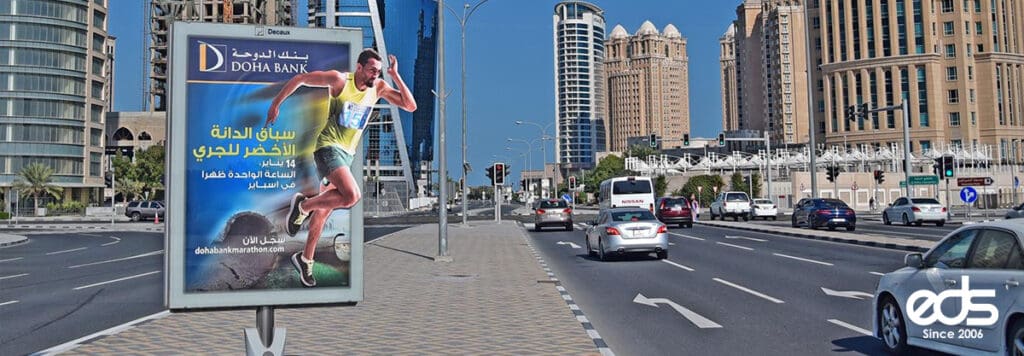
MUPI advertising in Dubai provides street-level Out-of-Home (OOH) visibility through advertising panels and digital screens positioned within selected urban, commercial, pedestrian and transport environments.
EDS provides access to MUPI advertising opportunities across Dubai, including static panels, backlit displays, digital MUPIs and multi-location MUPI networks, subject to current authorised media inventory.
Unlike large roadside formats designed primarily for longer-distance viewing, MUPIs are generally positioned closer to pedestrians, shoppers, commuters, residents and motorists, making the exact location, viewing distance and surrounding environment particularly important when selecting a campaign.
WHAT IS MUPI ADVERTISING?
MUPI is commonly used to describe street-furniture advertising displays positioned within urban environments, including pedestrian areas, transport environments, retail districts and other high-footfall locations.
The term originates from the French expression Mobilier Urbain pour l’Information, referring to urban street furniture used for information and advertising.
Depending on the approved media inventory, MUPI advertising in Dubai can include:
Static Advertising Panels • Backlit Displays • Digital MUPI Screens • Multi-Location Networks • Special-Format Executions Where Available
The exact dimensions, orientation and technical specifications vary according to the individual media unit and network.
MUPI ADVERTISING COSTS & RATES IN DUBAI
MUPI advertising costs in Dubai vary depending on the location, number of advertising panels or screens, static or digital format, campaign duration, production and installation requirements and media availability.
The following advertising rates are provided for reference. Please reconfirm the applicable rates and availability before booking your campaign.
| MUPI Advertising Type | Typical Locations | Estimated Cost (AED) | Typical Application |
|---|---|---|---|
| Standard Static MUPI Panel | Community streets, local areas | AED 1,500 – 5,000 per panel/month | Local businesses, retail promotions |
| Premium Static MUPI Panel | Commercial districts, shopping areas | AED 5,000 – 10,000 per panel/month | Brand awareness campaigns |
| Bus Stop MUPI Advertising | Public transport areas & busy roads | AED 5,000 – 15,000 per panel/month | Mass consumer reach |
| Digital MUPI Screen | High-footfall locations | AED 3,000 – 10,000 per screen/month | Dynamic campaigns & multiple creatives |
| Premium Digital MUPI Network | Major commercial areas | AED 50,000 – 150,000+ per campaign | Large brands & city-wide visibility |
| MUPI Network Campaign (10–50 Panels) | Multiple Dubai locations | AED 15,000 – 100,000+ per month | Regional campaigns |
MUPI advertising prices vary depending on location, pedestrian traffic, panel availability, campaign duration, format (static or digital), printing, installation and authority requirements.
What Affects MUPI Advertising Costs?
Location: Premium commercial and high-footfall locations can have different rates from community and local-area placements.
Number of Panels: A single MUPI placement has a different cost structure from a 10, 20 or 50-panel network.
Static or Digital Format: Printed panels and digital screens have different production and media-buying structures.
Campaign Duration: Commercial terms can vary according to the length of the campaign.
Production & Installation: Static MUPIs can involve printing, installation and removal costs.
Digital Advertising Rotation: Digital MUPIs may operate within an advertising loop shared by multiple advertisers.
Illumination: Backlit or illuminated advertising units can have different specifications from standard static panels.
Availability: Individual units and networks are subject to existing bookings and current authorised inventory.
For accurate pricing, advertisers should provide:
Campaign Dates • Preferred Areas • Number of Panels or Screens • Static or Digital Preference • Target Audience • Approximate Budget
TYPES OF MUPI ADVERTISING IN DUBAI
Static MUPI Panels
Static MUPIs use printed creative displayed within an approved street-level advertising unit.
The creative remains continuously visible throughout the booked campaign period.
Static MUPIs can be suitable for:
Brand Awareness • Retail • Real Estate • F&B • Events • Entertainment • Consumer Campaigns • Local Promotions
Backlit MUPIs
Backlit MUPIs use illumination to enhance the appearance and visibility of the advertising creative, particularly during evening and lower-light conditions.
The exact lighting system and operating specifications depend on the individual media network.
Digital MUPIs
Digital MUPIs use digital screens instead of printed creative.
Depending on the network, digital MUPIs can provide:
Multiple Creatives • Creative Rotation • Scheduled Messaging • Faster Creative Changes • Time-Based Campaigns • Motion Where Permitted
Digital screen capabilities vary by network and location.
Advertisers should confirm the spot duration, advertising loop, frequency and Share of Voice when evaluating digital MUPI inventory.
MUPI Network Advertising
MUPIs are particularly suitable for network campaigns because multiple units can be selected across a geographic area.
Instead of relying on one advertising panel, a network can provide repeated street-level visibility across communities, retail areas, commercial districts or multiple parts of Dubai.
The value of the campaign depends not only on the number of panels but also on where those panels are positioned.
WHERE IS MUPI ADVERTISING AVAILABLE IN DUBAI?
MUPI advertising can potentially be available across selected residential, commercial, retail, pedestrian and transport-oriented environments in Dubai, subject to approved inventory.
Potential areas can include:
Downtown Dubai • Business Bay • Dubai Marina • JBR • Jumeirah • JLT • DIFC • City Walk • Deira • Bur Dubai • Karama • Al Barsha • Dubai Silicon Oasis • Mirdif • Retail Districts • Commercial Areas • Residential Communities • Transport Hubs • Pedestrian Areas
Not every street or neighbourhood has commercially available MUPI inventory.
Availability can change according to the individual media network, location and campaign dates.
Downtown Dubai & Business Bay
MUPI opportunities within and around Downtown Dubai and Business Bay can reach combinations of residents, professionals, visitors, hospitality audiences and pedestrians.
The exact unit location should be evaluated because audience movement can vary substantially within the same district.
Dubai Marina, JBR & JLT
These areas combine residential, commercial, hospitality, retail and leisure activity.
Street-level advertising can be particularly relevant where MUPIs are positioned around pedestrian routes, commercial destinations and local road networks.
DIFC & Commercial Districts
MUPI advertising around business districts can provide close-range visibility among professionals, office workers, residents and visitors.
Jumeirah & Residential Communities
Community-based MUPI networks can provide geographically concentrated exposure within selected residential and local commercial areas.
This can be useful when the advertiser’s target audience is concentrated within particular parts of Dubai.
Retail & Pedestrian Areas
MUPIs positioned near shopping, dining and entertainment environments can reach audiences when they are moving more slowly than on major highways.
This can allow slightly more detailed creative than high-speed roadside advertising, although simplicity remains important.
HOW TO SELECT MUPI ADVERTISING LOCATIONS
The busiest MUPI location is not automatically the most suitable location for every campaign.
Audience Profile
Consider who is likely to pass or spend time around the advertising location.
A premium business district and a residential community can both be valuable, but they serve different audiences.
Pedestrian & Road Environment
Determine whether the unit primarily reaches:
Pedestrians • Motorists • Public Transport Users • Shoppers • Residents • Office Workers • Visitors
This affects both media selection and creative design.
Surrounding Destinations
Consider whether the MUPI is positioned near relevant:
Shopping Areas • Restaurants • Offices • Hotels • Residential Communities • Attractions • Transport Locations
Visibility
Assess how clearly the advertising face can be seen from the intended viewing areas.
Orientation
Determine which direction the advertising face is positioned and which audiences can actually see it.
Viewing Distance
MUPIs are generally designed for relatively close-range viewing, but the actual distance varies by site.
Geographic Relevance
Consider whether the location corresponds with where the intended audience lives, works, shops, travels or spends leisure time.
For a network campaign, the distribution of the panels can be as important as the total number of panels.
STATIC VS DIGITAL MUPI ADVERTISING
Static and digital MUPIs use similar street-level environments but offer different advertising characteristics.
| Consideration | Static MUPI | Digital MUPI |
|---|---|---|
| Creative Format | Printed | Digital |
| Exposure | Continuous | Usually rotating |
| Creative Changes | Requires replacement | More flexible |
| Multiple Creatives | Limited | Usually possible |
| Motion | No | Where permitted |
| Illumination | Available on selected units | Screen illuminated |
| Share of Voice | Usually dedicated face | Depends on advertising loop |
| Primary Strength | Continuous presence | Creative flexibility |
Neither format is automatically better.
Static MUPIs can provide continuous visibility throughout the booked period, while digital MUPIs can provide more flexibility for creative changes and scheduled messaging.
The appropriate format depends on the campaign objective, location, audience, budget and available inventory.
MUPI ADVERTISING VS BILLBOARD ADVERTISING
MUPIs and billboards serve different roles within an outdoor advertising campaign.
| Consideration | MUPI Advertising | Billboard Advertising |
|---|---|---|
| Viewing Position | Street level | Large roadside format |
| Viewing Distance | Relatively close | Longer distance |
| Creative Size | Smaller | Large |
| Geographic Targeting | Highly localised | Road/location based |
| Pedestrian Relevance | Strong | Location dependent |
| Network Campaigns | Particularly suitable | Requires multiple sites |
| Primary Strength | Proximity & frequency | Scale & visual impact |
MUPIs can be particularly useful where advertisers want repeated street-level visibility across a defined geographic area, while billboards provide larger-scale roadside presence.
For some campaigns, the two formats can complement each other.
MUPI ADVERTISING VS BUS SHELTER ADVERTISING
MUPIs and bus shelter advertising can look similar in certain environments, but they are not necessarily the same advertising product.
A MUPI generally refers to a dedicated street-furniture advertising unit, while bus shelter advertising specifically uses advertising panels or digital screens incorporated within or around bus shelters and bus stops.
| Consideration | MUPI | Bus Shelter Advertising |
|---|---|---|
| Structure | Dedicated street-furniture unit | Integrated with bus shelter/stop |
| Audience | Pedestrians, motorists, local audiences | Commuters, pedestrians, road users |
| Viewing Environment | Urban & street-level | Public transport environment |
| Campaign Distribution | Location/network dependent | Bus shelter network dependent |
The appropriate format depends on the target audience, desired locations and available media inventory.
MUPI ADVERTISING VS LAMPPOST ADVERTISING
MUPIs generally provide closer, street-level viewing, while lamppost advertising typically uses repeated banners or panels positioned along selected road corridors.
MUPIs can be particularly relevant when advertisers want exposure around:
Retail Districts • Pedestrian Zones • Commercial Destinations • Transport Environments • Specific Communities
Lamppost advertising may be more suitable when the objective is repeated roadside exposure along a longer route.
The two formats can also be combined when a campaign requires both street-level presence and broader corridor repetition.
USING SEQUENTIAL CREATIVE ACROSS MUPI NETWORKS
One advantage of a multi-location MUPI campaign is the ability to use several related creatives instead of repeating exactly the same advertisement across every panel.
For example:
MUPI 1: Introduce the product or campaign
MUPI 2: Highlight a key benefit
MUPI 3: Present the offer or launch message
MUPI 4: Reinforce the brand and call to action
This can create a simple campaign sequence across selected locations.
However, audiences may not encounter the MUPIs in a specific order. Each creative should therefore still make sense independently.
Actual creative rotation and placement possibilities depend on the selected media network.
MUPI ADVERTISING AVAILABILITY & CAMPAIGN DURATION
MUPI inventory can vary considerably according to:
Location • Media Network • Number of Panels • Static or Digital Format • Campaign Dates • Existing Bookings • Required Geographic Coverage
For network campaigns, advertisers should confirm the actual number of units and their locations, rather than evaluating the campaign solely by the advertised network size.
Static campaigns may also require time for printing and installation.
For digital MUPIs, advertisers should confirm:
Number of Screens • Spot Duration • Advertising Loop • Frequency • Share of Voice • Operating Hours
Campaign duration and booking terms depend on the selected media inventory.
MUPI ADVERTISING RULES & APPROVALS IN DUBAI
MUPI advertising in Dubai is subject to applicable outdoor advertising, planning, technical, public-safety, content and installation requirements.
Requirements depend on the individual MUPI unit, its location, whether it is static or digital and the relevant media owner or applicable authority.
Authorised Advertising Inventory
Advertising should use approved MUPI units or networks.
The presence of street furniture in a location does not automatically mean it is commercially available for advertising.
Advertising Dimensions
Artwork must be prepared according to the approved dimensions and specifications of the individual advertising unit.
Placement & Public Safety
MUPIs should comply with applicable placement and safety requirements and should not obstruct:
Pedestrian Movement • Road Visibility • Traffic Infrastructure • Access Routes • Other Essential Public Functions
Illumination
Backlit and illuminated MUPIs may be subject to technical requirements applicable to the individual media unit.
Digital MUPIs
Digital screens can have additional requirements relating to brightness, transitions, animation, technical specifications and permitted creative behaviour.
Advertising Content
Creative must comply with applicable UAE and Dubai advertising requirements.
Certain products, services, offers or promotional claims may require additional approvals.
Installation & Maintenance
Static advertising materials should be installed and maintained according to the specifications of the approved MUPI network.
EDS operates as an advertising and media-buying agency and coordinates available MUPI advertising opportunities with relevant media owners, operators and applicable stakeholders.
MUPI ADVERTISING IN DUBAI – FREQUENTLY ASKED QUESTIONS
What is MUPI advertising in Dubai?
MUPI advertising uses approved street-level advertising panels or digital screens in urban environments. These units can reach pedestrians, motorists, shoppers and commuters near commercial and residential destinations.
How much does MUPI advertising cost in Dubai?
Costs depend on the specific unit, location, static or digital format, number of panels and campaign duration. The indicative ranges in the table above are planning estimates, not confirmed media-owner quotations.
Where can I advertise on MUPIs in Dubai?
Opportunities may be available in selected commercial districts, pedestrian areas, transport environments and communities. Exact sites and network coverage must be confirmed against authorised inventory.
What is the difference between static and digital MUPIs?
Static MUPIs display printed artwork throughout the booked period. Digital MUPIs typically rotate screen content and may allow scheduled messages, subject to the network’s technical specifications.
Can I book a network of MUPIs rather than one panel?
Yes, where inventory permits. A network can cover several streets or districts. Compare the actual panel list, face orientation and geographic distribution rather than relying on unit count alone.
Are MUPIs suitable for local businesses?
They can be useful for retail, hospitality, healthcare, property and other local campaigns when available units are close to the intended audience or destination.
How does MUPI advertising differ from billboard advertising?
MUPIs are smaller street-level units generally viewed at shorter distances. Billboards provide larger advertising faces intended for wider or longer-distance visibility.
Are MUPIs and bus shelter advertisements the same?
Not necessarily. MUPIs are street-furniture advertising units, while bus shelter advertising uses approved panels or screens at bus stops. Media owners may classify individual assets differently.
Can MUPIs be illuminated or backlit?
Some static units are backlit and digital units have illuminated screens. Lighting specifications and operating conditions depend on the selected network.
How long can a MUPI campaign run?
Booking periods vary by media owner, site, network and available dates. Confirm the minimum period and installation or creative-change deadlines before booking.
What makes an effective MUPI advertisement?
Use a prominent brand, clear headline, strong contrast and one primary message. Adapt the design to the actual panel dimensions and expected viewing distance.
Can different creatives run across the same MUPI network?
Different artwork may be possible across static panels or within digital rotations, subject to media-owner approval. Each message should remain understandable independently.
Do digital MUPI campaigns have a share of voice?
Typically, digital inventory is sold with defined spot duration, loop length or frequency. Request the actual screen schedule and share-of-voice terms before booking.
Does MUPI advertising in Dubai require approvals?
Yes. Advertising must use authorised inventory and comply with applicable location, content, technical and safety requirements. Approval arrangements depend on the operator and asset.
Can EDS arrange MUPI advertising in Dubai?
Yes. EDS FZCO can help review available MUPI sites and networks, obtain specifications and coordinate quotations and bookings through relevant media owners, subject to availability and approvals.