
DIGITAL MARKETING

Transit Media Advertising in Dubai
Transit media advertising in Dubai places brands within the everyday movement of residents, commuters, tourists and business travellers across the city’s public transport and mobility networks.
Campaigns can use Dubai Metro advertising, Dubai Tram advertising, bus advertising, taxi advertising, station media, passenger-facing formats and digital transit screens, subject to current authorised media inventory.
Unlike a traditional billboard that remains in one location, transit advertising can reach audiences at different stages of their journey — while travelling, waiting, entering or exiting stations, moving through transport environments or encountering branded vehicles on Dubai’s roads.
EDS provides access to transit advertising opportunities across Dubai and coordinates available media options with relevant media owners, operators and stakeholders.
Featured Transit Media Advertising Formats in Dubai
Dubai’s transit network offers brands multiple ways to stay visible as people travel across the city. Featured transit media formats include Dubai Metro advertising, Dubai Tram advertising, bus advertising and taxi advertising, with opportunities ranging from vehicle branding and station media to interior displays and digital formats.
Each option provides a different way to reach commuters, residents, tourists and business travellers across key routes and destinations in Dubai.
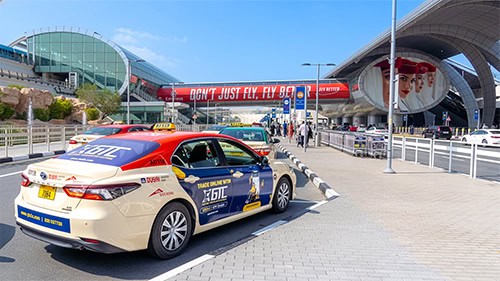
Taxi advertising creates mobile brand visibility as vehicles travel across commercial districts, residential communities, tourism areas, hotels, malls and other destinations throughout Dubai.
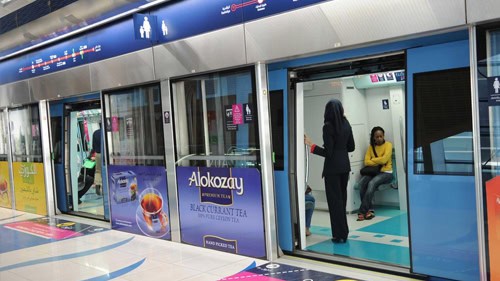
Advertising opportunities across the Dubai Metro environment can include station media, platform and concourse displays, digital screens and other passenger-facing formats, depending on current inventory.
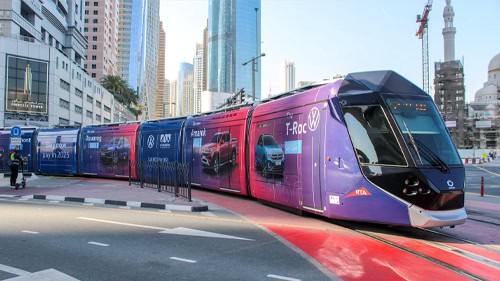
Dubai Tram advertising provides opportunities to reach audiences travelling through areas including Dubai Marina, JBR, Al Sufouh and surrounding destinations, subject to available media formats.
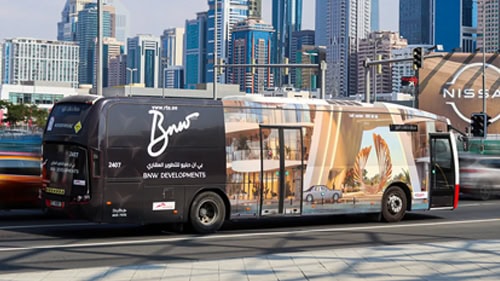
Bus advertising can place campaigns across Dubai’s road and public transport environment through exterior branding and other approved formats, depending on current media availability.
WHAT IS TRANSIT MEDIA ADVERTISING?
Transit media advertising is a form of Out-of-Home (OOH) advertising that uses public transport vehicles, stations, passenger environments and mobility networks as advertising media.
Transit advertising in Dubai can broadly be divided into two environments:
Vehicle-Based Transit Advertising
Advertising placed on or inside transport vehicles can include:
Taxi Advertising • Bus Advertising • Dubai Tram Advertising • Exterior Vehicle Branding • Interior Advertising • Side & Rear Panels • Selected Digital Displays
Vehicle-based formats create mobile visibility as vehicles move through their operating networks.
Transport Environment Advertising
Advertising can also appear within the infrastructure surrounding passenger journeys, including:
Metro Stations • Tram Stations • Platforms • Concourses • Passenger Waiting Areas • Transport Shelters • Digital Screens • Interior Passenger Environments
These formats reach audiences while they are waiting, entering, exiting or travelling through Dubai’s transport network.
TRANSIT ADVERTISING COSTS & RATES IN DUBAI
How much does transit advertising cost in Dubai? Transit advertising rates vary considerably depending on the transport format, advertising size, number of vehicles or locations, campaign duration, route or network coverage, production requirements and current media availability.
| Transit Advertising Format | Indicative Cost (AED) | Typical Basis | Typical Application |
|---|---|---|---|
| Taxi Advertising | AED 800 – 2,000+ | Per taxi / month | Mobile citywide advertising |
| Full Bus Wrap | AED 25,000 – 45,000+ | Per bus / month | Large-format mobile branding |
| Bus Shelter Advertising | AED 10,000 – 25,000+ | Per location / month | Commuter & street-level advertising |
| Metro Interior Advertising | AED 2,000 – 8,000+ | Per panel / month | Passenger-focused campaigns |
| Metro Train Wrap | AED 30,000 – 80,000+ | Per train / month | Large-format Metro branding |
| Tram Interior / Station Media | AED 15,000 – 80,000+ | Per asset / month | Dubai Marina & JBR audiences |
| Tram Exterior Wrap | AED 25,000 – 60,000+ | Per tram / month | Large-format mobile advertising |
| Multi-Format Transit Campaign | AED 100,000 – 500,000+ | Multiple formats / campaign | Wider Dubai transport coverage |
Rate Note: These figures are indicative planning ranges only and should not be considered fixed quotations. Final transit advertising rates depend on the exact media asset, transport network, number of vehicles or advertising locations, campaign duration, production and installation requirements, applicable approvals, digital Share of Voice where relevant and current media availability.
What Affects Transit Advertising Costs?
Transport Network: Metro, Tram, bus and taxi advertising operate within different media environments and commercial structures.
Advertising Format: A passenger-facing panel, full vehicle wrap, station display and digital screen have very different pricing bases.
Number of Vehicles or Media Units: Fleet size and the number of station or passenger-facing assets can significantly affect campaign cost.
Station or Network Coverage: Pricing can vary according to the stations, transport environments or operating networks included.
Campaign Duration: Commercial terms depend partly on the length of the booking.
Static or Digital Media: Digital inventory can have different pricing structures from dedicated static advertising faces.
Spot Duration & Rotation: Digital transit advertising should be evaluated according to the length and frequency of each advertising appearance.
Share of Voice: The proportion of the digital advertising loop allocated to the advertiser can materially affect exposure and pricing.
Vehicle Branding Coverage: Full wraps, partial wraps, side panels and rear advertising involve different media and production costs.
Production & Installation: Vehicle wraps and physical advertising panels require production, installation and eventual removal.
Current Availability: Premium stations, routes, fleets and digital assets can vary according to existing bookings.
For accurate pricing, advertisers should provide:
Campaign Dates • Target Audience • Preferred Transit Format • Preferred Areas or Network • Number of Vehicles or Media Units • Campaign Duration • Approximate Budget
DUBAI TRANSIT RIDERSHIP & ADVERTISING ENVIRONMENT
Dubai’s transport network carries large volumes of passengers across Metro, bus, taxi and Tram services, creating multiple environments in which transit advertising can operate.
Recent Dubai transport data for the first half of 2026 reported approximately:
| Transport Mode | Passenger Trips / Riders – H1 2026 |
|---|---|
| Dubai Metro | Approx. 136.5 million |
| Taxis | Approx. 88.9 million |
| Public Buses | Approx. 85.1 million |
| Dubai Tram | Approx. 3.8 million |
These figures describe overall transport usage and should not be interpreted as advertising impressions or guaranteed campaign reach. Actual advertising exposure depends on the selected format, number of units, routes, stations, placement, campaign duration and operating environment. transit
For advertisers, the value of Dubai’s transport network is not simply its passenger volume. Different transport modes provide access to different audiences, journeys, locations and moments of exposure.
TYPES OF TRANSIT MEDIA ADVERTISING IN DUBAI
Dubai Metro Advertising
Dubai Metro advertising provides opportunities to reach audiences within one of the city’s principal public transport networks.
Depending on current authorised inventory, formats can include:
Station Advertising • Platform Media • Concourse Advertising • Digital Screens • Passenger-Facing Displays • Entrance & Exit Environments • Metro Interior Advertising • Train Branding Where Available
Metro advertising can be particularly relevant where the target audience regularly moves between Dubai’s major business, residential, retail and tourism districts.
Station selection should be based on the audience and surrounding destinations rather than simply selecting the busiest station.
Dubai Tram Advertising
The Dubai Tram serves a concentrated corridor around Dubai Marina, JBR, Al Sufouh and surrounding areas.
Depending on current opportunities, Tram advertising can include:
Exterior Tram Branding • Interior Advertising • Station Media • Passenger-Facing Formats • Digital or Static Displays
The Tram’s concentrated geography can make it particularly relevant for campaigns targeting audiences moving through Dubai’s Marina and coastal districts.
Bus Advertising in Dubai
Dubai’s bus network travels through a wide range of residential, commercial and transport corridors.
Available formats can include:
Full Bus Wraps • Partial Bus Branding • Side Panels • Rear Advertising • Selected Interior Formats • Other Approved Bus Media
Because buses move through the road network, advertising can potentially be seen by passengers, motorists and pedestrians.
Exact routes, fleet quantities, formats and availability should be confirmed for each campaign.
Taxi Advertising in Dubai
Taxi advertising creates mobile visibility as vehicles travel throughout the city, including:
Business Districts • Residential Communities • Shopping Destinations • Hotels • Tourism Areas • Airports • Entertainment Districts
Depending on approved inventory, formats can include:
Exterior Vehicle Branding • Door or Side Advertising • Rear Advertising • Roof-Based Media Where Available • Interior Passenger-Facing Media • Selected Digital Formats
Unlike route-based buses or rail networks, taxi movement is more variable and should generally be evaluated as mobile citywide advertising rather than guaranteed exposure on one particular road.
Bus Shelter & Transport Shelter Advertising
Bus shelter advertising provides a fixed street-level element within the wider transit-media category.
Available formats can potentially include:
Static Posters • Backlit Panels • Digital Screens • Premium Shelter Branding
Unlike vehicle advertising, shelters remain in a specific location and can therefore support more precise geographic targeting.
Digital Transit Advertising
Digital transit media can appear across selected:
Stations • Passenger Environments • Transport Shelters • Vehicle Interiors • Other Approved Transport Locations
Digital formats can potentially support:
Multiple Creatives • Creative Rotation • Scheduled Messaging • Faster Creative Changes
When comparing digital transit options, advertisers should consider:
Screen Location • Screen Size • Spot Duration • Advertising Loop • Frequency • Share of Voice • Number of Screens
The number of screens alone does not indicate how frequently an advertisement will actually appear.
TRANSIT ADVERTISING LOCATIONS IN DUBAI
Transit media can provide exposure across many of Dubai’s major movement corridors and destinations.
Depending on the selected transport network and advertising format, campaigns may reach audiences travelling through or around:
Downtown Dubai • Business Bay • DIFC • Sheikh Zayed Road Corridor • Dubai Marina • JBR • Al Sufouh • Deira • Bur Dubai • Dubai Airport Areas • Shopping & Retail Destinations • Hotels & Tourism Districts • Business Districts • Residential Communities • Major Transport Interchanges
Unlike a fixed billboard, however, vehicle-based transit advertising does not necessarily correspond to one exact location.
For vehicle-based campaigns, advertisers should consider:
Operating Network • Route Environment • Fleet Quantity • Likely Areas of Movement
For station-based campaigns, the more important factors are:
Specific Station • Passenger Environment • Display Position • Viewing Distance • Nearby Destinations
HOW TO CHOOSE A TRANSIT ADVERTISING FORMAT
The appropriate transit format depends on who the campaign needs to reach and where in the journey the advertising should appear.
| Transit Format | Advertising Environment | Typical Audience Opportunity |
|---|---|---|
| Dubai Metro | Stations, platforms, concourses & passenger environments | Commuters, residents, professionals & tourists |
| Dubai Tram | Tram network, stations & selected vehicle environments | Marina, JBR & Al Sufouh audiences |
| Bus Advertising | Moving vehicles across road & transport networks | Road users, pedestrians, residents & commuters |
| Taxi Advertising | Mobile vehicles travelling throughout Dubai | Residents, tourists, business travellers & road users |
| Station Media | Fixed passenger & transport environments | Passengers entering, waiting, transferring or exiting |
| Digital Transit Screens | Selected stations, passenger areas & transport networks | Audiences exposed to rotating digital advertising |
The highest-traffic transport environment is not automatically the most appropriate for every campaign.
Consider:
Audience Profile • Geographic Relevance • Viewing Environment • Format Visibility • Campaign Objective • Budget
VEHICLE-BASED VS STATION-BASED TRANSIT ADVERTISING
The two environments serve different campaign requirements.
| Consideration | Vehicle-Based Media | Station-Based Media |
|---|---|---|
| Movement | Mobile | Fixed |
| Geographic Exposure | Route/network dependent | Location specific |
| Primary Audience | Passengers, motorists & pedestrians | Passengers & station users |
| Viewing Time | Often shorter externally | Can be longer |
| Creative Scale | Can be large on exterior wraps | Asset dependent |
| Geographic Control | Broader operating area | More precise |
| Typical Use | Mobile visibility | Passenger & location targeting |
Neither is inherently better. The choice depends on whether the campaign requires movement across a network or presence within particular transport environments.
CREATIVE FOR TRANSIT MEDIA ADVERTISING
Transit creative should be designed around the physical environment in which people will actually see it.
A passenger waiting at a Metro station has a very different viewing opportunity from a motorist passing a branded bus or someone travelling inside a taxi.
Creative for Moving Vehicle Advertising
Bus, taxi and Tram exterior advertising generally benefits from:
Short Messaging • Large Brand Elements • Strong Product Imagery • Simple Layouts • Clear Visual Hierarchy
The message should remain understandable while either the vehicle or viewer is moving.
Creative for Station & Passenger Media
Where viewing distance and dwell time permit, station and interior passenger media can potentially include:
Product Information • Promotional Messages • Calls to Action • QR Codes • Multiple Creative Executions • Sequential Messaging
Creative for Digital Transit Screens
Digital creative should be adapted to:
Screen Orientation • Resolution • Spot Duration • Viewing Distance • Advertising Loop • Motion Restrictions • Technical Specifications
A creative designed for social media should not automatically be reused on a transit screen without adapting it to the physical viewing environment.
TRANSIT MEDIA AVAILABILITY & CAMPAIGN DURATION
Transit advertising availability varies by:
Transport Network • Media Format • Station or Route • Campaign Dates • Existing Bookings • Number of Units Required
Popular media environments or large fleet requirements may require additional advance planning.
For vehicle-based campaigns, advertisers should confirm:
Vehicle Type • Number of Vehicles • Advertising Surfaces • Operating Network or Route Information • Campaign Period
For station campaigns, confirm:
Station • Exact Advertising Asset • Position • Dimensions • Campaign Period
For digital campaigns, confirm:
Number of Screens • Spot Duration • Advertising Loop • Frequency • Share of Voice
For time-sensitive campaigns such as product launches, exhibitions, events, seasonal promotions and property launches, availability should ideally be confirmed before final artwork and production are approved.
TRANSIT ADVERTISING RULES & APPROVALS IN DUBAI
Transit advertising in Dubai is subject to the requirements applicable to the relevant transport network, media owner, operator, advertising format and campaign.
Depending on the selected media, requirements can relate to:
Advertising Content
Creative must comply with applicable UAE and Dubai advertising requirements.
Artwork Dimensions
Artwork must be prepared according to the approved dimensions and templates for the selected advertising asset.
Vehicle Branding
Vehicle advertising must remain within approved branding areas and should not interfere with:
Driver Visibility • Doors • Windows Where Restricted • Emergency Exits • Lights • Mirrors • Safety Equipment • Required Vehicle Markings
Station & Passenger Media
Advertising should not interfere with:
Passenger Movement • Wayfinding • Transport Information • Accessibility • Emergency Signage • Safety Systems
Language & Creative Specifications
Campaigns must comply with the language, design and content requirements applicable to the selected media and advertising category.
Digital Advertising
Digital media can be subject to additional specifications covering:
Screen Format • Resolution • Spot Duration • Animation • Transitions • Brightness • Technical Delivery
Production & Installation
Printed, wrapped or physically installed advertising must comply with the production and installation specifications of the relevant operator or media owner.
Applicable Approvals
Certain advertising categories, promotional claims or campaign content can require additional approval.
Advertisers should avoid finalising production until the required artwork specifications and approval process have been confirmed.
EDS operates as an advertising and media-buying agency and coordinates available transit advertising opportunities with relevant media owners, transport operators and stakeholders.
Transit Media Advertising FAQs
What is transit media advertising?
Transit media advertising is OOH advertising displayed on, inside or around public transport and mobility environments such as Metro, Tram, buses, taxis and transport stations.
What types of transit advertising are available in Dubai?
Depending on current approved inventory, opportunities can include Metro advertising, Tram advertising, bus advertising, taxi advertising, station media, passenger-facing advertising and digital transit screens.
Is Dubai Metro advertising considered transit advertising?
Yes. Metro advertising is a major form of transit media and can include selected advertising opportunities within stations and passenger environments.
Can I advertise on Dubai buses?
Bus advertising opportunities may include exterior and interior formats, subject to current approved media inventory and applicable specifications.
Can I advertise on taxis in Dubai?
Yes. Depending on available inventory, taxi advertising can include full or partial wraps, door branding, rear advertising, interior media and selected digital formats.
Is Dubai Tram advertising available?
Advertising opportunities may be available across selected Dubai Tram media inventory, subject to current availability and applicable requirements.
Is digital transit advertising available in Dubai?
Yes, selected transport environments can offer digital advertising. Screen locations, network coverage, spot duration, rotation and Share of Voice vary by media package.
How much does transit advertising cost in Dubai?
There is no single standard rate. Cost depends on the transport network, advertising format, location or fleet size, campaign duration, production requirements and current availability.
Can transit advertising target specific areas of Dubai?
Some formats, such as station-based media, are linked to specific locations. Vehicle-based media such as taxis and buses may move across routes or areas, so geographic targeting depends on the particular transport network and media package.
Can transit advertising reach tourists in Dubai?
Yes. Transport networks serving airports, hotels, shopping areas, tourist destinations and major visitor districts can provide opportunities to reach tourist audiences. Actual audience composition varies by location and transport mode.
Does transit advertising require approval in Dubai?
Yes. Transit advertising is subject to applicable advertising, transport, safety, creative and media-owner requirements. Exact approvals and specifications depend on the selected format.
Can EDS arrange transit media advertising in Dubai?
Yes. EDS works as an advertising and media-buying agency and can help advertisers evaluate available transit media opportunities across Dubai according to campaign requirements, current inventory and applicable specifications.