
DIGITAL MARKETING


Outdoor LED Display Screens in Dubai, UAE
Looking for an outdoor LED screen supplier in Dubai? EDS provides outdoor LED display solutions for commercial buildings, retail destinations, shopping centres, hotels, restaurants, showrooms, building facades and approved outdoor advertising locations across Dubai, Abu Dhabi, Sharjah and the UAE.
Outdoor LED screens are designed to display videos, animations, advertisements, promotional campaigns and digital information in external environments. Unlike indoor displays, outdoor LED systems must account for direct sunlight, high temperatures, dust, humidity, rain, wind and changing lighting conditions.
Available in pixel pitches such as P3, P4, P5, P6, P8 and P10, outdoor LED displays can be configured for different screen dimensions, viewing distances, brightness requirements and installation locations.
Established in Dubai in 2006, EDS FZCO provides LED display screen solutions in Dubai, supporting outdoor screen projects through technical specification, equipment supply, structural and installation coordination, content configuration and ongoing maintenance, depending on the agreed project scope.
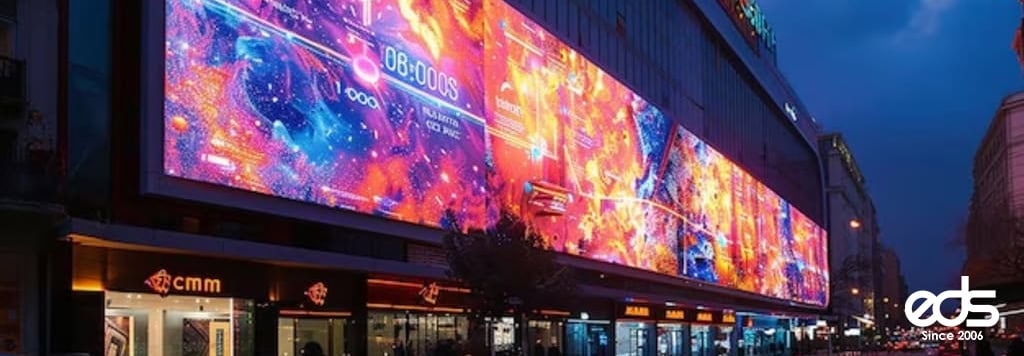
WHAT IS AN OUTDOOR LED DISPLAY SCREEN?
An outdoor LED display screen is a digital display system that uses light-emitting diodes to produce images, videos, graphics and text in external environments.
LED modules or cabinets are connected to form a larger digital display surface. This modular construction allows outdoor LED screens to be configured in different dimensions according to the available space, structural requirements and intended application.
Outdoor LED screens can display:
Commercial advertisements and brand campaigns
Promotional offers and product launches
Videos and animations
Building and destination branding
Event announcements
Product information
Public-facing information
Scheduled digital content
Unlike conventional printed advertising, LED displays allow businesses to change digital content without physically replacing printed artwork.
Outdoor LED systems require appropriate environmental protection, brightness, thermal management, electrical infrastructure and structural support.
OUTDOOR LED SCREEN RATES & COST IN DUBAI, UAE
Outdoor LED screen prices in Dubai depend on screen dimensions, pixel pitch, brightness, weather protection, LED technology, cabinet design, supporting structure and installation requirements.
There is no single standard price for an outdoor LED screen.
Estimated Outdoor LED Screen Prices in Dubai
| Outdoor LED Screen Type | Indicative Equipment Cost (AED/m²) | Typical Application |
|---|---|---|
| P8–P10 Outdoor LED Screen | 2,500–4,000 | Large displays, longer-distance viewing |
| P6–P8 Outdoor LED Screen | 2,800–4,500 | Building exteriors, commercial signage |
| P5–P6 Outdoor LED Screen | 3,000–5,000 | Commercial properties, retail destinations |
| P4–P5 Outdoor LED Screen | 3,500–5,500 | Shopping centres, pedestrian-facing displays |
| P3–P4 Outdoor LED Screen | 4,000–6,500 | Close-viewing outdoor commercial displays |
| High-Brightness Outdoor LED Screen | 3,500–7,000+ | Bright daylight and specialised installations |
| Outdoor Mesh LED Screen | 3,000–7,000+ | Selected facades and architectural installations |
| Outdoor Transparent LED Display | 4,000–8,000+ | Selected glass and architectural applications |
Important: These are indicative equipment-only budgeting estimates, not verified current EDS quotations or fixed UAE market prices. Actual rates can fall outside these ranges. Prices generally exclude supporting structures, installation, electrical work, controllers, delivery, permits, maintenance and VAT.
Outdoor LED Screen Installation & Additional Costs
| Component | Indicative Cost (AED) |
|---|---|
| Basic Outdoor LED Installation | 5,000–20,000+ |
| LED Video Processor / Controller | 1,000–6,000+ |
| Structural Steelwork & Mounting | Based on engineering requirements |
| Electrical Supply & Distribution | Based on site requirements |
| Data Cabling & Connectivity | Based on installation |
| Weatherproof Cabinet Configuration | Based on selected equipment |
| Structural Engineering & Technical Drawings | Based on project |
| Permits & Approvals | Subject to authority requirements |
| Annual Maintenance Contract | Based on screen size and service scope |
These are preliminary budgeting allowances. Large facade screens, elevated installations and projects requiring significant structural work can cost substantially more.
Example: Cost of a 5m × 3m Outdoor LED Screen
| Description | Estimated Cost |
|---|---|
| Screen Dimensions | 5m × 3m |
| Total Display Area | 15 m² |
| LED Specification | Outdoor P5 |
| Indicative Equipment Rate | AED 3,500–5,500/m² |
| Estimated Screen Equipment Cost | AED 52,500–82,500 |
| Structural Support & Installation | Additional |
| Controller, Electrical & Accessories | Additional |
| Permits & Approvals | If applicable |
| Total Project Cost | Subject to final technical specification |
This example is for initial budgeting only. It is not a fixed project quotation.
WHAT AFFECTS OUTDOOR LED SCREEN PRICES?
The main factors influencing the cost include screen dimensions, pixel pitch, brightness, outdoor protection rating, cabinet type, LED technology, controller, supporting structure, electrical infrastructure, installation height, site accessibility and maintenance requirements.
For advertising screens, permit and approval requirements can add further costs.
Comparing screens solely by price per square metre can therefore be misleading. Quotations should be compared using equivalent technical specifications and installation scopes.
WHY USE OUTDOOR LED SCREENS?
Outdoor LED displays provide businesses with a flexible digital communication medium for commercial properties, retail destinations, building exteriors and approved advertising locations.
Visibility in Outdoor Environments
Outdoor LED screens can be specified with brightness levels suitable for visibility under strong ambient light and daylight conditions.
The appropriate brightness depends on screen orientation, surrounding buildings, direct sunlight and operating hours.
Dynamic Advertising Content
Unlike conventional static signage, outdoor LED screens can display changing advertisements, promotional campaigns, videos, offers and brand messages.
Multiple creative messages can be scheduled on the same display, subject to the content management system and applicable advertising regulations.
Large-Format Digital Displays
Modular LED technology allows large display surfaces to be constructed according to screen dimensions, supporting structures and site requirements.
Flexible Content Management
Outdoor LED screens can display scheduled content and update campaigns according to operational or marketing requirements.
Permanent Commercial Applications
A permanent outdoor LED installation can provide a digital communication platform that businesses update throughout its operational life.
WHERE CAN OUTDOOR LED SCREENS BE INSTALLED IN DUBAI?
Outdoor LED screens can be considered for a variety of commercial environments, subject to technical feasibility, property permissions and applicable regulatory approvals.
| Location | Typical Outdoor LED Application |
|---|---|
| Commercial Buildings | Corporate branding, promotions and digital information |
| Building Facades | Architectural displays and approved digital advertising |
| Retail Destinations | Product launches, promotional campaigns and offers |
| Shopping Centres | External advertising and destination information |
| Hotels & Resorts | Events, branding and guest information |
| Restaurants & F&B | Promotions, product visuals and digital menus |
| Automotive Showrooms | Vehicle launches and brand campaigns |
| Real Estate Developments | Project information and approved promotional displays |
| Entertainment Venues | Events, videos and audience information |
| Approved Advertising Locations | Commercial digital outdoor advertising |
The installation and approval requirements may differ substantially between these environments.
OUTDOOR LED SCREENS FOR COMMERCIAL BUILDINGS
Commercial buildings can use outdoor LED displays for corporate communication, promotional campaigns, tenant content, advertisements and digital information.
Possible installation locations include building exteriors, entrances, commercial frontages and external structures.
Building-mounted LED screens require particular consideration of screen weight, structural capacity, wind loading, electrical supply, maintenance access and heat management.
The screen should be evaluated as part of the building environment rather than simply attached to an available exterior wall.
OUTDOOR LED SCREENS FOR RETAIL STORES
Retail destinations can use outdoor LED displays to communicate promotional offers, product launches, seasonal campaigns, new arrivals, brand videos and customer information.
A screen intended primarily for pedestrians may require a different pixel pitch and content strategy from one designed for motorists.
Important considerations include viewing distance, audience movement, screen height, sunlight exposure, content readability and surrounding architecture.
OUTDOOR LED SCREENS FOR SHOPPING CENTRES
Outdoor areas surrounding shopping centres may provide opportunities for digital displays where technically and legally suitable.
LED screens can support retail promotions, brand advertising, events, entertainment and destination information.
When evaluating an outdoor shopping centre installation, factors include screen position, pedestrian movement, road visibility, viewing distance, brightness and architectural integration.
Businesses seeking advertising placements on existing media can also explore shopping mall and outdoor advertising opportunities in Dubai.
OUTDOOR LED SCREENS FOR HOTELS & HOSPITALITY
Hotels, resorts, restaurants and hospitality destinations may use outdoor LED screens for events, promotions, entertainment, branded content and guest information.
The appropriate solution depends on the property’s architecture, audience and intended application.
Particular attention should be given to screen position, brightness, operating hours, viewing distance and the potential impact on neighbouring properties.
OUTDOOR LED SCREENS FOR SHOWROOMS
Automotive, property and other commercial showrooms can use outdoor LED displays for product launches, promotional campaigns, brand films and product information.
Displays facing public roads require different planning from screens intended primarily for visitors approaching the showroom.
Road-facing installations should consider traffic direction, viewing distance, screen height, content duration, readability and applicable restrictions.
OUTDOOR LED SCREENS FOR DIGITAL ADVERTISING
Outdoor LED screens can also function as digital out-of-home advertising media at approved locations.
They allow different advertising creatives to be scheduled on the same digital display.
However, installing an outdoor advertising screen involves more than purchasing display equipment.
The location, screen dimensions, supporting structure, advertising purpose and regulatory approval feasibility should be evaluated before the final specification is confirmed.
EDS also provides digital outdoor advertising solutions in Dubai and UAE, including information about advertising formats and locations.
PERMANENT OUTDOOR LED SCREEN VS TEMPORARY RENTAL SCREEN
Permanent outdoor LED installations and temporary rental screens serve different purposes.
| Factor | Permanent Outdoor LED Screen | Temporary LED Screen Rental |
|---|---|---|
| Duration | Long-term installation | Short-term requirement |
| Applications | Buildings, retail, digital signage | Events, concerts, exhibitions |
| Equipment | Selected for permanent operation | Selected for temporary deployment |
| Supporting Structure | Permanent structural design | Temporary support or rigging |
| Content Management | Ongoing scheduled content | Event-specific content |
| Maintenance | Long-term maintenance planning | Event technical support |
| Commercial Model | Equipment purchase and installation | Rental charges and services |
Permanent installations are suitable for commercial properties, retail destinations, hotels, showrooms and approved long-term digital advertising locations.
Temporary LED screens are commonly used for events, exhibitions, concerts, festivals and short-term activations.
For temporary requirements, EDS can also assist with LED screen rental solutions in Dubai.
UNDERSTANDING OUTDOOR LED SCREEN PIXEL PITCH
Pixel pitch is the distance between the centres of neighbouring LED pixels, measured in millimetres.
Outdoor LED screens commonly use specifications such as P3, P4, P5, P6, P8 and P10, although other configurations are available depending on the technology and application.
A smaller pixel pitch provides greater pixel density and can improve image detail at shorter viewing distances.
However, outdoor displays are frequently viewed from greater distances than indoor screens, so an extremely fine pixel pitch may not always be necessary.
OUTDOOR LED PIXEL PITCH GUIDE
| Pixel Pitch | Typical Viewing Application | Common Use |
|---|---|---|
| P3–P4 | Close-viewing outdoor commercial applications | Retail frontages, pedestrian-facing displays |
| P4–P5 | Short-to-medium outdoor viewing | Commercial buildings, outdoor retail |
| P5–P6 | Medium-distance outdoor applications | Building displays, commercial signage |
| P6–P8 | Large displays viewed from farther away | Building exteriors, large digital signage |
| P8–P10 | Large-format, longer-distance viewing | Large outdoor displays and selected advertising locations |
These are general planning guidelines rather than fixed technical specifications.
HOW DO I CHOOSE THE RIGHT OUTDOOR LED PIXEL PITCH?
Pixel pitch selection should begin with the closest realistic viewing distance.
If audiences regularly view the screen from relatively close range, a finer pixel pitch may be appropriate.
If the display is mounted high on a building and viewed from a considerable distance, an extremely fine pixel pitch may increase project cost without providing a proportionate visual benefit.
Important considerations include minimum viewing distance, typical viewing distance, screen dimensions, content, required resolution and budget.
OUTDOOR LED SCREEN RESOLUTION
Pixel pitch and physical screen dimensions determine the native resolution of an outdoor LED display.
Two screens with identical physical dimensions can have very different pixel resolutions.
This becomes particularly important when the content includes text, product details, logos, photography or detailed graphics.
Content should ideally be produced according to the final screen’s native resolution, aspect ratio and expected viewing distance.
OUTDOOR LED SCREEN BRIGHTNESS
Brightness is an important specification for outdoor LED displays because screens may need to remain visible under strong daylight.
LED screen brightness is commonly expressed in nits.
The appropriate brightness depends on screen orientation, direct sunlight, surrounding buildings, viewing distance, operating hours and ambient lighting.
Indicative Outdoor LED Brightness Guide
| Installation Environment | Indicative Brightness Range |
|---|---|
| Shaded Outdoor Areas | 2,500–4,500 nits |
| Partially Sunlit Commercial Areas | 4,000–5,500 nits |
| Bright Outdoor Environments | 5,000–6,500 nits |
| Direct-Sunlight Applications | 5,500–8,000+ nits |
These are general technical planning ranges, not universal requirements. Actual brightness specifications depend on the LED technology, site conditions and permitted operating parameters.
Automatic Brightness Control
Depending on the selected LED system, brightness can be adjusted according to changing ambient light.
This may be particularly useful because the brightness required during strong daylight can be unnecessary during evening or nighttime operation.
Appropriate brightness management can help maintain comfortable visibility and reduce unnecessary power consumption.
OUTDOOR LED SCREEN WEATHER PROTECTION
Outdoor LED screens require environmental protection appropriate for their installation location.
Potential exposure includes dust, humidity, rain, heat, wind and temperature changes.
The LED system, cabinet design, electrical connections and supporting installation should be suitable for the intended outdoor environment.
Understanding IP Ratings
Ingress Protection (IP) ratings indicate levels of protection against solid particles and water.
For outdoor LED installations, protection requirements may differ between the front and rear of the screen, depending on cabinet design, installation position and environmental exposure.
An IP65 rating, for example, indicates dust-tight protection and resistance to water jets under the applicable test conditions. It does not mean the equipment is suitable for immersion or every possible outdoor exposure.
The appropriate IP specification should be confirmed for the complete installation.
Outdoor LED Screens & Dubai Heat
Dubai’s climate makes thermal management particularly important.
Outdoor LED systems may operate in high ambient temperatures while also generating internal heat.
Project planning should consider ventilation, heat dissipation, cabinet construction, power supplies, screen orientation and operating hours.
The thermal design should form part of the technical specification.
OUTDOOR LED SCREEN WIND & STRUCTURAL REQUIREMENTS
Large outdoor LED screens can create significant structural loads.
The supporting system must be designed according to factors including screen dimensions, screen weight, installation height, supporting structure, location and wind exposure.
Depending on the project, structural engineering assessments and supporting documentation may be required.
A large outdoor LED screen should not be treated simply as a display panel attached to an exterior wall.
FRONT-SERVICE VS REAR-SERVICE OUTDOOR LED SCREENS
Maintenance access can significantly influence the installation design.
Front-Service Outdoor LED Screens
Selected modules and components can be accessed from the front of the display.
This may be useful where limited space is available behind the screen.
Rear-Service Outdoor LED Screens
Components are accessed from behind the screen.
This configuration requires sufficient safe maintenance access behind the installation.
The appropriate configuration depends on the building, supporting structure, available space, screen design and maintenance requirements.
OUTDOOR LED SCREEN CONTENT MANAGEMENT
Outdoor LED screens can display scheduled advertisements, brand campaigns, promotional messages, videos and other digital content.
Depending on the system, content can be managed through a media player, LED controller, local network or remote content management platform.
Single-Screen Content Management
A standalone outdoor display may use a dedicated controller and content management system.
Multiple-Screen Content Management
Businesses operating screens at multiple locations may use centralised management to schedule and distribute content.
Advertising Content Scheduling
Where the screen is used for commercial advertising, multiple approved creatives may be scheduled according to the operating arrangement.
For businesses requiring promotional video content, EDS also offers video production and photography services.
OUTDOOR LED SCREEN MAINTENANCE
Permanent outdoor LED installations require ongoing maintenance because they operate in demanding environmental conditions.
Maintenance may include:
Visual inspection
LED module replacement
Power supply checks
Controller checks
Cable inspections
Cleaning
Calibration
Structural inspection
Software support
Outdoor screens may require additional attention because of heat, dust, humidity and weather exposure.
Maintenance access should be considered during the initial screen and structural design.
OUTDOOR LED SCREEN PERMITS, APPROVALS & REGULATIONS IN DUBAI
Permanent outdoor LED screens may require approvals depending on their location, intended use, property ownership, dimensions, supporting structure, visibility and advertising function.
Dubai has a formal regulatory framework for electronic screens used as outdoor advertising.
The applicable approval route may depend on whether the screen is installed on land, mounted on a building, located within a free zone, used for advertising or used for other commercial display purposes.
Electronic Advertising Screen Permits
Outdoor electronic advertising screens may require permits from the relevant authority.
Depending on the location and installation, supporting documents can include property owner consent, proposed screen design, dimensions, location details and advertising content information.
Building-Mounted LED Screens
LED screens installed on building exteriors may require property approvals, structural assessments and relevant advertising permits.
Free Zone & Special Development Locations
Projects within free zones or special developments may be subject to the requirements of the relevant authority or development jurisdiction.
Structural & Electrical Safety
Large outdoor LED screens should be assessed for structural loads, electrical requirements, weather exposure and safe maintenance access.
Advertising Content Requirements
Where the display is used for advertising, the content must comply with applicable UAE advertising rules and any relevant permit conditions.
EDS can assist with coordinating project requirements involving property stakeholders, technical parties and applicable authorities, according to the agreed scope.
Final approval requirements must be confirmed for the actual installation location, screen type and intended use before equipment purchase and installation.
Partner with Us
At EDS, we are committed to providing top-quality outdoor LED screens in Dubai, UAE. Our innovative LED solutions are designed to enhance your outdoor advertising and communication efforts. Contact us today to explore our outdoor LED screen solutions and transform your outdoor spaces with powerful, high-resolution displays.
OUTDOOR LED DISPLAY SCREENS IN DUBAI & UAE – FAQ
What is an outdoor LED display screen?
An outdoor LED display screen is a digital display designed for external environments. It uses light-emitting diodes to display videos, advertisements, images, graphics and information. Outdoor screens require appropriate brightness, weather protection, structural support and electrical specifications.
How much does an outdoor LED screen cost in Dubai?
Indicative equipment-only prices may range from AED 2,500–4,000 per square metre for standard P8–P10 displays to AED 4,000–6,500 or more per square metre for finer-pitch outdoor screens. Installation, supporting structures, controllers, permits and maintenance are generally additional. Actual costs depend on project specifications.
Which pixel pitch is best for outdoor LED screens?
The appropriate pixel pitch depends on viewing distance, screen dimensions and content. P3–P5 displays may suit closer outdoor viewing, while P6–P10 screens are commonly considered for larger displays viewed from farther away.
What brightness is required for outdoor LED screens in Dubai?
Outdoor LED brightness depends on sunlight exposure, screen orientation and surrounding conditions. Bright outdoor installations may require approximately 5,000–6,500 nits or more, while shaded locations may require less. The final specification should reflect actual site conditions.
Are outdoor LED screens waterproof and weather-resistant?
Outdoor LED screens are designed with environmental protection appropriate to their intended use. The required IP rating depends on cabinet construction, exposure and installation conditions. Weather resistance should be assessed for the complete installation, not only the LED modules.
Can outdoor LED screens be installed on building facades?
Yes. Outdoor LED screens can be installed on suitable building facades, subject to structural feasibility, property permissions and applicable regulatory approvals. Installation planning should consider wind loading, screen weight, electrical requirements and maintenance access.
Do outdoor LED screens require permits in Dubai?
Some outdoor LED installations require permits depending on their location, size and intended use. Screens used for commercial advertising may be subject to electronic advertising permit requirements. Approval conditions should be confirmed with the relevant authority before installation.
What is the difference between indoor and outdoor LED screens?
Indoor LED screens are designed for controlled interior environments and often use finer pixel pitches for close viewing. Outdoor LED screens require suitable brightness, weather protection, thermal management and structural specifications for external conditions.
Can outdoor LED screens display advertisements and videos?
Yes. Outdoor LED screens can display advertisements, videos, animations, brand campaigns, promotional offers and information. Content can be scheduled or updated through a compatible control system, subject to applicable advertising regulations.
How much maintenance does an outdoor LED screen require?
Maintenance depends on the screen technology, installation location and operating conditions. Typical activities include cleaning, LED module inspections, controller checks, power supply checks, calibration and structural inspections.
Can outdoor LED screens be rented for events in Dubai?
Yes. Outdoor LED screens can be rented for concerts, exhibitions, festivals, corporate events and temporary promotional activities. Rental specifications depend on screen size, venue, duration, weather exposure, installation and technical support requirements.
Does EDS supply and install outdoor LED screens in Dubai and UAE?
Yes. Established in Dubai in 2006, EDS provides outdoor LED display solutions for businesses across Dubai, Abu Dhabi, Sharjah and other UAE emirates. Depending on the project scope, services can include screen selection, technical planning, equipment supply, installation coordination, configuration and maintenance support.