
DIGITAL MARKETING


LED Screen Rental in Dubai, UAE
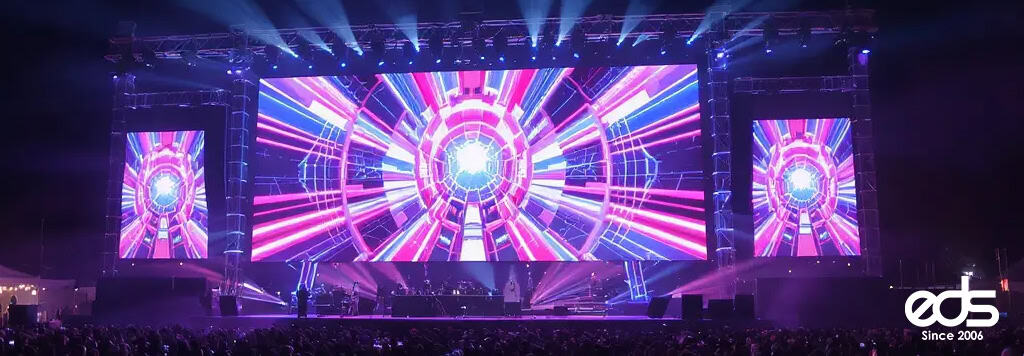
Looking for LED screen rental in Dubai for a corporate event, conference, exhibition, product launch, gala dinner or outdoor function? EDS provides temporary indoor and outdoor LED display solutions for events across Dubai, Abu Dhabi, Sharjah and the UAE, with screen configurations selected according to the venue, audience size, viewing distance, content and technical requirements.
Whether you require a large LED stage backdrop, LED video wall rental, conference presentation screen, exhibition LED display or outdoor event screen, EDS can coordinate the appropriate LED screen, supporting structure, controller, installation, configuration, testing, technical support and dismantling according to the project scope.
LED screen rental allows businesses and event organisers to use professional digital displays for a defined event period without purchasing permanent equipment. Modular LED panels can be assembled into different screen dimensions, making them suitable for everything from small corporate presentations to large outdoor events.
Established in Dubai in 2006, EDS provides LED display screen solutions in Dubai, including indoor LED screens, outdoor LED displays and LED video walls.
WHAT IS LED SCREEN RENTAL?
LED screen rental is the temporary provision of a digital display system for an event, exhibition or short-term requirement without purchasing and permanently installing the screen.
Rental LED screens use modular LED panels or cabinets that can be assembled into the required dimensions and installed using a suitable ground-supported, hanging or other approved mounting system.
Depending on the event and technical setup, rental LED screens can display presentations, videos, live camera feeds, branding, sponsor content, product demonstrations, animations, event information and social media content.
After the event, the equipment is dismantled and removed according to the agreed schedule and venue requirements.
WHAT IS INCLUDED IN LED SCREEN RENTAL?
The scope of an LED screen rental project can include:
LED screen panels or cabinets
Supporting structure or approved rigging
LED controller and video processor
Power and data cabling
Screen installation and configuration
Content testing and screen calibration
Technical operators during the event
Dismantling and equipment removal
The exact inclusions depend on the quotation and event requirements. Video production, camera systems, video switching, generators and other AV services may be quoted separately.
LED SCREEN RENTAL RATES & COST IN DUBAI, UAE
The cost of LED screen rental in Dubai depends on screen dimensions, pixel pitch, indoor or outdoor specification, rental duration, supporting structure, installation method, venue access, controller, technical crew, setup, dismantling, transportation and event location.
Additional production requirements such as live camera feeds, complex video switching, custom structures and extended technical support can affect the final scope.
ESTIMATED LED SCREEN RENTAL PRICES IN DUBAI
| Rental LED Screen Type | Indicative Daily Equipment Rate (AED/m²) | Typical Application |
|---|---|---|
| P3.9 Indoor LED Screen | 150–250 | Corporate events, stage backdrops |
| P2.9 Indoor LED Screen | 200–350 | Conferences, exhibitions |
| P2.6 Indoor LED Screen | 250–400 | Premium corporate events |
| P4.8 Outdoor LED Screen | 200–350 | Outdoor events, festivals |
| P3.9 Outdoor LED Screen | 250–450 | Outdoor stages, public events |
| Fine-Pitch Premium LED | 350–600+ | Close-viewing premium events |
Important: These are illustrative equipment-only daily budgeting estimates, not verified current EDS rental rates or fixed UAE market quotations. Actual rates may differ substantially based on availability, duration, screen size and supplier minimum charges. Installation, structure, crew, transportation, processing, VAT and other services may be additional.
ESTIMATED LED SCREEN RENTAL COST BY SCREEN SIZE
| LED Screen Size | Display Area | Illustrative Equipment-Only Daily Cost |
|---|---|---|
| 3m × 2m | 6 m² | AED 1,200–2,100 |
| 4m × 2.5m | 10 m² | AED 2,000–3,500 |
| 5m × 3m | 15 m² | AED 3,000–5,250 |
| 6m × 3m | 18 m² | AED 3,600–6,300 |
| 8m × 4m | 32 m² | AED 6,400–11,200 |
| 10m × 5m | 50 m² | AED 10,000–17,500 |
These examples use an illustrative equipment rate of AED 200–350 per square metre per day. They are not complete installed-event prices, and small projects may be subject to minimum charges.
LED SCREEN RENTAL INSTALLATION & ADDITIONAL COSTS
| Component | Indicative Cost (AED) |
|---|---|
| Basic Indoor Installation & Dismantling | 1,500–4,000+ |
| Large Stage Installation | 3,000–8,000+ |
| Outdoor Supporting Structure | Based on engineering and size |
| LED Controller / Video Processor | 500–2,000+ |
| On-Site LED Technician | 500–1,200+ per day |
| Transportation | Based on location and equipment |
| Video Switching Equipment | Based on production scope |
| Live Camera Feed Setup | Based on production requirements |
| Power Distribution / Generator | Based on event requirements |
These are preliminary budgeting allowances and not fixed service rates.
EXAMPLE: COST OF A 5M × 3M LED SCREEN FOR A CORPORATE EVENT
| Description | Estimated Cost |
|---|---|
| Screen Dimensions | 5m × 3m |
| Total Display Area | 15 m² |
| LED Specification | P2.9 Indoor |
| Indicative Equipment Rate | AED 200–350/m²/day |
| Equipment Cost | AED 3,000–5,250 |
| Installation & Dismantling | Additional |
| Controller & Technical Crew | Additional |
| Transportation | Additional |
| Total Event Rental Cost | Subject to final quotation |
The complete event quotation should be based on the venue, screen configuration, event schedule and technical requirements.
WHAT AFFECTS LED SCREEN RENTAL COST?
Screen Size
Larger screens require more LED cabinets and supporting equipment.
Pixel Pitch
Fine-pitch LED systems can have different rental costs from larger-pitch systems.
Indoor or Outdoor Specification
Outdoor systems have different technical and structural requirements.
Rental Duration
The event period and equipment allocation can influence pricing.
Supporting Structure
Ground-supported, hanging and custom installations involve different requirements.
Venue Access
Restricted loading times, difficult access or unusual installation locations can affect setup requirements.
Technical Support
On-site operators and extended technical support can influence the scope.
Content & Production Requirements
Live feeds, multiple sources and complex switching can require additional technical equipment.
WHY RENT AN LED SCREEN FOR AN EVENT?
Purchasing a permanent LED display may not be practical for a one-day event, conference or short-term exhibition.
LED screen rental allows the display configuration to be selected specifically for the event.
Temporary Requirement
Use an LED screen for the required event period without purchasing permanent equipment.
Custom Screen Dimensions
Modular rental LED systems can be configured in different dimensions according to the selected equipment and venue requirements.
Indoor & Outdoor Options
Different LED systems can be selected depending on whether the event takes place indoors or outdoors.
Multiple Content Sources
Depending on the technical setup, rental LED screens can display presentations, videos, live camera feeds and other compatible sources.
Installation & Dismantling
The rental scope can include installation before the event and dismantling afterwards.
Technical Support
Technical support can be arranged according to the complexity and requirements of the event.
WHERE CAN RENTAL LED SCREENS BE USED?
LED screen rental is suitable for a wide range of corporate, commercial and entertainment events.
| Event Type | Typical LED Screen Application |
|---|---|
| Corporate Events | Presentations, branding, speaker content |
| Conferences | Speaker slides, videos, live camera feeds |
| Exhibitions | Product demonstrations, promotional videos |
| Product Launches | Product reveals, animations, brand films |
| Award Ceremonies | Nominee content, winner announcements |
| Gala Dinners | Stage backdrops, entertainment visuals |
| Trade Shows | Stand displays, product presentations |
| Brand Activations | Promotional visuals, interactive content |
| Roadshows | Portable event display configurations |
| Outdoor Festivals | Large-format stage screens |
| Sports Events | Live feeds, event information |
| Weddings & Private Events | Visual backdrops, photographs, videos |
The appropriate screen depends on the venue, audience, installation environment and content requirements.
LED SCREEN RENTAL FOR CORPORATE EVENTS
Corporate events can use rental LED screens for presentations, company videos, branding, speaker content, product demonstrations, awards and live camera feeds.
Potential applications include annual meetings, corporate functions, town halls, award ceremonies, gala events and networking events.
The appropriate screen configuration depends on room dimensions, stage size, audience size, seating layout, viewing distance and content.
For presentation-heavy events, text readability and resolution can be particularly important.
CORPORATE EVENT LED BACKDROPS
A large LED screen positioned behind the stage can provide a digital backdrop for corporate events.
The same screen can display company branding during registration, speaker presentations during conference sessions, award graphics during ceremonies and sponsor messages during breaks.
This allows the stage background to change throughout the event without replacing physical printed graphics.
LED SCREEN RENTAL FOR CONFERENCES
Conferences often require screens that can clearly display presentations, speaker slides, videos, event branding, schedules and live camera feeds.
The screen should be sized according to the audience and room rather than simply according to the available stage width.
For larger conference rooms, the configuration may include a main stage LED screen and additional supporting displays.
CONFERENCE LED SCREEN REQUIREMENTS
Important considerations include:
Audience size and seating layout
Distance from the stage
Presentation text size
Screen dimensions and resolution
Laptop and presentation connectivity
Speaker confidence monitors
Live camera feeds
Video switching requirements
A large screen with insufficient resolution may still produce difficult-to-read text.
For conferences, clarity and legibility should take priority over screen size alone.
LED SCREEN RENTAL FOR EXHIBITIONS
Exhibition stands can use LED displays for brand videos, product demonstrations, promotional content, corporate presentations and animations.
The appropriate LED specification depends heavily on viewing distance.
Because exhibition visitors can often approach the screen closely, a finer pixel pitch may be appropriate compared with a large event screen viewed from farther away.
EXHIBITION LED DISPLAY OPTIONS
Possible configurations include:
Wall-mounted LED displays
Freestanding LED screens
Exhibition stand video walls
LED screens integrated into custom stands
Product demonstration displays
Digital branding walls
Planning should consider stand dimensions, screen size, viewing distance, structure, content and exhibition organiser requirements.
LED SCREEN RENTAL FOR PRODUCT LAUNCHES
Product launches can use LED screens to combine branding, product videos, presentations, demonstrations, animations and live content with the physical event environment.
Depending on the event concept, the screen can function as a stage background, presentation display, product reveal element or branded feature.
The screen dimensions and content should ideally be planned together rather than treating the LED display as a last-minute addition to the stage.
PRODUCT REVEAL LED SCREENS
For product launches, LED screens can display countdown animations, product teasers, launch films, product specifications and branded visual effects.
The screen can also be coordinated with stage lighting, audio and the timing of the product reveal.
The final configuration depends on the event concept and production requirements.
LED SCREEN RENTAL FOR AWARD CEREMONIES
Award ceremonies can use LED screens for award categories, nominee content, winner announcements, sponsor branding, videos and live camera feeds.
For these events, the LED screen often becomes an important part of the stage design.
Screen dimensions and placement should therefore be coordinated with stage dimensions, podium position, lighting, cameras and event branding.
AWARD CEREMONY LED CONTENT
A typical award ceremony may require:
Opening animation
Award category graphics
Nominee photographs and videos
Winner announcement slides
Sponsor logos
Live camera feeds
Closing visuals
Content transitions should be coordinated with the event programme.
LED SCREEN RENTAL FOR GALA DINNERS
LED screens can support gala dinners and formal corporate functions with event branding, videos, sponsor content, presentations, awards and entertainment visuals.
The screen should be positioned so attendees across the venue have an appropriate viewing angle.
For wide ballrooms, screen placement can sometimes be as important as total screen size.
A main LED backdrop may be supplemented with side displays depending on the seating arrangement and audience.
LED SCREEN RENTAL FOR TRADE SHOWS
Trade shows and exhibitions can use rental LED screens to present product videos, demonstrations, brand content, promotions and presentations within suitable stands and activation areas.
Because audiences often view exhibition screens from short distances, the relationship between pixel pitch and viewing distance should be considered carefully.
Screens used in trade shows should also be configured according to stand dimensions, power availability and exhibition regulations.
LED SCREEN RENTAL FOR BRAND ACTIVATIONS
Brand activations can incorporate LED screens into temporary experiential installations.
Possible uses include campaign visuals, product demonstrations, interactive content, social media content and brand animations.
The appropriate solution depends on the creative concept, venue and technical requirements.
For selected concepts, flexible LED screens or transparent LED displays may also be evaluated where suitable rental equipment is available.
LED SCREEN RENTAL FOR ROADSHOWS
Temporary roadshows can require LED displays at multiple locations.
Depending on the project, screen configurations can be evaluated according to venue type, audience, installation time, content and indoor or outdoor requirements.
Where the same equipment is moved between venues, logistics and setup requirements should be considered during planning.
Multi-location roadshows may require additional transportation, technical crew and installation time.
LED SCREEN RENTAL FOR WEDDINGS & PRIVATE EVENTS
LED screens can be used for weddings and private events to display photographs, videos, live camera feeds, animations, event branding and decorative visual content.
Possible applications include stage backdrops, entrance displays, entertainment visuals and live video coverage.
The appropriate screen should be selected according to venue size, audience distance, lighting and the event’s visual design.
INDOOR LED SCREEN RENTAL IN DUBAI
Indoor rental LED screens can be used for conferences, corporate events, exhibitions, product launches, award ceremonies, gala dinners and brand activations.
Indoor environments generally provide greater control over lighting, weather and temperature than outdoor events.
However, indoor screen selection still requires careful consideration of viewing distance, pixel pitch, screen dimensions, content and venue lighting.
A screen positioned close to an audience may require a finer pixel pitch than a large stage display viewed from across a ballroom.
COMMON INDOOR LED SCREEN SIZES
| Screen Size | Display Area | Typical Application |
|---|---|---|
| 2m × 1.5m | 3 m² | Small presentations, exhibition stands |
| 3m × 2m | 6 m² | Small corporate events |
| 4m × 2.5m | 10 m² | Conferences, product launches |
| 5m × 3m | 15 m² | Corporate stages, gala dinners |
| 6m × 3m | 18 m² | Medium-to-large event stages |
| 8m × 4m | 32 m² | Large conferences, award ceremonies |
| 10m × 5m | 50 m² | Large-scale corporate events |
These are illustrative dimensions rather than guaranteed available rental sizes. Actual configurations depend on LED cabinet dimensions, inventory and venue requirements.
OUTDOOR LED SCREEN RENTAL IN DUBAI
Outdoor events require LED screens specifically suitable for the installation environment.
Potential applications include festivals, outdoor corporate events, public events, sports screenings and outdoor brand activations.
Outdoor screen planning can require consideration of brightness, weather protection, wind, supporting structure, power, viewing distance, daylight and access.
An indoor rental LED system should not be used outdoors without confirming that it is appropriate for the environment.
OUTDOOR LED SCREEN REQUIREMENTS
| Requirement | Consideration |
|---|---|
| Brightness | Visibility in daylight and ambient lighting |
| Weather Protection | Suitable outdoor-rated equipment |
| Wind Load | Appropriate structural assessment |
| Screen Structure | Safe ground-supported or approved installation |
| Power Supply | Suitable electrical capacity |
| Viewing Distance | Screen size and pixel pitch |
| Installation Access | Loading, lifting and technical access |
| Event Duration | Equipment and crew scheduling |
For permanent installations, businesses can also explore outdoor LED display screens in Dubai.
STAGE LED SCREEN RENTAL
LED screens are frequently used as digital stage backdrops.
Depending on the event design, the screen can display event branding, presentations, speaker content, videos, animations and live feeds.
The screen dimensions should be coordinated with the stage.
A screen that is too small can appear visually disconnected from a large stage, while an unnecessarily large screen can increase cost and technical complexity without improving the audience experience.
MAIN STAGE LED SCREENS
A main stage LED screen can be positioned behind speakers or performers.
Its dimensions should be planned around the stage width, audience viewing distance, lighting and camera positions.
SIDE LED SCREENS
Side screens may be useful for larger venues where attendees seated farther from the stage require additional visibility.
FREESTANDING LED SCREENS
Freestanding LED screens can be considered for selected event spaces where wall mounting or hanging is unsuitable.
LED BACKDROP RENTAL IN DUBAI
An LED backdrop can replace or complement conventional printed stage branding.
One advantage is that the background can change throughout the event.
For example:
| Event Segment | LED Backdrop Content |
|---|---|
| Opening | Event branding |
| Presentation | Speaker slides |
| Product Launch | Product video |
| Awards | Nominee and winner content |
| Closing | Sponsor or brand message |
This allows the same physical display area to support multiple event segments.
LED SCREENS FOR LIVE CAMERA FEEDS
For larger events, attendees positioned farther from the stage may need a closer view of speakers or performers.
Depending on the production setup, LED screens can display live camera feeds.
This can be useful for conferences, award ceremonies, large corporate events and entertainment events.
Live video requires coordination between the LED screen system and the event’s camera and video-production setup.
LIVE CAMERA FEED REQUIREMENTS
The technical setup may involve cameras, video switchers, signal converters, LED processors, suitable cabling and monitoring equipment.
The final configuration depends on the number of cameras, screen resolution, event production system and latency requirements.
LED SCREENS FOR PRESENTATIONS
Rental LED screens can display presentations from compatible source equipment.
For presentation-heavy events, it is important to confirm presentation resolution, aspect ratio, laptop output and screen native resolution before the event.
This reduces the risk of incorrect scaling, black borders, cropped content and unreadable text during the presentation.
PRESENTATION FORMAT CONSIDERATIONS
A conventional widescreen format may simplify content production for events using standard presentation slides and videos.
However, modular LED technology also allows other screen proportions depending on the rental system.
If a custom aspect ratio is selected, content should be created specifically for that format.
LED SCREENS FOR VIDEO CONTENT
LED screens can display suitable video content through the event’s playback and processing system.
Videos should ideally be prepared according to screen aspect ratio, native resolution and the event playback system.
Content testing before the event is particularly important for major presentations and product launches.
For event films, promotional videos and branded animations, EDS also provides video production and photography services.
LED SCREENS FOR SPONSOR BRANDING
Events involving sponsors can use LED screens to display sponsor logos, partner content, event branding and promotional videos.
Content can be scheduled according to the event programme.
For multiple sponsor logos, artwork should be designed so individual brands remain legible from the expected audience distance.
LED SCREEN PIXEL PITCH FOR EVENTS
Pixel pitch is the distance between neighbouring LED pixels and is normally expressed in millimetres.
A smaller pixel pitch generally provides greater pixel density.
For rental screens, the appropriate pitch depends largely on the expected viewing distance.
Common rental LED configurations can include P2.6, P2.9, P3.9, P4.8 and other specifications depending on the available rental system and application.
LED SCREEN PIXEL PITCH GUIDE FOR EVENTS
| Pixel Pitch | Typical Application |
|---|---|
| P1.9–P2.5 | Premium indoor events with close viewing |
| P2.6–P2.9 | Conferences, exhibitions, corporate events |
| P3.9 | General indoor event stages and selected outdoor systems |
| P4.8 | Larger stage displays and outdoor events |
| P5–P6 | Selected outdoor events with longer viewing distances |
| P6–P8 | Large outdoor displays viewed from farther away |
These are general planning categories rather than fixed recommendations. Actual rental availability and suitability depend on the selected equipment and event environment.
HOW DO I CHOOSE THE RIGHT PIXEL PITCH FOR AN EVENT?
Start with the closest audience viewing distance.
For example, an exhibition screen that visitors can approach closely may require a finer pixel pitch than a stage screen viewed from much farther away.
Important considerations include the closest viewer, typical viewing distance, screen dimensions, content detail, required resolution and budget.
The smallest available pixel pitch is not automatically necessary for every event.
CHOOSING THE RIGHT LED SCREEN SIZE
The correct screen size depends on audience size, viewing distance, venue dimensions, stage size, content and seating layout.
Rather than asking only how many square metres of LED are required, consider whether attendees at the farthest practical viewing positions will be able to understand the content.
For presentations, the ability to read text can be more important than simply making the screen visually impressive.
LED SCREEN SIZE & VIEWING DISTANCE
| Event Environment | Screen Selection Consideration |
|---|---|
| Small Meeting Room | Compact screen with suitable close-viewing resolution |
| Exhibition Stand | Fine-pitch screen for nearby visitors |
| Corporate Ballroom | Screen dimensions suited to stage and seating |
| Large Conference | Main screen plus possible supporting displays |
| Outdoor Festival | Large display suitable for longer viewing distances |
| Sports Screening | Screen size suited to audience and viewing area |
There is no universal screen size suitable for every event.
LED SCREEN ASPECT RATIO
Aspect ratio is the relationship between screen width and height.
For events using presentations, videos and live feeds, a conventional widescreen format can simplify content production.
However, modular LED technology also allows other screen proportions depending on the rental system.
If a custom aspect ratio is selected, content should be created specifically for that format.
LED SCREEN RESOLUTION FOR EVENTS
The native resolution of an LED screen depends on physical screen dimensions and pixel pitch.
A physically large screen does not automatically mean a high-resolution screen.
For content containing small text, charts, product details and data, resolution becomes particularly important.
For a large stage backdrop displaying primarily video, branding and animation, the technical requirements may be different.
INDOOR VS OUTDOOR RENTAL LED SCREENS
| Factor | Indoor Rental LED | Outdoor Rental LED |
|---|---|---|
| Environment | Indoor venues | Exterior environments |
| Brightness Requirement | Generally lower | Generally higher |
| Weather Protection | Indoor specification | Outdoor-specific protection required |
| Wind Consideration | Usually limited | Important |
| Typical Viewing | Often closer | Often farther away |
| Applications | Conferences, exhibitions, corporate events | Festivals, outdoor events, screenings |
The screen should always be selected according to the actual event environment.
LED SCREEN INSTALLATION METHODS
Rental LED screens can be installed using different methods depending on the venue, screen dimensions and equipment.
GROUND-SUPPORTED LED SCREENS
Depending on the event and rental system, an LED screen can be installed on an appropriate ground-supported structure.
This can be useful where hanging is not possible, venue rigging is restricted or stage design requires ground support.
The structure should be designed according to screen dimensions, weight and installation environment.
HANGING LED SCREENS
In suitable venues, LED screens may be suspended from an approved rigging system.
Hanging installations require coordination with the venue and rigging team.
The availability and capacity of rigging points should be confirmed before finalising the screen design.
OUTDOOR LED SCREEN STRUCTURES
Outdoor LED installations can require appropriate temporary supporting structures.
Planning should consider screen area, screen weight, wind exposure, ground conditions, location and installation method.
Outdoor structural requirements should be determined according to the actual event site and screen configuration.
LED SCREEN CONTROLLERS & VIDEO PROCESSING
The LED panels are only one part of the rental system.
A controller or video processor maps the source content to the LED screen.
Depending on the event, sources can include laptops, media players, presentation computers, camera systems, video mixers and other compatible video sources.
The processing system should be determined according to screen resolution and event-production requirements.
MULTIPLE INPUTS & EVENT VIDEO SWITCHING
Events may require switching between different content sources.
For example:
Presentation Laptop → Corporate Video → Live Camera Feed → Sponsor Content
The appropriate video-switching and processing setup depends on the production requirements.
For technically complex events, these requirements should be established before event day.
CONTENT PREPARATION FOR RENTAL LED SCREENS
LED screen content should ideally be prepared according to the final screen configuration.
Before producing final artwork and videos, confirm the fixed resolution, aspect ratio, file requirements and playback system.
This is especially important for custom-size screens.
EVENT LED SCREEN CONTENT CHECKLIST
| Content | Preparation Requirement |
|---|---|
| Final Presentation | Correct aspect ratio and readable text |
| Videos | Compatible format and resolution |
| Logos | High-quality files |
| Sponsor Artwork | Appropriate sizing and legibility |
| Holding Slides | Correct event branding |
| Speaker Slides | Tested presentation output |
| Opening Content | Confirmed playback sequence |
| Closing Content | Final approved artwork |
| Backup Files | Available to the technical team |
Final content should be tested before the event wherever practical.
LED SCREEN SETUP & TESTING
Rental screen installation should allow sufficient time for structure setup, LED assembly, cabling, power, controller configuration, screen mapping and content testing.
The amount of setup time required depends on screen size, venue access, structure and event complexity.
Large installations generally require more preparation than small exhibition screens.
PRE-EVENT TECHNICAL TESTING
Before the event, testing may include:
LED panel operation
Controller configuration
Video source compatibility
Screen mapping
Brightness adjustment
Presentation playback
Video playback
Live camera feeds
Backup content
Testing helps identify technical issues before the audience arrives.
TECHNICAL SUPPORT DURING THE EVENT
Depending on the project, technical support can be arranged during the event.
This can be particularly useful where the LED screen is handling presentations, live feeds, multiple sources or frequent content changes.
The required level of technical support should be agreed according to the event programme and production complexity.
LED SCREEN DISMANTLING AFTER THE EVENT
After the event, the rental screen is dismantled and removed according to the agreed schedule and venue access requirements.
Dismantling can include screen panels, supporting structures, controllers, cabling and associated rental equipment.
Venue loading and access timings should be confirmed during planning.
ONE-DAY VS MULTI-DAY LED SCREEN RENTAL
LED screens can be rented for different event durations according to equipment availability and project requirements.
A multi-day event does not necessarily mean multiplying a one-day rental rate by the number of days.
Pricing can depend on equipment allocation, installation period, event days, technical crew, venue access and dismantling schedule.
For example, a three-day exhibition with one installation and one dismantling may have a different cost structure from three separate one-day events requiring repeated setup and removal.
The complete event schedule should therefore be provided when requesting a quotation.
LED SCREEN RENTAL VS BUYING AN LED SCREEN
Rental and permanent LED installations serve different requirements.
| Factor | LED Screen Rental | Permanent LED Screen |
|---|---|---|
| Best For | Events and temporary requirements | Long-term installations |
| Installation | Temporary | Permanent |
| Ownership | Rental provider | Client or project owner |
| Dismantling | After event | Not normally required |
| Configuration | Selected for each event | Designed for fixed location |
| Capital Investment | No permanent screen purchase | Screen purchase required |
| Typical Use | Conferences, exhibitions, launches | Retail, corporate, commercial spaces |
If the display is required only occasionally, rental may be more practical.
If a business requires a screen continuously at the same location, purchasing a permanent LED system may be more appropriate.
LED SCREEN RENTAL VS PROJECTOR
Both technologies can be appropriate for events.
A projector may work well in selected controlled-light environments.
An LED screen can be useful where higher ambient light is present, a large-format bright display is required, a modular screen size is preferred or projection shadows need to be avoided.
However, LED is not automatically necessary for every event.
The appropriate technology should be selected according to venue, lighting, audience, screen size, content and budget.
WHEN IS LED SCREEN RENTAL THE RIGHT CHOICE?
LED screen rental can be appropriate when the display is required temporarily, you are organising an event or exhibition, a digital stage backdrop is required, the audience needs to view presentations or video, live camera content needs to be displayed, or purchasing a permanent screen is unnecessary.
For short-term corporate events, exhibitions and product launches, rental allows the screen specification to be matched to the actual event requirements.
LED SCREEN RENTAL PERMITS, VENUE APPROVALS & SAFETY REQUIREMENTS IN UAE
LED screen rental installations in Dubai and the UAE must comply with applicable venue, electrical, structural, rigging, fire safety and event requirements.
The approval process depends on the venue, screen dimensions, supporting structure, installation method and intended use.
For indoor events, venue approval may be required for hanging screens, ground-supported structures, electrical connections and loading schedules.
For outdoor events, additional considerations can include temporary structures, wind loading, weather protection, power distribution and public safety.
Public events and outdoor advertising displays may also require permissions from relevant authorities depending on the location and activity.
The applicable requirements should be confirmed with the venue, event organiser and relevant authorities before installation.
Partner with Us
At EDS, we are dedicated to providing reliable LED screen rental services in Dubai, UAE. Whether you’re planning a corporate event, hosting an exhibition, or organizing a promotional campaign, our LED screen rental solutions offer unmatched quality and versatility. Contact us today to discuss your LED screen rental needs and discover how we can elevate your visual presentations with cutting-edge technology and exceptional service.
LED SCREEN RENTAL IN DUBAI & UAE – FAQ
How much does LED screen rental cost in Dubai?
LED screen rental prices in Dubai depend on screen size, pixel pitch, indoor or outdoor specification, rental duration and technical requirements. Illustrative equipment-only rates may range from AED 150–250 per square metre per day for selected standard indoor systems to AED 350–600 or more for premium fine-pitch systems. Installation and other services may be additional. These are budgeting estimates rather than fixed quotations.
Can I rent an LED screen for one day in Dubai?
Yes. LED screens can be rented for one-day events, subject to equipment availability and project requirements. The quotation may also include setup, testing, dismantling, transportation and technical crew. Multi-day rental arrangements can also be considered for exhibitions, conferences and extended events.
What LED screen sizes are available for rental?
Rental LED screens are modular and can be assembled into different dimensions depending on the selected equipment. Common event configurations may include 3m × 2m, 4m × 2.5m, 5m × 3m, 6m × 3m and larger displays, subject to cabinet dimensions and availability. The appropriate size depends on the venue, audience and viewing distance.
Can LED screens be rented for outdoor events?
Yes. Outdoor-rated LED screens can be rented for festivals, public events, sports screenings, corporate functions and brand activations. Outdoor installations require appropriate brightness, weather protection, supporting structures, electrical planning and safety considerations. The equipment should be suitable for the actual outdoor environment.
What pixel pitch is best for an event LED screen?
The appropriate pixel pitch depends on viewing distance, screen dimensions and content. Fine-pitch screens such as P2.6 or P2.9 may suit conferences and exhibitions where audiences are close, while larger pixel pitches such as P3.9 or P4.8 may be suitable for stage backdrops and outdoor events viewed from farther away.
Does LED screen rental include installation and dismantling?
Installation and dismantling can be included in the rental scope depending on the quotation. The requirements depend on screen size, supporting structure, venue access and event schedule. The scope may also include controller configuration, cabling, testing and equipment removal after the event.
Can rental LED screens display presentations and videos?
Yes. Rental LED screens can display presentations, videos, animations, sponsor content and other compatible digital material. Content should be prepared according to the screen’s resolution, aspect ratio and playback system. Testing before the event helps avoid scaling issues, cropped visuals and unreadable text.
Can LED screens show live camera feeds during events?
Yes. LED screens can display live camera feeds when connected to a suitable camera, video-switching and processing system. This is particularly useful for conferences, award ceremonies, corporate events and entertainment functions where attendees seated farther from the stage need a closer view of speakers or performers.
Are LED screens suitable for conferences and corporate events?
Yes. LED screens are commonly used for conferences, corporate meetings, award ceremonies, gala dinners and product launches. They can display presentations, branding, videos, speaker content, sponsor messages and live camera feeds. The screen configuration should be selected according to audience size, venue dimensions and viewing distance.
Is technical support available during LED screen rental?
Technical support can be arranged depending on the event requirements. This may include screen operation, content playback, video source switching, monitoring and troubleshooting during the event. The required level of technical support should be confirmed according to the event programme and production complexity.
What is the difference between indoor and outdoor rental LED screens?
Indoor rental LED screens are designed for controlled indoor environments and often support closer viewing distances. Outdoor rental LED screens require suitable weather protection, brightness and structural arrangements for exterior conditions. The correct screen should be selected according to the actual event environment rather than screen size alone.
Does EDS provide LED screen rental in Dubai and across UAE?
Yes. Established in Dubai in 2006, EDS provides LED screen rental solutions for corporate events, conferences, exhibitions, product launches and other events across Dubai, Abu Dhabi, Sharjah and the UAE. Depending on the project scope, services can include screen selection, equipment rental, installation, configuration, technical support and dismantling.