
DIGITAL MARKETING


Transparent LED Screens in Dubai, UAE
Looking for transparent LED screens in Dubai? EDS provides transparent LED display solutions for retail stores, glass storefronts, shopping malls, automotive showrooms, hotels, corporate offices and commercial buildings across Dubai, Abu Dhabi, Sharjah and the UAE.
Transparent LED screens allow businesses to display digital advertisements, videos, animations and promotional content across glass surfaces while maintaining a degree of visibility through the display. Unlike conventional LED screens that create a solid visual barrier, transparent LED technology combines digital communication with architectural openness.
These displays are particularly suitable for businesses that want to transform glass windows, storefronts and building facades into digital advertising surfaces without completely blocking natural light or visibility.
Established in Dubai in 2006, EDS provides LED display screen solutions in Dubai, including transparent LED screens, indoor LED displays, outdoor LED screens and LED videowalls.
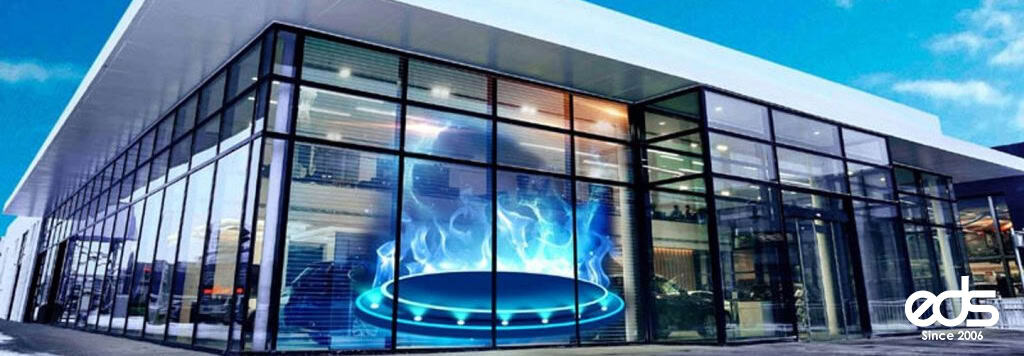
WHAT IS A TRANSPARENT LED SCREEN?
A transparent LED screen is a digital display designed to show visual content while allowing some light and background visibility to pass through its structure.
Unlike conventional LED displays, transparent LED screens use specially designed LED strips, modules or panels with open spaces between the display elements.
These spaces allow viewers to see through portions of the screen while the LEDs display digital content.
Transparent LED screens can display videos, animations, images, brand advertisements, product information, promotional offers and announcements.
When installed on or behind suitable glass surfaces, the technology can transform windows and facades into digital communication areas without completely obscuring the view behind them.
TRANSPARENT LED SCREEN RATES & COST IN DUBAI, UAE
The cost of a transparent LED screen in Dubai depends on screen dimensions, pixel pitch, transparency, brightness, LED technology, module construction, supporting structure and installation requirements.
Transparent LED screens are commonly priced according to display area, although some specialised systems may be quoted differently.
Estimated Transparent LED Screen Prices in Dubai
| Transparent LED Screen Type | Indicative Equipment Cost (AED/m²) | Typical Application |
|---|---|---|
| Standard Transparent LED P7.8–P10 | 3,500–5,500 | Large storefronts, commercial glass |
| Transparent LED P5–P7.8 | 4,000–6,500 | Retail windows, shopping malls |
| Transparent LED P3.9–P5 | 4,500–7,500 | Premium retail, showrooms |
| Fine-Pitch Transparent LED P2.5–P3.9 | 6,000–10,000+ | Close-viewing commercial applications |
| High-Brightness Transparent LED | 5,000–9,000+ | Bright storefronts, selected facades |
| Custom Architectural Transparent LED | Based on specification | Specialised glass installations |
Important: These are indicative equipment-only budgeting estimates, not verified current EDS quotations or fixed UAE market prices. Actual prices vary by product, supplier, project and specification. Installation, structural work, controllers, electrical connections, permits, maintenance and VAT may be additional.
Transparent LED Installation & Additional Costs
| Component | Indicative Cost (AED) |
|---|---|
| Basic Indoor Installation | 2,000–6,000+ |
| Large Storefront Installation | 5,000–15,000+ |
| Supporting Structure | Based on project requirements |
| LED Controller / Video Processor | 1,500–6,000+ |
| Electrical & Data Cabling | Based on installation |
| Glass Facade Integration | Based on technical requirements |
| Annual Maintenance | Based on screen size and service scope |
These figures are preliminary budgeting allowances, not fixed installation rates.
EXAMPLE: COST OF A 4M × 2.5M TRANSPARENT LED SCREEN
| Description | Estimated Cost |
|---|---|
| Screen Dimensions | 4m × 2.5m |
| Total Display Area | 10 m² |
| Pixel Pitch | P5–P7.8 |
| Indicative Equipment Rate | AED 4,000–6,500/m² |
| Estimated Equipment Cost | AED 40,000–65,000 |
| Installation & Supporting Structure | Additional |
| Controller & Accessories | Additional |
| Total Project Cost | Subject to final specification |
The final project cost should be established after confirming the glass dimensions, screen specification, installation method and technical requirements.
WHAT AFFECTS TRANSPARENT LED SCREEN PRICES?
The main factors include total display area, pixel pitch, transparency percentage, brightness, LED technology, module construction, installation environment, supporting structure, controller and maintenance requirements.
Installation complexity can materially influence the total cost, particularly when the screen must be integrated into an existing glass facade or architectural structure.
Businesses should compare complete technical specifications and installation scope rather than price per square metre alone.
HOW DOES A TRANSPARENT LED SCREEN WORK?
Transparent LED displays use LED strips or specially designed modules arranged to leave open spaces between the display elements.
The LEDs produce the visible digital image, while the open areas allow light and background visibility to pass through the screen.
A compatible controller distributes digital content across the display.
The perceived transparency depends on LED design, pixel pitch, module construction, viewing distance, content, brightness and installation conditions.
Transparency & Pixel Density
Transparent LED technology involves balancing two important characteristics: transparency and image quality.
Greater spacing between LED elements can improve physical openness and transparency.
Closer spacing can increase pixel density and improve image detail, but may reduce the openness of the display.
The correct balance depends on the installation environment and intended application.
Visibility Through the Screen
A transparent LED screen does not become completely invisible when content is not displayed.
The LED strips, modules and supporting components remain physically present.
The actual degree of visibility depends on the screen design, transparency specification, lighting conditions and viewing angle.
WHY CHOOSE TRANSPARENT LED SCREENS?
Transparent LED screens are useful where businesses want to combine digital advertising with visibility through glass or architectural surfaces.
Digital Advertising Without Completely Blocking Glass
Traditional large-format LED screens can obstruct visibility when installed across storefront windows.
Transparent LED technology allows promotional content to be displayed while maintaining a degree of visibility through the screen.
Architectural Integration
Transparent LED screens can be integrated into suitable glass storefronts, building interiors, commercial facades and architectural features.
Dynamic Promotional Content
Businesses can display product launches, seasonal campaigns, advertisements, animations and branded videos on the same screen.
Natural Light & Visibility
Depending on the transparency level and installation, the screen can allow some natural light and background visibility to remain.
Large Display Configurations
Transparent LED modules can be configured into larger display surfaces, subject to the selected technology, supporting structure and installation requirements.
Commercial & Retail Applications
Transparent LED displays are particularly relevant to retail stores, showrooms, shopping malls and commercial properties where glass visibility forms part of the customer experience.
WHERE CAN TRANSPARENT LED SCREENS BE USED IN DUBAI?
Transparent LED displays can be considered for different commercial and architectural environments.
| Location | Common Applications |
|---|---|
| Retail Stores | Window advertising, product promotions |
| Shopping Malls | Retail frontages, atriums, brand activations |
| Automotive Showrooms | Vehicle launches, model information |
| Real Estate Showrooms | Property presentations, project promotions |
| Hotels | Glass entrances, lobbies, event spaces |
| Corporate Offices | Reception areas, glass partitions |
| Commercial Buildings | Architectural glass displays |
| Exhibition Spaces | Brand presentations, product launches |
| Experience Centres | Digital content and interactive displays |
| Glass Facades | Large-format architectural advertising |
The appropriate screen and installation method depend on whether the display is primarily viewed from inside, outside or both.
TRANSPARENT LED SCREENS FOR RETAIL STORES
Retail storefronts are among the most practical applications for transparent LED technology.
Traditional digital displays positioned inside shop windows can block products, merchandise, interior design and visibility into the store.
A transparent LED screen can allow retailers to introduce digital advertising while retaining a degree of visibility through the storefront.
Common content includes new arrivals, seasonal campaigns, product launches, promotional offers, brand videos and event announcements.
For example, a fashion retailer can display promotional animations across a glass window while customers continue to see parts of the store interior.
The screen specification should reflect window dimensions, viewing distance, daylight exposure, store lighting and the visibility required through the glass.
TRANSPARENT LED SCREENS FOR GLASS STOREFRONTS
Large glass storefronts provide valuable visual space, but businesses may not want to permanently obscure them with conventional digital displays.
Transparent LED technology allows selected glass areas to become dynamic digital surfaces.
Depending on the installation, content can appear across the window while customers retain visibility through parts of the display.
This can be particularly useful for fashion, luxury retail, automotive, electronics, jewellery, beauty and lifestyle brands.
The objective should be to integrate digital advertising with the storefront rather than simply cover the maximum available glass area.
TRANSPARENT LED SCREENS FOR SHOPPING MALLS
Shopping malls can use transparent LED displays in suitable retail frontages, atriums, promotional areas and commercial glass structures.
Potential applications include retail advertising, brand activations, promotional campaigns, events and product launches.
Mall installations should consider pedestrian movement, viewing distance, screen height, ambient lighting, architectural requirements and property management approvals.
A transparent LED screen viewed across a large mall atrium may require a different specification from one installed directly behind a retail storefront.
For businesses interested in advertising placements rather than purchasing display equipment, EDS also provides shopping mall and outdoor advertising solutions in Dubai.
TRANSPARENT LED SCREENS FOR AUTOMOTIVE SHOWROOMS
Automotive showrooms often use large glass facades to provide visibility of vehicles from outside the property.
Installing conventional opaque digital displays across these windows can reduce that visibility.
Transparent LED technology offers an alternative by displaying vehicle launches, promotional offers, model information and brand campaigns while retaining a degree of visibility into the showroom.
Screen selection should consider glass dimensions, viewing distance, sunlight exposure, screen orientation and the required transparency.
TRANSPARENT LED SCREENS FOR REAL ESTATE SHOWROOMS
Real estate developers and property sales centres can use transparent LED screens to display project information, architectural visualisations, promotional videos and development highlights.
Transparent displays may be particularly suitable for sales galleries with extensive glass surfaces.
They can communicate digital content without completely separating the interior showroom from the surrounding environment.
TRANSPARENT LED SCREENS FOR HOTELS & HOSPITALITY
Hotels and hospitality environments can use transparent LED screens where digital communication needs to coexist with interior architecture.
Potential locations include glass entrances, lobby areas, restaurants, event spaces and architectural features.
Content can include event promotions, branded videos, guest information, restaurant campaigns and announcements.
The display should complement the architecture and guest experience rather than unnecessarily dominate the space.
TRANSPARENT LED SCREENS FOR CORPORATE OFFICES
Corporate environments can use transparent LED displays in reception areas, experience centres, glass partitions, corporate lobbies and product demonstration areas.
Possible content includes corporate videos, brand messages, presentations, announcements and product information.
For corporate installations, the physical finish of the display, supporting structure, cabling and integration with the interior design can be as important as the image specification.
TRANSPARENT LED SCREENS FOR GLASS BUILDING FACADES
Transparent LED technology can also be considered for selected larger glass facade applications.
These projects require careful technical evaluation because facade installations can involve large display areas, structural requirements, environmental exposure, brightness, power, maintenance access and regulatory approvals.
Not every glass facade is suitable for transparent LED technology.
The property, supporting structure, glass system, screen technology and intended use should be evaluated before equipment selection.
UNDERSTANDING TRANSPARENCY IN LED SCREENS
Transparency is one of the defining characteristics of this technology.
However, a quoted transparency percentage should not be evaluated independently of the screen’s image quality and installation conditions.
For example, a display with high physical openness may provide better visibility through the screen but lower pixel density.
A screen with closer LED spacing may provide more detailed images but reduce the visible openness.
Typical Transparent LED Screen Transparency Levels
| Transparency Level | General Characteristics |
|---|---|
| 40%–50% | Greater display density may be possible, with reduced openness |
| 50%–60% | Balance between image visibility and transparency |
| 60%–70% | Higher openness for selected retail and glass applications |
| 70%–80% | Greater background visibility, depending on display design |
| Above 80% | Specialised high-transparency systems, with application-specific limitations |
These ranges describe broad product categories, not guaranteed performance. Actual transparency varies by manufacturer, technology, pixel pitch and module construction.
HOW IS TRANSPARENCY MEASURED?
Manufacturers generally express transparency as a percentage indicating how much of the display area remains physically open or permits light transmission under a defined measurement method.
However, actual perceived transparency can differ from the published specification because of lighting conditions, content, supporting structures and viewing angle.
Businesses should evaluate the screen both while displaying content and while switched off.
TRANSPARENCY VS IMAGE QUALITY
Transparent LED displays involve a technical balance between openness and visual density.
The appropriate balance depends on the application.
For a close-viewing retail window, image detail may be particularly important.
For a large glass facade, transparency, viewing distance and overall visual impact may have greater importance.
For an automotive showroom, maintaining visibility of vehicles behind the screen may be a priority.
There is no single transparency specification that is ideal for every installation.
TRANSPARENT LED SCREEN PIXEL PITCH
Pixel pitch is the distance between neighbouring LED pixels, measured in millimetres.
As with other LED technologies, smaller pixel pitch generally provides greater pixel density.
However, with transparent LED screens, pixel pitch can also influence the physical openness of the display.
Transparent LED Screen Pixel Pitch Guide
| Pixel Pitch | Typical Application |
|---|---|
| P2.5–P3.9 | Close-viewing retail and selected premium installations |
| P3.9–P5 | Retail storefronts, showrooms |
| P5–P7.8 | Commercial windows, shopping malls |
| P7.8–P10 | Larger glass surfaces and commercial displays |
| P10–P16 | Large-format architectural installations viewed from greater distances |
These are illustrative product categories. Transparent LED systems may have different horizontal and vertical pixel pitches, such as P3.9 × 7.8, depending on the design.
The correct specification depends on viewing distance, screen size, transparency requirements, content and budget.
VIEWING DISTANCE FOR TRANSPARENT LED SCREENS
Viewing distance should be considered early in the project.
A transparent LED screen viewed from a few metres away requires different image detail from a large facade screen viewed from across a road or open space.
The relevant considerations include closest viewing distance, typical viewing distance, screen dimensions, content detail and required transparency.
For example, a retail storefront displaying detailed product information may require a finer pixel pitch than a large facade displaying bold brand animations.
TRANSPARENT LED SCREEN BRIGHTNESS
Brightness requirements depend heavily on the installation environment.
A transparent LED display installed inside a shopping mall may require a different specification from a screen positioned behind glass and facing strong daylight.
Important factors include direct sunlight, window orientation, ambient light, interior lighting, viewing direction and operating hours.
Indicative Brightness Considerations
| Installation Environment | General Brightness Consideration |
|---|---|
| Controlled Indoor Environment | Moderate brightness may be sufficient |
| Indoor Shopping Mall | Brightness depends on surrounding lighting |
| Behind Glass Facing Outdoors | Higher brightness may be needed during daylight |
| Bright Commercial Storefront | Strong ambient-light performance may be required |
| External Architectural Installation | Outdoor-rated brightness and protection required |
The final brightness specification should be based on actual site conditions rather than simply selecting the highest available rating.
DAYLIGHT & GLASS CONSIDERATIONS
Transparent LED screens installed near exterior glass can be affected by changing daylight conditions.
A display that appears bright indoors at night may look significantly different when viewed through glass during strong daylight.
Planning should consider screen orientation, sunlight, glass tint, reflections, interior lighting, exterior lighting and viewing direction.
Tinted or reflective glass can influence how digital content appears from outside the property.
For this reason, transparent LED performance should ideally be evaluated according to the actual installation environment.
TRANSPARENT LED SCREEN SIZE & DIMENSIONS
Transparent LED screens can be configured in different dimensions depending on the selected system.
The appropriate size depends on available glass area, viewing distance, architecture, content, intended purpose and installation method.
Covering the entire available glass surface is not always necessary.
In some environments, using only a selected section of the glass can provide a better balance between digital content and architectural transparency.
TRANSPARENT LED SCREEN INSTALLATION METHODS
Transparent LED screens can be installed using different configurations depending on the selected product and property.
Behind-Glass Installation
The screen is installed inside the property behind an existing glass storefront or facade.
This may allow the equipment to remain within a controlled interior environment while content is visible from outside.
Glass-Integrated Installation
Selected transparent LED systems can be incorporated into suitable architectural glass applications.
These projects require specialised design and compatibility assessment.
Suspended Installation
Some systems can be suspended from suitable supporting structures, subject to structural design and manufacturer requirements.
Supporting-Frame Installation
Transparent LED modules can be installed using engineered supporting frames where the building and screen configuration permit.
The installation should account for screen weight, structural support, glass area, electrical power, cabling, ventilation and maintenance access.
INSTALLING TRANSPARENT LED SCREENS BEHIND GLASS
One common application is installing the LED screen inside a property behind an existing glass storefront or facade.
This approach can provide several practical advantages depending on the project.
The screen itself may remain within the interior environment while promotional content is visible through the glass.
However, the glass can influence brightness, reflections, colour appearance and visibility.
The glass type and lighting environment should therefore be considered during planning.
TRANSPARENT LED SCREEN VS CONVENTIONAL LED SCREEN
Transparent and conventional LED displays serve different purposes.
| Factor | Transparent LED Screen | Conventional LED Screen |
|---|---|---|
| Visibility Through Screen | Yes, to varying degrees | Generally no |
| Glass Integration | Particularly suitable | Can obstruct glass |
| Pixel Density | Depends on transparent LED design | Wide range available |
| Architectural Openness | Major advantage | Solid display surface |
| Background Visibility | Maintained to a degree | Generally blocked |
| Typical Applications | Glass storefronts, showrooms, facades | General indoor and outdoor displays |
A conventional LED screen may be more appropriate when maximum image density and visual detail are more important than visibility through the display.
Transparent LED is particularly valuable when the physical environment behind the screen remains part of the visual experience.
TRANSPARENT LED SCREEN VS LED MESH DISPLAY
Transparent LED and LED mesh technologies can both provide a degree of openness, but they can serve different applications.
Transparent LED screens are commonly considered for glass storefronts, showrooms, retail interiors and architectural glass installations.
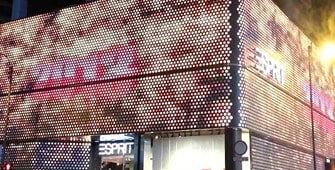
LED mesh displays may be particularly useful for large facades, architectural exteriors and large-format installations where weight, airflow and structural considerations are important.
| Factor | Transparent LED Screen | LED Mesh Display |
|---|---|---|
| Typical Application | Glass storefronts, retail, showrooms | Large facades, architectural exteriors |
| Transparency | Depends on module design | Open mesh construction |
| Pixel Pitch | Fine to medium options | Often larger pitches |
| Viewing Distance | Close to long distance | Commonly medium to long distance |
| Installation | Glass-associated and architectural | Facade and structural installations |
The appropriate technology depends on display size, supporting structure, viewing distance, transparency and environmental conditions.
TRANSPARENT LED SCREEN CONTENT MANAGEMENT
Transparent LED screens can display advertisements, promotional videos, brand animations, product information and announcements.
Depending on the controller and software, businesses may be able to schedule campaigns, update content remotely and manage multiple screens.
Content should be designed with the transparent display characteristics in mind.
High-contrast visuals, clear messages and suitable typography may be more effective than complex artwork containing excessive detail.
For businesses requiring branded videos and digital advertising content, EDS also provides video production and photography services.
TRANSPARENT LED SCREEN INSTALLATION & MAINTENANCE
Transparent LED installations should be planned according to the screen technology, property and operating environment.
A typical project may involve site inspection, screen specification, supporting structure, electrical planning, installation, controller configuration, calibration and testing.
Maintenance may include module inspections, controller checks, power supply checks, cleaning, calibration and replacement of defective components.
For facade installations, maintenance access and environmental protection are particularly important.
TRANSPARENT LED SCREEN PERMITS, APPROVALS & REGULATIONS IN UAE
Transparent LED screen installations in Dubai and the UAE must comply with applicable property, building, electrical, structural, fire safety and advertising requirements.
The approval process depends on the installation location, screen dimensions, structural arrangement and intended use.
For shopping malls and commercial properties, permission may be required from the property owner, mall management or building operator.
For glass facades and external advertising installations, additional approvals may be required from the relevant authorities.
Large installations should also consider structural loading, wind exposure, electrical safety, maintenance access and the compatibility of the existing glass system.
A transparent LED screen should not be installed on or behind architectural glass without confirming the suitability of the property and installation method.
Partner with Us
At EDS, we are committed to pushing the boundaries of visual display technology with our innovative transparent LED screens in Dubai, UAE. Whether you’re looking to enhance retail environments, integrate technology into architecture, or elevate event experiences, our transparent LED solutions offer unparalleled versatility and impact. Contact us today to explore how our transparent LED screens can transform your space and captivate your audience with cutting-edge visual displays.
TRANSPARENT LED SCREENS IN DUBAI & UAE – FAQ
What is a transparent LED screen?
A transparent LED screen is a digital display that uses specially designed LED modules or strips with open spaces between the display elements. It can display videos, advertisements, animations and information while maintaining a degree of visibility through the screen. Transparent LED displays are commonly used for retail storefronts, shopping malls, showrooms and glass facades.
How much does a transparent LED screen cost in Dubai?
Indicative equipment-only prices may range from AED 3,500–5,500 per square metre for standard transparent LED displays to AED 6,000–10,000 or more per square metre for fine-pitch systems. Actual prices depend on screen dimensions, pixel pitch, transparency, brightness and installation requirements. These figures are budgeting estimates rather than fixed quotations.
How transparent are transparent LED screens?
Transparency varies according to the technology, pixel pitch and module construction. Some systems offer approximately 40%–80% transparency, while specialised products may offer higher levels. Actual perceived transparency depends on lighting, viewing angle, displayed content and installation conditions.
Can transparent LED screens be installed on glass windows?
Yes. Transparent LED screens can be installed behind suitable glass windows or integrated into selected architectural glass applications. The installation method depends on the screen technology, glass structure, supporting system and property requirements. Structural suitability and maintenance access should be evaluated before installation.
Are transparent LED screens suitable for retail stores?
Yes. Transparent LED screens are particularly suitable for retail storefronts where businesses want to display digital promotions while maintaining visibility into the store. They can be used for product launches, seasonal campaigns, advertisements, promotional offers and brand videos.
Can transparent LED screens be viewed in daylight?
Yes, provided the display has suitable brightness for the installation environment. Daylight visibility depends on screen brightness, glass tint, sunlight exposure, reflections, viewing direction and content design. Screens positioned behind exterior glass may require different specifications from those installed inside shopping malls.
What is the difference between transparent LED and conventional LED screens?
Transparent LED screens allow a degree of visibility through the display, while conventional LED screens generally create an opaque viewing surface. Transparent displays are often suitable for glass storefronts and architectural applications, while conventional LED screens offer different pixel density, brightness and installation options.
What pixel pitch is best for a transparent LED screen?
The appropriate pixel pitch depends on viewing distance, screen dimensions, transparency requirements and content. Finer pixel pitches may be suitable for closer viewing, while larger pixel pitches can be appropriate for larger displays viewed from farther away. Pixel pitch should be selected alongside the required transparency and image quality.
Can transparent LED screens be installed on building facades?
Yes. Transparent LED technology can be considered for suitable building facades. However, facade installations require structural assessment, environmental considerations, electrical planning, maintenance access and applicable property or regulatory approvals. Not every glass facade is suitable for transparent LED installation.
What is the difference between transparent LED and LED mesh screens?
Transparent LED screens are commonly used for glass storefronts, showrooms and architectural interiors. LED mesh displays are often considered for larger facade installations where openness, weight and airflow are important. The correct technology depends on screen dimensions, supporting structure, viewing distance and environmental conditions.
Do transparent LED screens require maintenance?
Yes. Maintenance may include LED module inspections, controller checks, power supply checks, cleaning, calibration and component replacement. Requirements depend on the screen technology, operating hours and installation environment. For large glass facade installations, maintenance access should be considered during technical planning.
Does EDS supply and install transparent LED screens in Dubai and UAE?
Yes. Established in Dubai in 2006, EDS provides transparent LED display solutions for businesses across Dubai, Abu Dhabi, Sharjah and other UAE emirates. Depending on the project scope, services can include screen selection, technical planning, equipment supply, installation, configuration and maintenance support.