
DIGITAL MARKETING


LED Poster LED Displays in Dubai, UAE
Looking for LED poster display screens in Dubai? EDS provides digital LED poster solutions for retail stores, shopping malls, hotels, restaurants, corporate offices, showrooms, exhibitions and commercial environments across Dubai, Abu Dhabi, Sharjah and the UAE.
LED poster screens combine the familiar vertical format of a traditional advertising poster with digital LED technology, allowing businesses to display promotional videos, animations, product information, advertisements and branded content on a compact digital screen.
Unlike conventional printed posters, digital LED posters can display multiple messages, update promotions and support scheduled content without requiring a new printed advertisement each time.
Available in different screen sizes, pixel pitches, resolutions and brightness specifications, LED poster displays can be selected according to viewing distance, available floor space, installation environment and content requirements.
Established in Dubai in 2006, EDS provides LED display screen solutions in Dubai, including LED poster screens, indoor LED displays, LED video walls and other commercial digital display technologies.
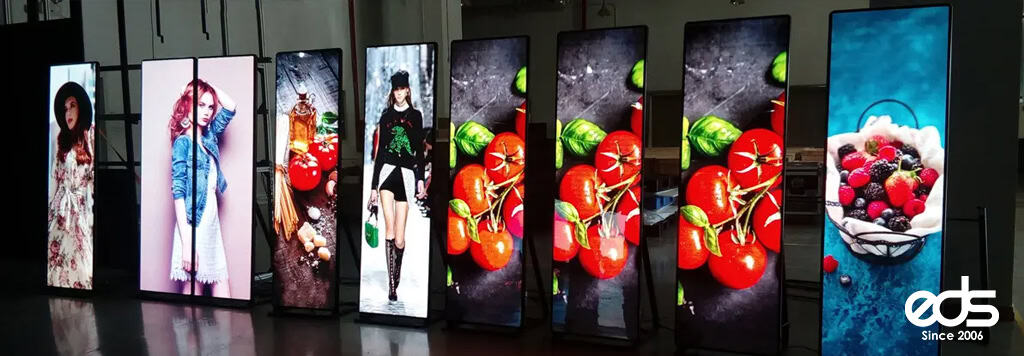
WHAT IS AN LED POSTER DISPLAY SCREEN?
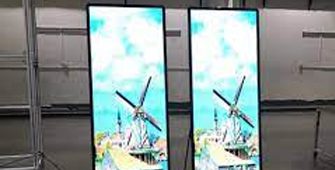
An LED poster display screen is a compact digital display, typically designed in a vertical or portrait format, that uses light-emitting diodes to display videos, images, animations, advertisements and information. Many LED poster displays are freestanding, while selected models support wall mounting.
Typical content includes promotional offers, product demonstrations, branded videos, digital menus, event schedules, corporate announcements, QR codes and visitor information. Content can be managed through a compatible LED controller, media player or content management system.
LED POSTER DISPLAY SCREEN RATES & COST IN DUBAI, UAE
LED poster screen prices vary according to dimensions, pixel pitch, native resolution, brightness, cabinet design, controller and quantity. LED posters are commonly sold as complete units rather than priced only per square metre.
Estimated LED Poster Screen Prices in Dubai
| LED Poster Type | Indicative Price per Unit (AED) | Typical Application |
| Standard Indoor P3–P4 | 4,000–7,000 | General retail promotions |
| Indoor P2.5–P3 | 5,000–9,000 | Retail stores and showrooms |
| High-Resolution P2–P2.5 | 7,000–12,000 | Premium retail and hospitality |
| Fine-Pitch P1.5–P1.8 | 10,000–18,000+ | Corporate and premium commercial |
| Custom Configuration | Based on specification | Custom installations |
| Multi-Poster System | Based on screen count | Coordinated displays |
IMPORTANT: Indicative budgeting estimates only, not verified current EDS quotations or fixed UAE supplier rates. Representative standalone indoor units are assumed. Actual dimensions, specifications and prices vary. Delivery, installation, software, maintenance and VAT may be additional.
LED Poster Installation & Additional Costs
| Component | Indicative Cost (AED) |
| Basic LED Poster Setup | 300–1,000+ |
| Wall-Mounting Installation | 500–1,500+ |
| Controller / Media Player | 500–2,500+ |
| Content Management Software | Based on licensing |
| Network & Connectivity | Based on requirements |
| Multi-Screen Synchronisation | Based on system |
| Annual Maintenance | Based on scope |
Example: Cost of Three LED Poster Screens for a Retail Store
| Description | Estimated Cost |
| Number of Screens | 3 |
| Specification | Indoor P2.5–P3 |
| Indicative Unit Price | AED 5,000–9,000 |
| Estimated Equipment Cost | AED 15,000–27,000 |
| Setup & Configuration | Additional |
| Content Management | Depends on system |
| Total Project Cost | Subject to final specification |
What Affects LED Poster Screen Prices?
Cost factors include screen size, pixel pitch, resolution, brightness, cabinet construction, LED technology, controller, software, quantity and installation. Compare the complete technical specification and functionality, not only unit price.
WHY CHOOSE AN LED POSTER SCREEN?
Dynamic Alternative to Printed Posters
A digital LED poster can rotate campaigns, videos and offers without physically replacing printed artwork.
Compact Portrait Display
The vertical footprint suits store entrances, reception areas, showrooms and exhibition stands where a large screen is impractical.
Flexible Content Updates
Businesses can update artwork and promotional messages using the supported content management system.
Video & Animation Support
LED posters can display motion graphics, product demonstrations and branded video content.
Freestanding Installation Options
Selected products are designed for freestanding placement, subject to stability and safety requirements.
Multiple-Screen Applications
Several screens can present separate or coordinated campaigns where the hardware and software support it.
WHERE ARE LED POSTER SCREENS USED IN DUBAI?
| Location | Common LED Poster Applications |
| Retail Stores | Product launches, promotions, seasonal campaigns |
| Shopping Malls | Brand advertisements, offers, events |
| Automotive Showrooms | Vehicle features and promotions |
| Real Estate Showrooms | Property information and launches |
| Hotels & Resorts | Guest information, events, promotions |
| Restaurants & Cafés | Menus, offers, product videos |
| Corporate Offices | Welcome messages and announcements |
| Exhibitions & Conferences | Product demonstrations, schedules and sponsor content |
LED Poster Displays for Retail Stores
Retail stores can position digital posters near entrances, promotional zones, product displays and checkout counters. Content may include new arrivals, seasonal offers, product videos and loyalty promotions.
LED Poster Displays for Shopping Malls
LED posters can communicate promotions, advertising, events and visitor information. Placement should consider pedestrian flow, viewing distance, ambient lighting and property requirements.
LED Poster Displays for Showrooms
Automotive, property, furniture and electronics showrooms can display product features, specifications, launches and promotional videos alongside physical products.
LED Poster Displays for Hotels & Hospitality
Hotels can use portrait LED displays for welcome messages, event schedules, guest information, restaurant promotions and branded content.
LED Poster Displays for Restaurants & Cafés
Restaurants can use digital posters for menu highlights, offers, seasonal products and short promotional videos. Readability is important when detailed menu information is shown.
LED Poster Displays for Corporate Offices
Corporate offices can use LED posters in reception areas for visitor messages, internal communications, events and company branding.
LED Poster Displays for Exhibitions & Events
LED posters can support exhibition stands, conferences, product launches and promotional activations with product videos, schedules, sponsor information and directional messages.
For temporary exhibitions and events, compare purchasing a display with LED screen rental in Dubai.
LED POSTER SCREEN SIZES & DIMENSIONS
LED poster displays commonly use portrait-oriented configurations, but physical dimensions vary by manufacturer and model. The correct size depends on available floor space, audience movement, viewing distance, content and installation requirements.
What Size LED Poster Should You Choose?
A compact poster may suit a store entrance or reception area, while a larger display may suit a showroom or exhibition. Confirm the available width and height, nearest viewing position, content format, supporting structure and power requirements.
LED POSTER SCREEN PIXEL PITCH
Pixel pitch is the distance between the centres of neighbouring LED pixels, measured in millimetres. Smaller pixel pitches generally provide greater pixel density and can improve close-viewing image detail.
| Pixel Pitch | Typical Application | Viewing Consideration |
| P1.5–P1.8 | Premium retail, corporate | Close viewing and detailed content |
| P1.8–P2 | Retail and reception | Close-to-medium viewing |
| P2–P2.5 | Showrooms and commercial interiors | General indoor promotion |
| P2.5–P3 | Larger commercial spaces | Medium viewing distance |
| P3–P4 | Selected larger displays | Longer indoor viewing distance |
These are general planning guidelines; available specifications depend on the manufacturer and model.
How Do I Choose the Right Pixel Pitch?
Consider the closest viewing distance, typical viewing distance, screen dimensions, content detail and required resolution. Small product text may need finer pixel pitch than large promotional imagery.
LED POSTER SCREEN RESOLUTION
Native resolution depends on physical dimensions and pixel pitch. It matters when displaying prices, QR codes, logos, product specifications and fine text. Artwork should be prepared for the actual native resolution and aspect ratio rather than stretched from landscape creative.
LED POSTER SCREEN BRIGHTNESS
The appropriate brightness depends on ambient light, nearby windows, viewing distance, screen position and operating hours. Excessive brightness is not automatically better, particularly for close-viewing displays. Window-facing installations require special attention to daylight exposure.
FREESTANDING LED POSTER DISPLAYS
Freestanding LED posters can suit retail stores, showrooms, hotels, exhibitions and corporate environments. They must be positioned securely in accordance with manufacturer requirements, with attention to stability, cabling and pedestrian movement.
CAN LED POSTER SCREENS BE WALL-MOUNTED?
Some models support wall mounting. Suitability depends on the product, screen weight, wall construction, mounting system and maintenance access.
For permanent wall installations, a dedicated indoor LED display screen may be more appropriate.
SINGLE LED POSTER VS MULTIPLE LED POSTER SCREENS
Multiple displays can communicate different messages across a business location or show coordinated creative, where supported by the selected equipment.
| Screen Location | Suggested Content |
| Store Entrance | Main promotional campaign |
| Product Area | Product features and demonstrations |
| Checkout | Loyalty offers and seasonal promotions |
| Reception | Welcome messages and information |
| Exhibition Stand | Product videos and event details |
CAN MULTIPLE LED POSTERS DISPLAY SYNCHRONISED CONTENT?
Some LED poster systems support coordinated or synchronised content across multiple screens. Capabilities depend on the hardware, controller, connectivity and content management system. Confirm compatibility before procurement.
WHAT CONTENT CAN BE DISPLAYED ON AN LED POSTER?
Depending on the controller and supported formats, LED posters can show videos, animations, images, advertisements, product information, menus, announcements, schedules and branded content.
For original promotional creative, EDS also offers video production and photography services.
DESIGNING CONTENT FOR LED POSTER DISPLAYS
Use Vertical Creative
Design for portrait orientation rather than compressing landscape videos.
Keep the Main Message Clear
Make the primary promotion understandable at a glance.
Use Readable Typography
Size text according to viewing distance.
Maintain a Clear Visual Hierarchy
Use a main message, supporting information and clear call to action.
Avoid Excessive Information
Treat the screen as signage rather than a full brochure.
Create Content at Native Resolution
Prepare creative for the display’s actual resolution and aspect ratio.
USING QR CODES ON LED POSTER SCREENS
QR codes can connect customers to product pages, websites, menus, registration pages or WhatsApp. Use adequate size, contrast and spacing; ensure the display is close enough for scanning; and test the code on the installed screen.
LED POSTER CONTENT MANAGEMENT SYSTEMS
Content may be managed through a compatible media player, controller, local network or remote content management platform. Features can include uploads, playlists, scheduled campaigns, time-based messages and remote updates. Multi-screen installations may benefit from centralised management.
LED POSTER VS PRINTED ADVERTISING POSTER
| Factor | LED Poster | Printed Poster |
| Content | Digital and dynamic | Static |
| Video & Animation | Supported | Not supported |
| Content Changes | Digital updates | New print required |
| Multiple Messages | Can rotate content | Usually one creative |
| Initial Investment | Generally higher | Generally lower |
| Power Requirement | Yes | No |
| Best Use | Frequently changing campaigns | Simple static campaigns |
Printed posters remain appropriate for simple, infrequently changing messages; LED posters can be useful for dynamic promotions and videos.
LED POSTER VS LCD DIGITAL SIGNAGE
| Factor | LED Poster | LCD Digital Signage |
| Technology | Direct-view LED | LCD panel |
| Pixel Density | Depends on pixel pitch | Depends on LCD resolution |
| Dimensions | Depends on modular design | Typically fixed panel sizes |
| Close-Viewing Detail | Depends on specification | Often high pixel density |
| Brightness | Model dependent | Model dependent |
| Application | Retail, exhibitions, commercial | Retail, menus, corporate |
Neither technology is universally superior. Compare the actual resolution, viewing distance, brightness, size and budget.
LED POSTER VS LARGE-FORMAT LED SCREEN
An LED poster is suited to compact portrait-format communication and close-to-medium viewing. A large-format LED screen may be more appropriate when the audience is larger, viewing distances are greater or the display is an architectural feature.
For larger installations, see LED video walls in Dubai.
LED POSTER SCREEN INSTALLATION & SETUP
Setup may include positioning, power connection, controller configuration, network connection, content upload and testing. Multiple screens can require additional connectivity, synchronisation and remote management planning.
LED POSTER SCREEN MAINTENANCE
Maintenance can include visual inspections, module and power-supply checks, controller inspections, cable checks, cleaning and software support. Service requirements depend on usage, operating conditions and the manufacturer’s guidance.
LED POSTER SCREEN RULES, APPROVALS & SAFETY IN UAE
LED poster installations in Dubai and the UAE must comply with applicable property, electrical, fire safety and advertising requirements. Indoor displays may need property owner, mall management or venue approval. Screens must not obstruct entrances, emergency exits, corridors or pedestrian movement. Electrical cabling and supporting structures must be safe. Public-facing advertising may require further permissions. Confirm the applicable requirements for the actual location and intended use.
Partner with Us
At EDS, we are dedicated to providing advanced LED poster screens in Dubai, UAE. Whether you’re enhancing retail displays, creating interactive exhibits, or improving event experiences, our LED poster screen solutions offer unparalleled versatility and visual impact. Contact us today to discover how our LED poster screens can transform your space and elevate your brand’s visual communication strategy with cutting-edge technology.
LED POSTER DISPLAY SCREENS IN DUBAI & UAE – FAQ
What is an LED poster display screen?
An LED poster display screen is a compact digital display, usually designed in portrait orientation, that uses LED technology to show advertisements, videos, images, animations and information. It is commonly used in retail stores, shopping malls, hotels, showrooms and exhibitions.
How much does an LED poster screen cost in Dubai?
Indicative planning estimates for representative indoor LED poster units may range from AED 4,000–7,000 for standard P3–P4 displays to AED 10,000–18,000 or more for fine-pitch models. Actual prices depend on screen dimensions, pixel pitch, resolution, controller and installation requirements. These figures are budgeting estimates rather than fixed quotations.
What is the difference between an LED poster and an LCD digital poster?
An LED poster uses direct-view LED technology, while an LCD digital poster uses an LCD panel. The appropriate option depends on screen dimensions, pixel density, brightness, viewing distance and budget. Both technologies can be used for portrait-format commercial communication.
Can LED poster screens display videos and animations?
Yes. LED poster screens can display videos, animations, images, advertisements, product information and other compatible digital content. Supported formats and playback capabilities depend on the controller and content management system.
Are LED poster screens suitable for retail stores?
Yes. LED posters are suitable for retail promotions, product launches, seasonal offers, brand campaigns and product demonstrations. Their portrait format can make them practical for entrances, promotional zones and selected in-store locations.
Can LED poster screens be used in shopping malls?
Yes. LED poster screens can be used in suitable shopping mall environments for promotions, advertising, events and information. Placement may require approval from mall management and should consider pedestrian movement, electrical safety and accessibility.
Can LED poster displays be wall-mounted?
Some LED poster models support wall mounting, while others are designed primarily for freestanding use. The appropriate installation depends on the selected product, wall construction, screen weight, supporting structure and maintenance requirements.
Can multiple LED posters display synchronised content?
Yes. Some LED poster systems support synchronised or coordinated content across multiple screens. Compatibility depends on the hardware, controller, connectivity and content management system. Depending on the configuration, displays may operate independently or present coordinated visual content.
What pixel pitch is best for an LED poster screen?
The appropriate pixel pitch depends on viewing distance and content. Fine-pitch displays may be suitable for close-viewing applications involving detailed graphics or text, while larger pixel pitches may be sufficient for promotional content viewed from farther away. Screen dimensions and budget should also be considered.
Can LED poster content be updated remotely?
Some LED poster systems support remote content updates through compatible software and network connectivity. Available features depend on the controller and content management platform. Remote management may allow businesses to update promotions, schedule content and manage multiple screens.
Do LED poster screens require maintenance?
Yes. Maintenance may include cleaning, LED module inspections, controller checks, power supply checks, cable inspections and software support. Requirements depend on the screen model, operating hours and installation environment. Preventive maintenance can help maintain display performance.
Does EDS supply LED poster display screens in Dubai and UAE?
Yes. Established in Dubai in 2006, EDS provides LED poster display solutions for businesses across Dubai, Abu Dhabi, Sharjah and other UAE emirates. Depending on the project scope, services can include screen selection, supply, setup, configuration, content management requirements and technical support.