
DIGITAL MARKETING


Street Advertising in Dubai, UAE
Street advertising in Dubai gives brands visibility within the city’s everyday urban environment, reaching motorists, pedestrians, commuters, residents, shoppers and visitors as they move through major roads, commercial districts, residential communities and transport environments.
EDS provides access to street-level Out-of-Home (OOH) and Digital Out-of-Home (DOOH) advertising opportunities across Dubai, including MUPIs, citylights, lamppost banners, bus shelters, digital screens, street furniture, billboards, hoardings and other approved advertising formats.
Established in Dubai in 2006, EDS works as an advertising and media-buying agency, coordinating with relevant media owners and operators to evaluate suitable locations, formats and available inventory according to the target audience, campaign objective, dates and budget.
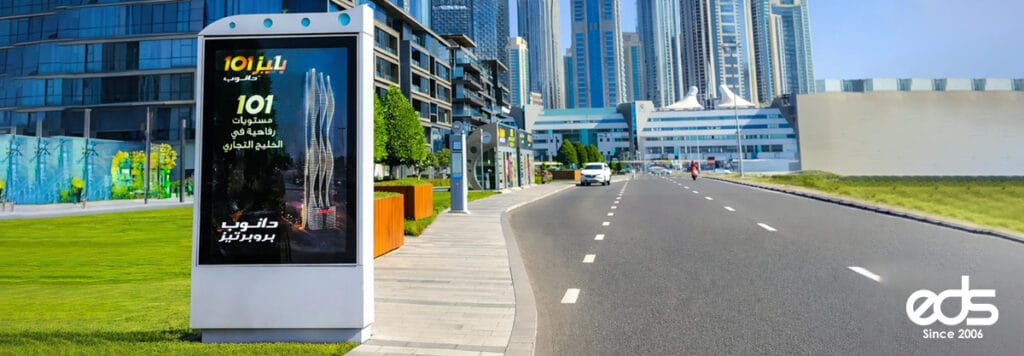
WHAT IS STREET ADVERTISING IN DUBAI?
Street advertising refers to advertising displayed within Dubai’s roads, streets, pedestrian environments, transport areas and other publicly visible urban locations.
Unlike advertising contained entirely within malls, offices or other indoor environments, street advertising reaches audiences while they are moving through the city.
Depending on the location and available inventory, street advertising can include:
MUPIs & Citylights • Lamppost Banners • Bus Shelters • Digital Street Screens • Street Furniture • Billboards • Hoardings • Unipoles • Bridge Advertising
Different formats create different viewing conditions. A MUPI may be encountered by a pedestrian at close range, while a billboard or unipole may need to communicate its message to motorists from considerably greater distances.
The appropriate format should therefore be selected according to audience, location, viewing environment and campaign objective.
STREET ADVERTISING COSTS IN DUBAI
Street advertising prices vary considerably because the category includes everything from individual street-level panels to large-format roadside structures.
The following ranges can be used for initial campaign planning:
| Format | Indicative Advertising Cost | Pricing Basis |
|---|---|---|
| MUPI / Citylight | Site Specific | Per unit / network |
| Community Lamppost Campaign | AED 18,000–33,500 | 10 banners / month |
| Main Road Lamppost Campaign | AED 50,000–90,000 | 10 banners / month |
| Premium Highway Lamppost Campaign | AED 80,000–150,000+ | 10 banners / month |
| Standard Bus Shelter Panel | AED 3,000–8,000 | Per shelter |
| Premium Bus Shelter | AED 8,000–15,000 | Per shelter |
| Backlit Bus Shelter | AED 10,000–20,000 | Per shelter |
| Digital Bus Shelter | AED 15,000–40,000+ | Per shelter |
| Community Billboard | AED 8,000–20,000 | Per month |
| Standard Static Billboard | AED 60,000–90,000 | Per month |
| Digital / DOOH | AED 30,000–200,000+ | Per month |
| Large-Format Hoarding | AED 60,000–180,000+ | Per month |
| Unipole | AED 50,000–150,000+ | Per month |
These figures are indicative planning ranges rather than universal media-owner rates.
Actual campaign costs depend on the exact site, dimensions, number of advertising units, booking period, current inventory and commercial terms. Production, installation and applicable approval-related charges can also affect the total campaign budget.
STREET ADVERTISING FORMATS IN DUBAI
Dubai provides a wide range of street-level advertising environments. Availability varies according to the road, district, media owner, campaign dates and applicable approvals.
MUPI & Citylight Advertising
MUPIs and citylights are street-level advertising displays generally positioned where advertisements can be viewed from closer distances than conventional roadside billboards.
Depending on available inventory, these formats may be static, illuminated or digital.
They can be relevant for:
Retail • Restaurants • Entertainment • Events • Property • Telecommunications • Healthcare • Consumer Services
The value of a MUPI campaign depends heavily on the location and surrounding audience rather than simply the physical dimensions of the advertising panel.
Lamppost Advertising
Lamppost advertising uses multiple banners or approved advertising panels positioned along selected roads and community routes.
Rather than relying on one large advertising face, a lamppost campaign creates repeated brand presence as audiences move through a particular road or district.
Lamppost campaigns can be considered for:
Events • Property Launches • Retail Promotions • Education • Hospitality • Restaurants • Community Campaigns • Brand Awareness
Campaign planning should consider the number of poles, advertising faces, direction of travel and road environment.
Bus Shelter Advertising
Bus shelters provide street-level advertising opportunities within selected public transport environments.
Depending on current inventory, formats can include:
Standard Poster Panels • Premium Shelter Displays • Backlit Panels • Digital Screens
Bus shelter advertising can be encountered by waiting passengers, pedestrians and passing road users, creating a different viewing environment from conventional roadside billboards.
Digital Street Advertising & DOOH
Digital Out-of-Home advertising uses electronic screens capable of displaying changing advertising creative.
Depending on the media network, DOOH can support:
Multiple Creatives • Scheduled Messages • Motion Content • Campaign Updates • Creative Rotation
When evaluating a digital screen, advertisers should consider:
Screen Location • Viewing Direction • Viewing Distance • Spot Duration • Advertising Loop • Share of Voice • Operating Schedule
A large screen is not automatically the most suitable digital advertising option. The quality of the location and the advertiser’s share of the advertising rotation are also important.
Street Billboard Advertising
Billboards provide larger-format advertising visibility along selected roads and urban locations.
Formats can range from community billboards to large roadside and digital displays.
Billboards can be relevant for:
Real Estate • Automotive • Banking • Telecommunications • Retail • Events • Hospitality • Corporate Campaigns
Roadside billboard creative should normally communicate one principal message that can be understood quickly.
Hoarding Advertising
Hoardings provide advertising surfaces around construction sites, development boundaries and other approved locations.
They can be particularly relevant for real estate and property campaigns because advertising may be positioned at or close to the development being promoted.
Hoardings can also be used for retail openings, events, automotive and general brand campaigns where suitable inventory is available.
Unipole Advertising
Unipoles are elevated large-format advertising structures typically positioned for visibility from road traffic.
Their height and advertising dimensions can provide strong roadside presence, but individual locations should be evaluated according to viewing distance, direction of travel, surrounding environment and audience relevance.
Street Furniture Advertising
Street furniture advertising integrates commercial messages into selected elements of the urban environment.
Depending on authorised inventory, this can include street-level panels, information structures, kiosks and other approved urban advertising assets.
These formats can provide closer-range visibility and can be particularly relevant where pedestrian or neighbourhood audiences are important.
POPULAR AREAS FOR STREET ADVERTISING IN DUBAI
The most appropriate street advertising location depends on the audience a campaign needs to reach.
A premium location is not automatically the most relevant location for every advertiser.
Sheikh Zayed Road
Sheikh Zayed Road is one of Dubai’s principal commercial and transport corridors.
Available OOH environments can include large-format billboards, digital screens, unipoles, bridge media and other approved roadside formats.
Campaigns should be planned according to the precise advertising face and direction of travel rather than treating the entire road as one advertising location.
Al Khail Road
Al Khail Road connects multiple residential, commercial and development areas across Dubai.
Selected roadside locations can be relevant for property, automotive, retail, corporate and broader brand-awareness campaigns.
Hessa Road
Hessa Road connects several residential and commercial communities and provides selected roadside advertising opportunities.
Depending on current inventory, formats can include billboards, digital screens, unipoles, lamppost advertising and other OOH media.
Downtown Dubai
Downtown Dubai combines road traffic with significant pedestrian, retail, hospitality, residential and visitor activity.
Advertising opportunities should be evaluated according to the individual media or property location rather than assuming the same audience profile across the entire district.
Dubai Marina
Dubai Marina combines high-rise residential communities, hotels, restaurants, retail, leisure and waterfront environments.
Depending on inventory, advertisers can evaluate street-level media, digital screens, lampposts and other OOH opportunities serving the wider Marina environment.
Jumeirah Lake Towers
JLT combines residential towers, offices, restaurants, retail and pedestrian areas.
Street-level advertising can be relevant for campaigns targeting residents, employees, business visitors and local consumer audiences.
Deira
Deira is an established commercial and residential area with shopping districts, hotels, traditional trading environments and extensive transport connections.
Advertising locations should be selected according to the specific audience and commercial area being targeted.
Bur Dubai & Karama
Bur Dubai and Karama combine residential communities, shopping streets, restaurants, offices and public transport environments.
Street advertising can be useful for brands seeking geographically focused visibility within established central Dubai communities.
Dubai Silicon Oasis
Dubai Silicon Oasis combines residential, commercial, education and retail environments.
Depending on available inventory, street advertising opportunities can include lampposts, MUPIs, digital screens and other community-oriented media.
CHOOSING THE RIGHT STREET ADVERTISING FORMAT
Different street advertising formats serve different campaign requirements.
| Campaign Requirement | Formats to Consider |
|---|---|
| Local street-level visibility | MUPIs, citylights and street furniture |
| Repeated visibility along a road | Lamppost advertising |
| Passenger and pedestrian environments | Bus shelter advertising |
| Flexible creative messaging | Digital DOOH screens |
| Major roadside visibility | Billboards and unipoles |
| Property and development promotion | Hoardings and billboards |
| Major road corridors | Billboards, unipoles and bridge media |
| Community-focused campaigns | Lampposts, MUPIs and local billboards |
| Multiple locations | Street-media networks and multi-format campaigns |
The appropriate format should be selected according to where the audience is likely to encounter the advertising, rather than simply choosing the largest available display.
STREET-LEVEL MEDIA VS LARGE-FORMAT ROADSIDE ADVERTISING
Street advertising can operate at very different viewing distances.
Street-Level Advertising
MUPIs, bus shelters, citylights and street furniture are generally encountered from shorter distances.
They can be useful when:
- Pedestrian visibility is important
- Geographic targeting is relatively concentrated
- Repeated presence across multiple units is required
- Audiences may have more time to view the message
Large-Format Roadside Advertising
Billboards, unipoles and large hoardings are designed to communicate from greater distances.
They can be appropriate when:
- Motorist visibility is important
- Strong brand identification is required
- The message can be communicated quickly
- A prominent advertising location is strategically relevant
Neither approach is automatically better. The choice depends on the campaign objective and audience.
STATIC STREET ADVERTISING VS DIGITAL DOOH
Static and digital street advertising offer different characteristics.
| Consideration | Static Street Advertising | Digital DOOH |
|---|---|---|
| Creative | Printed / fabricated | Digital |
| Advertising Presence | Usually dedicated booked face | Often rotates with other advertisers |
| Creative Changes | Physical replacement required | Can be changed electronically |
| Motion | No | May be supported |
| Scheduling | Generally fixed | May support scheduled creative |
| Production | Printing/fabrication may be required | Physical printing generally not required |
| Particularly Relevant For | Sustained physical presence | Promotions, launches and changing messages |
Digital advertising should not automatically be considered more effective than static advertising.
A strong static location can be more relevant to a campaign than a digital screen positioned away from the target audience.
WHAT AFFECTS STREET ADVERTISING COSTS IN DUBAI?
There is no single standard price for street advertising because each format and location has a different commercial structure.
Advertising Location
Media positioned along a major road or premium commercial district can have a different price from advertising within a residential community or secondary road environment.
Advertising Format
MUPIs, lampposts, bus shelters, billboards, hoardings, unipoles and digital screens are priced differently.
Number of Units
A single billboard is commercially different from a network of MUPIs, ten lamppost banners or multiple bus shelters.
Campaign Duration
Rates can vary according to the booking period and commercial terms offered for the selected inventory.
Display Size
Large-format roadside structures generally have different media and production costs from smaller street-level formats.
Static or Digital
DOOH pricing can depend on spot duration, advertising loop, playback frequency, scheduling and Share of Voice.
Production & Installation
Static campaigns may require printing, fabrication, installation and removal in addition to the media cost.
Media Availability
Pricing and site options can change according to existing bookings, campaign dates and advertiser demand.
CREATIVE CONSIDERATIONS FOR STREET ADVERTISING
Street advertising is often viewed while audiences are moving, so creative should communicate quickly.
Lead With One Main Message
The viewer should be able to understand the central message without reading several lines of copy.
Make the Brand Prominent
The brand name or logo should remain identifiable from the expected viewing distance.
Use Readable Typography
Text that looks clear on a computer screen may not be readable from a road or across a pedestrian environment.
Avoid Excessive Information
Multiple offers, long descriptions and too many contact details can make street advertising difficult to understand quickly.
Design for the Actual Media Format
A billboard, lamppost banner, MUPI and bus shelter have different proportions and viewing conditions.
Artwork should be adapted to the selected media rather than simply resizing one design across every format.
Use QR Codes Where Appropriate
QR codes can be useful on pedestrian-oriented media where audiences have sufficient time and a safe opportunity to scan them.
For advertising primarily viewed from moving vehicles, a memorable brand name, short website address or simple call to action can be more practical.
CAMPAIGN DURATION & MEDIA AVAILABILITY
There is no universal campaign duration for street advertising in Dubai.
Shorter campaigns may support:
Events • Promotions • Product Launches • Retail Offers • Entertainment
Longer bookings can be considered for:
Property • Automotive • Education • Hospitality • Corporate Branding • Sustained Brand Awareness
Advertisers requiring specific streets, districts or campaign dates should check media availability before finalising production.
Lead time may be required for:
Inventory Confirmation • Site Selection • Artwork Preparation • Applicable Approvals • Printing or Fabrication • Installation
Digital campaigns may require less physical production, but screen availability, technical specifications and scheduling still need to be confirmed.
STREET ADVERTISING RULES, PERMITS & APPROVALS IN DUBAI
Street and outdoor advertising in Dubai is regulated, and requirements depend on the type of advertising, location, structure and media environment.
Depending on the selected advertising opportunity, requirements can relate to:
- Approved advertising locations
- Advertising dimensions and positioning
- Media-owner or property permission
- Structural and installation requirements
- Road and traffic safety
- Digital-screen specifications
- Lighting and illumination
- Advertising artwork and content
- Building or development requirements
- Installation, maintenance and removal
- Free-zone or special-development requirements
The competent authority can vary according to the advertising location and media format. Road, public transport, building, private-property and free-zone advertising can therefore involve different approval processes.
EDS operates as an advertising and media-buying agency and coordinates with relevant media owners, operators and other stakeholders according to the selected advertising opportunity.
Final permissions and approvals remain subject to the applicable authorities and relevant stakeholders.
FAQ: Street Advertising in Dubai
What is street advertising in Dubai?
Street advertising includes OOH and DOOH media displayed within roads, streets, pedestrian environments, transport locations and other publicly visible urban areas. Formats can include MUPIs, lamppost banners, bus shelters, digital screens, billboards, hoardings and street furniture.
How much does street advertising cost in Dubai?
Street advertising costs vary by format and location. Community lamppost campaigns can range from approximately AED 18,000–33,500 for 10 banners per month, while standard bus shelter panels can range from AED 3,000–8,000 per shelter. Community billboards can range from AED 8,000–20,000 per month and standard static billboards from AED 60,000–90,000 per month. Premium and digital formats can cost considerably more.
What street advertising formats are available in Dubai?
Depending on current inventory, street advertising formats can include MUPIs, citylights, lamppost banners, bus shelter advertising, digital DOOH screens, street furniture, billboards, hoardings, unipoles and bridge advertising. Availability varies according to the location, media owner and campaign dates.
What is the difference between street advertising and billboard advertising?
Street advertising is a broader category covering different advertising formats within Dubai’s urban environment. Billboard advertising is one specific large-format type of OOH advertising. Street advertising can also include smaller street-level formats such as MUPIs, bus shelters, citylights and lamppost banners.
Are digital street advertising screens available in Dubai?
Yes. Digital Out-of-Home (DOOH) screens are available in various Dubai environments. Screen location, advertising loop, spot duration, scheduling and Share of Voice vary according to the individual screen or media network.
Can I advertise on lampposts in Dubai?
Yes. Lamppost advertising is available at selected approved locations in Dubai. Campaigns generally use multiple banners along a road or within a community to create repeated visibility. Availability, number of poles and campaign rates depend on the selected location.
Is bus shelter advertising available in Dubai?
Yes. Depending on current inventory, bus shelter advertising can include standard poster panels, premium displays, backlit panels and selected digital screens. Individual shelter locations and available formats should be confirmed for the required campaign dates.
Can I choose a specific street or area for my advertising?
Advertisers can request particular roads, districts or communities in Dubai. Final placement depends on available authorised inventory, campaign dates, media rights and applicable approvals.
Which areas of Dubai can be considered for street advertising?
Potential advertising environments include Sheikh Zayed Road, Al Khail Road, Hessa Road, Downtown Dubai, Dubai Marina, JLT, Deira, Bur Dubai, Karama, Dubai Silicon Oasis and other residential and commercial districts. The appropriate location depends on the target audience and available media inventory.
How long should a street advertising campaign run in Dubai?
There is no fixed duration suitable for every campaign. The booking period depends on the campaign objective, advertising format, budget, campaign dates and commercial terms of the selected media. Specific locations should be checked for availability before campaign dates are finalised.
Does street advertising in Dubai require permits and approvals?
Yes. Street and outdoor advertising in Dubai is subject to applicable permits, permissions and advertising requirements. The relevant requirements depend on the advertising format, exact location, structure and media environment. Additional media-owner or property requirements may also apply.
Can EDS arrange street advertising across Dubai?
Yes. EDS can help advertisers evaluate and coordinate available street advertising opportunities through relevant media owners and operators. This can include MUPIs, lamppost advertising, bus shelters, digital screens, billboards, hoardings and other available OOH and DOOH formats across Dubai.