
DIGITAL MARKETING


Airport Advertising in dUBAI, Target HNI Frequent Flyers
Airport advertising in Dubai gives brands access to passengers at multiple stages of the international travel journey, from check-in and departures to retail areas, boarding gates, arrivals and baggage claim.
At Dubai International Airport (DXB), advertising opportunities can include digital screens, large-format displays, lightboxes, wall wraps, baggage claim media, gate advertising, lounge media, passenger boarding bridge branding and selected experiential formats, subject to current authorised inventory.
Dubai International welcomed approximately 95.2 million guests in 2025, its highest annual passenger traffic at the time, creating a substantial international passenger environment for airport media. airport
Airport advertising should not, however, be evaluated purely by total airport passenger numbers. The terminal, passenger journey, media location, format, dwell time and audience context determine how an individual advertising opportunity is experienced.
EDS operates as an advertising and media-buying agency and helps advertisers evaluate currently available airport advertising opportunities according to their audience, campaign requirements and budget.
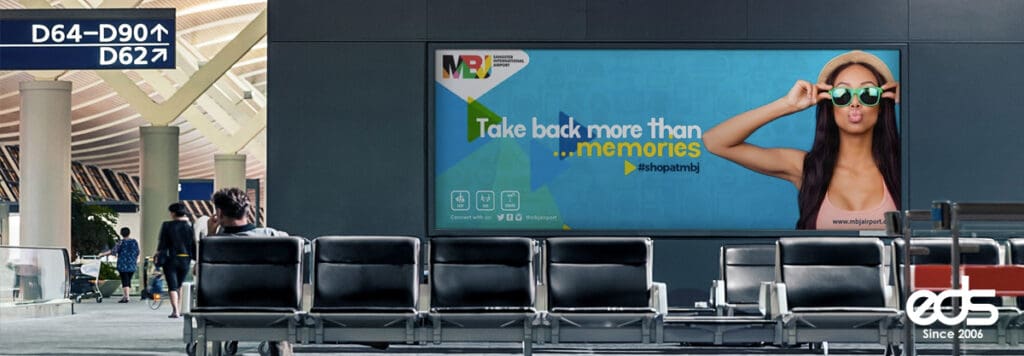
WHAT IS AIRPORT ADVERTISING?
Airport advertising is Out-of-Home advertising positioned within, around or directly connected to airport passenger environments.
Potential airport advertising formats can include:
Digital LED Screens • Large-Format Digital Displays • Video Walls • Lightboxes • Static Panels • Wall Wraps • Banners • Baggage Claim Media • Arrival Advertising • Departure Advertising • Gate Advertising • Lounge Advertising • Passenger Boarding Bridge Branding • Experiential Installations
One of the defining characteristics of airport advertising is that a passenger can encounter advertising at multiple points during the same journey:
Departure → Check-In → Security → Retail → Gate → Flight
or
Arrival → Immigration → Baggage Claim → Exit
The appropriate advertising location therefore depends not only on audience volume but also on where within the passenger journey the brand wants to communicate.
AIRPORT ADVERTISING COSTS & RATES IN DUBAI & UAE
How much does airport advertising cost in Dubai? Costs vary according to the airport, terminal or passenger environment, advertising format, display size, number of advertising units, campaign duration, digital playback or Share of Voice, production requirements and current media availability.
| Airport Advertising Format | Typical Location | Estimated Monthly Cost (AED) | Typical Application |
|---|---|---|---|
| Airport Digital Screen Advertising | Arrival halls, departure areas, passenger corridors | AED 120,000 – 250,000+ | Brand awareness & international campaigns |
| Airport Lightbox Advertising | Check-in halls, baggage claim, terminals | AED 50,000 – 150,000+ | Luxury brands, retail & services |
| Baggage Claim Advertising | Baggage belts & arrival zones | AED 155,000 – 260,000+ | Tourist-focused campaigns |
| Boarding Gate Advertising | Departure gates & waiting lounges | AED 90,000 – 250,000+ | Premium audience targeting |
| Passenger Boarding Bridge Branding | Aircraft boarding bridges | AED 80,000 – 180,000+ | Passenger engagement |
| Airport Lounge Advertising | VIP lounges & premium waiting areas | AED 50,000 – 200,000+ | Luxury & corporate brands |
| Terminal Domination Campaign | Full-area takeover branding | AED 250,000 – 1,000,000+ | Global brands & major launches |
| Airport Activation & Experiential Branding | Passenger engagement zones | AED 100,000 – 500,000+ | Product launches & experiences |
Airport advertising rates are indicative estimates and depend on airport terminal, passenger traffic, location visibility, media format, campaign duration, exclusivity and availability. Premium locations in major terminals can command higher rates.
What Affects Airport Advertising Costs?
Terminal & Passenger Environment: Advertising within different terminals, arrivals, departures, baggage claim and gate areas can have different commercial values.
Media Location: Position within the passenger journey can materially affect pricing.
Display Size: A large-format digital screen, video wall or terminal installation will normally have different commercial terms from a smaller static advertising panel.
Static or Digital Format: Digital screens and static advertising are sold differently.
Digital Rotation: Digital campaigns may share screens with other advertisers.
Share of Voice: The proportion of the advertising loop allocated to the campaign can affect both exposure and pricing.
Number of Media Units: Network campaigns using several screens or advertising faces can cost more than a single placement.
Campaign Duration: Commercial terms vary according to the booking period.
Production & Installation: Static displays, wraps and special-format installations can require additional production and installation.
Exclusivity: Category or location exclusivity, where commercially available, can affect pricing.
Current Inventory: Airport media is finite and premium locations may already be committed during required campaign periods.
For an accurate airport advertising quotation, advertisers should provide:
Campaign Dates • Target Audience • Preferred Airport/Terminal • Passenger Journey Stage • Preferred Format • Campaign Duration • Approximate Budget
AIRPORT ADVERTISING AT DUBAI INTERNATIONAL AIRPORT – DXB
Dubai International Airport is one of the world’s major international aviation hubs and provides multiple advertising environments across the passenger journey.
Potential airport media opportunities can exist across:
Terminals • Check-In Areas • Passenger Corridors • Security Approach Areas • Retail Environments • Departure Areas • Gates • Lounges • Arrivals • Immigration Approach Areas • Baggage Claim • Exit Routes
The availability of specific media formats depends on current approved airport inventory and campaign dates.
Advertisers should avoid treating “DXB advertising” as one homogeneous media environment.
A screen positioned in a passenger corridor, for example, provides a different advertising context from a baggage-claim display or gate-area installation.
AIRPORT DEPARTURE ADVERTISING
Departure advertising reaches passengers as they begin or continue their journey through the airport.
Potential environments can include:
Check-In • Passenger Processing Areas • Retail Environments • Duty-Free Areas • Lounges • Walkways • Gate Areas
Departure advertising can provide opportunities to communicate with passengers at several stages before boarding.
Check-In & Passenger Processing Areas
Advertising in these environments can reach passengers during the early part of their airport journey.
Creative should account for passenger movement, viewing distance and the amount of time audiences can reasonably engage with the display.
Retail & Duty-Free Environments
Airport retail environments place advertising close to shopping and purchase decisions.
These locations can be particularly relevant for categories such as:
Luxury • Fashion • Beauty • Fragrance • Jewellery • Electronics • FMCG • Banking & Payment Services • Consumer Technology
Boarding Gate Advertising
Gate areas can provide passenger-facing media during the waiting period before boarding.
Because passengers can have longer dwell times in these environments, selected formats may accommodate somewhat more detailed messaging than high-movement airport corridors.
AIRPORT ARRIVAL ADVERTISING
Arrival advertising communicates with passengers as they enter Dubai.
Potential touchpoints can include:
Immigration Approach Areas • Passenger Walkways • Arrival Halls • Baggage Claim • Exit Routes • Ground-Transport Areas
Arrival media can be relevant for campaigns targeting passengers making decisions after reaching Dubai, including:
Hotels • Attractions • Retail • Real Estate • Banking • Telecommunications • Transportation • Events
The creative should reflect the passenger’s point in the journey rather than simply repeating a generic airport advertisement.
BAGGAGE CLAIM ADVERTISING
Baggage claim provides a distinctive airport advertising environment because passengers can spend more time within the area while waiting for luggage.
Depending on available inventory, formats can include:
Digital Screens • Wall Displays • Large-Format Branding • Carousel-Area Advertising • Other Approved Media
The longer viewing opportunity can make baggage claim suitable for campaigns requiring more than a momentary brand impression.
However, the advertising should still remain visually simple and immediately understandable.
DIGITAL AIRPORT ADVERTISING
Digital media forms an important part of the airport advertising environment.
Depending on available inventory, digital formats can potentially provide:
Large-Format Displays • Video Walls • Digital Networks • Multiple Creative Executions • Creative Rotation • Motion • Video • Scheduled Messaging
Digital airport advertising should be evaluated according to:
Screen Location • Screen Size • Viewing Distance • Passenger Flow • Spot Duration • Advertising Rotation • Share of Voice • Audience Environment
Understanding Share of Voice
For a rotating digital screen, the advertiser generally does not occupy the screen continuously.
For example, the commercial value of a screen depends partly on:
How Long the Advertisement Appears • How Often It Appears • Total Advertising Loop Length • Number of Advertisers Sharing the Screen
Therefore, two digital screens in comparable airport locations can offer very different advertising exposure.
The number of screens alone should not be used to compare digital airport campaigns.
STATIC AIRPORT ADVERTISING
Static airport advertising provides continuous display of a particular creative during the booked campaign period.
Depending on available inventory, formats can include:
Lightboxes • Wall Panels • Posters • Banners • Wraps • Large-Format Installations
Static advertising can be particularly useful where the advertiser values continuous creative ownership of an advertising face rather than rotation within a digital loop.
When comparing static and digital airport media, advertisers should consider:
Location • Size • Viewing Distance • Dwell Time • Audience Environment • Creative Requirements • Cost
rather than assuming one format is inherently superior.
AIRPORT WALL WRAPS & LARGE-FORMAT ADVERTISING
Large-format wall wraps and architectural advertising can create a substantial visual presence within selected airport environments.
Potential characteristics include:
Large Creative Scale • Architectural Integration • Strong Brand Visibility • Premium Presentation
These formats are highly location-specific and depend on the availability of approved advertising surfaces.
Large-format airport advertising can be particularly relevant for:
Major Brand Launches • Luxury • Automotive • Real Estate • Tourism • Technology • International Campaigns
AIRPORT LOUNGE ADVERTISING
Airport lounges provide a different audience environment from high-movement terminal areas.
Potential opportunities can include selected:
Digital Displays • Static Media • Product Displays • Brand Partnerships • Other Approved Advertising Opportunities
The commercial value of lounge advertising depends on the specific lounge, passenger profile, location and available media format.
Advertisers should not assume that all airport lounge users have the same demographic, income or travel profile.
PASSENGER BOARDING BRIDGE ADVERTISING
Passenger boarding bridges can provide advertising exposure during the transition between the terminal and aircraft.
Depending on available inventory, branding can potentially appear on approved surfaces associated with the boarding environment.
This format can provide:
Close-Range Viewing • Passenger-Facing Branding • Journey-Stage Relevance
The exact creative area and specifications depend on the approved advertising asset.
EXPERIENTIAL AIRPORT ADVERTISING
Selected airport environments may support brand experiences, product displays, interactive installations or special creative executions.
Potential executions can include:
Brand Installations • Interactive Displays • Product Experiences • Technology Demonstrations • Special Creative Structures
These are typically project-specific opportunities rather than standard advertising inventory.
Feasibility can depend on:
Available Space • Passenger Flow • Security • Structural Requirements • Electrical Requirements • Fire & Life Safety • Airport Approval
Advertisers considering an activation should therefore confirm feasibility before developing the final concept.
CHOOSING THE RIGHT AIRPORT ADVERTISING ENVIRONMENT
The highest-profile airport media asset is not necessarily the best option for every advertiser.
The appropriate environment depends on who the campaign needs to reach and at what point in the journey.
| Passenger Environment | Audience Context | Potential Campaign Use |
|---|---|---|
| Check-In | Beginning the departure journey | Brand awareness, travel & services |
| Departure Corridors | Passengers moving toward gates | Broad passenger visibility |
| Retail / Duty-Free | Shopping environment | Luxury, retail & consumer brands |
| Boarding Gates | Passengers waiting to board | Longer-viewing communication |
| Lounges | Premium waiting environment | Luxury, corporate & premium services |
| Arrivals | Travellers entering Dubai | Tourism, hospitality & local services |
| Baggage Claim | Passengers waiting for luggage | Destination & service advertising |
| Exit / Ground Transport | Travellers leaving the airport | Hotels, transport, property & attractions |
The campaign should therefore be planned around the passenger journey rather than simply airport footfall.
AIRPORT ADVERTISING FOR INTERNATIONAL TRAVELLERS
One of the principal characteristics of airport advertising is its ability to communicate with audiences travelling between multiple international markets.
However, advertisers should avoid assuming that every airport-media placement reaches the same nationality, income group or traveller profile.
Audience relevance can vary according to:
Terminal • Passenger Journey • Airline Mix • Flight Destinations • Media Position • Campaign Timing
Where appropriate audience information is available, media should be selected according to the traveller characteristics most relevant to the campaign.
CREATIVE BEST PRACTICES FOR AIRPORT ADVERTISING
Airport advertising creative should be designed according to where passengers will encounter it.
Use One Main Message
Avoid trying to communicate several propositions simultaneously.
Make the Brand Immediately Recognisable
Airports contain many competing visual messages. Brand identity should therefore be prominent.
Keep Copy Concise
Large digital displays and wall formats generally work better with clear, quickly understood messaging.
Adapt Creative to the Passenger Journey
Arrival and departure audiences can have different priorities.
An arrival campaign might communicate:
“Welcome to Dubai…”
while a departure environment might use a message connected to the traveller’s onward journey.
Adapt to the Media Asset
Creative should account for:
Screen Size • Viewing Distance • Passenger Movement • Dwell Time • Orientation • Format
A social-media advertisement should not simply be enlarged and used as airport creative.
Use QR Codes Selectively
QR codes can be appropriate in environments where passengers have sufficient time and a safe opportunity to interact, such as selected gate, lounge or baggage-claim environments.
They are less useful where passengers are moving quickly past the advertising asset.
AIRPORT ADVERTISING AVAILABILITY & MEDIA OWNERSHIP
Airport advertising inventory is controlled by the relevant airport-media concessionaire, operator or authorised media partner.
At Dubai International Airport, the current page correctly identifies JCDecaux Dicon as the airport advertising media partner and clarifies that EDS does not own or exclusively operate DXB advertising inventory. airport airport
EDS operates as an advertising and media-buying agency, helping advertisers evaluate available airport-media opportunities and coordinate campaign requirements with the relevant media stakeholders.
Airport advertising availability varies according to:
Terminal • Media Location • Format • Campaign Dates • Existing Bookings • Number of Units • Special Creative Requirements
Advertisers requiring specific terminals or premium passenger environments should check current inventory before finalising campaign creative.
AIRPORT ADVERTISING RULES & APPROVALS
Airport advertising operates within a highly controlled environment and can be subject to more detailed technical and operational requirements than conventional outdoor advertising.
Requirements depend on the airport, terminal, media location, advertising format and campaign.
Advertising Content
Creative must comply with applicable UAE advertising requirements and any additional airport or media-owner content standards.
Creative Specifications
Artwork must be produced according to the dimensions, resolution and technical requirements of the selected advertising asset.
Digital Media
Digital campaigns can be subject to specifications covering:
Screen Resolution • File Format • Duration • Motion • Transitions • Technical Delivery
Physical Installations
Static displays, wraps and experiential executions can be subject to:
Installation Requirements • Structural Requirements • Electrical Requirements • Approved Materials
Passenger Safety & Movement
Advertising should not interfere with:
Passenger Movement • Wayfinding • Security Information • Emergency Signage • Airport Operations
Security Requirements
Airport installations and activations may require additional security coordination depending on the execution.
Fire & Life Safety
Physical installations must comply with applicable fire and life-safety requirements.
Campaign Timing
Installation, removal and creative changes can be subject to approved airport operating schedules.
Additional Approvals
Certain products, advertising claims, activations or creative executions may require additional approvals.
Advertisers should avoid committing to final production until the media specifications, creative requirements and applicable approval process have been confirmed.
EDS coordinates airport advertising requirements with the relevant media owners, operators and stakeholders for the selected opportunity.
Airport Advertising FAQ
What is Airport Advertising?
Airport advertising refers to promotional campaigns that take place within airport terminals, on airport exteriors, and sometimes on airport shuttle buses. It targets a captive audience of travelers with the aim of promoting brands, products, or services.
Why Choose Airport Advertising?
Airport advertising offers several advantages:
- High Visibility:Airports have a captive audience of travelers who spend significant time waiting and moving through terminals.
- Global Reach:Reach a diverse audience of international travelers, including business executives, tourists, and affluent consumers.
- Premium Environment:Enhance brand perception by associating with prestigious airlines and luxury travel services.
- Effective Targeting:Tailor campaigns to specific demographics, flight destinations, or travel behaviors.
What Types of Advertising Options are Available at Airports?
Airport advertising offers several advantages:
- High Visibility:Airports have a captive audience of travelers who spend significant time waiting and moving through terminals.
- Global Reach:Reach a diverse audience of international travelers, including business executives, tourists, and affluent consumers.
- Premium Environment:Enhance brand perception by associating with prestigious airlines and luxury travel services.
- Effective Targeting:Tailor campaigns to specific demographics, flight destinations, or travel behaviors.
What Permissions or Approvals are Required for Airport Advertising?
Advertising at airports requires permits and approvals from airport authorities. Agencies typically handle these requirements to ensure compliance and smooth execution of campaigns.
How Effective is Airport Advertising?
Airport advertising is highly effective due to:
- Dwell Time:Passengers spend considerable time in terminals, providing ample exposure to advertisements.
- Audience Quality:Reach affluent travelers with disposable income and a propensity to spend.
- Global Connectivity:Position brands in front of a global audience traveling to various destinations.
How Can I Measure the Success of my Airport Advertising Campaign?
Success can be measured through:
- Impressions:Estimate views based on foot traffic and screen visibility.
- Engagement:Track interactions such as QR code scans or website visits.
- Brand Recall:Conduct surveys to gauge ad recall among passengers.
What are the Benefits of Partnering with an Airport Advertising Agency?
Partnering with an agency offers:
- Expertise:Benefit from industry knowledge and insights into airport advertising best practices.
- Creative Solutions:Develop innovative campaigns tailored to airport environments.
- Comprehensive Service:Receive end-to-end support from planning and execution to performance analysis.
- ROI Tracking:Monitor campaign performance with detailed analytics and reporting.
How Do I Get Started with Airport Advertising?
To initiate an airport advertising campaign, contact an advertising agency specializing in airport media. They will assist in selecting the right formats, negotiating placements, and managing the logistics to ensure your campaign achieves maximum impact.
What are the different types of Facebook ad formats?
There are eight ad formats available on Facebook: video, story (image), photo, carousel, messenger, collection (images), slideshow (images), and playable. The right format for your ad depends on your goal and the type of ad copy you write.
Facebook ad campaigns produce varied results, depending on many factors, including the quality of the ads and your investment level. The only way to determine the exact effectiveness of Facebook advertising for your business is to make an effort, create the ads using the guidelines and then monitor them over time.