
DIGITAL MARKETING

DIGITAL OUT-OF-HOME ADVERTISING (DOOH) IN DUBAI, UAE
Digital Out-of-Home advertising (DOOH) in Dubai uses digital screens, LED displays and other approved digital advertising assets in public and commercial environments to deliver advertising outside the home.
EDS provides access to DOOH advertising opportunities across Dubai, including digital billboards, roadside digital screens, digital unipoles, digital bridge displays, mall screens, transit media, airport advertising and other location-based digital media, subject to current authorised inventory.
Unlike static OOH, digital outdoor advertising can allow advertisers to use multiple creatives, scheduled messaging, different time periods and faster creative changes. However, most DOOH screens operate on an advertising loop, which means advertisers should evaluate not only the location and screen size but also the spot duration, loop length, frequency and Share of Voice.
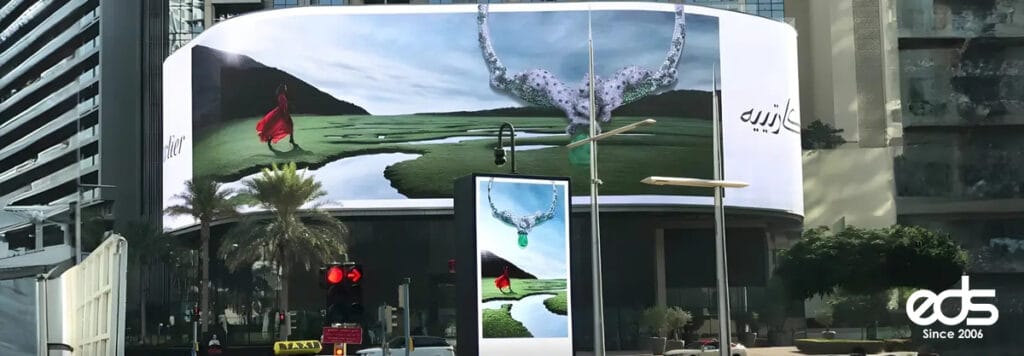
WHAT IS DIGITAL OUT-OF-HOME (DOOH) ADVERTISING?
Digital Out-of-Home advertising, commonly called DOOH, is the digital form of outdoor and location-based advertising.
Instead of printing and physically installing a new advertisement for every creative change, content is displayed electronically on approved digital advertising screens.
DOOH can appear across environments such as:
Roads & Highways • Commercial Districts • Shopping Malls • Metro & Transit Locations • Airports • Retail Destinations • Business Districts • Entertainment Venues • Other Approved Public & Commercial Locations
Depending on the individual media asset, DOOH can support:
Multiple Creatives • Scheduled Advertising • Dayparting • Faster Creative Changes • Motion Where Permitted • Campaign Rotation • Location-Specific Messaging
The capabilities of each digital screen differ. Advertisers should therefore evaluate the individual media asset and its commercial terms, rather than assuming every DOOH screen operates in the same way.
DOOH ADVERTISING COSTS & RATES IN DUBAI
How much does Digital Out-of-Home advertising cost in Dubai? There is no single standard DOOH advertising rate because digital inventory varies substantially by location, screen format, audience environment and advertising rotation.
Indicative planning ranges can include:
DOOH Format | Typical Environment | Indicative Cost (AED) | Typical Buying Basis |
Community Digital Screens | Residential & community areas | AED 10,000 – 30,000+ | Campaign / monthly |
Mall & Indoor Digital Screens | Shopping malls & retail environments | AED 15,000 – 50,000+ | Network / campaign |
Digital Roadside Screens | Main roads & commercial districts | AED 30,000 – 100,000+ | Monthly / campaign |
Premium Digital Billboards / Unipoles | Major Dubai road corridors | AED 60,000 – 200,000+ | Monthly / campaign |
Landmark Digital Screens | Premium & high-profile locations | AED 100,000 – 300,000+ | Campaign / media package |
Multi-Location DOOH Network | Multiple digital locations | AED 150,000 – 500,000+ | Network campaign |
These figures are indicative planning ranges only. Actual DOOH rates depend on the individual media asset, location, campaign period, spot duration, loop length, frequency, Share of Voice, number of screens and current availability.
What Affects DOOH Advertising Costs?
Location: Premium road corridors, major commercial districts, landmark destinations, malls, airports and community locations have different commercial values.
Screen Size & Format: A large roadside LED screen has a different cost structure from an indoor digital display.
Number of Screens: DOOH campaigns can use one premium screen or a network of screens across multiple locations.
Spot Duration: Digital advertising is often sold using defined creative durations such as a specific number of seconds per play.
Loop Length: The complete advertising loop determines how frequently the advertisement returns.
Share of Voice: The proportion of available advertising time allocated to the advertiser directly affects campaign exposure.
Frequency: The number of times the creative is scheduled to appear within an hour or other defined period can affect pricing.
Campaign Duration: Rates can differ for short tactical campaigns, monthly bookings and longer-term campaigns.
Time of Day: Where dayparting is available, selected time periods may have different commercial arrangements.
Season & Demand: Premium digital inventory can have different availability and pricing during periods of strong advertiser demand.
For an accurate DOOH quotation, advertisers should provide:
Campaign Dates • Target Audience • Preferred Locations • Campaign Duration • Approximate Budget • Number of Locations Required
HOW DO DOOH ADVERTISING LOOPS & SHARE OF VOICE WORK?
Understanding the advertising loop is particularly important when comparing digital outdoor media.
A digital screen generally displays advertisements from multiple advertisers in rotation.
For example, if a screen operates a 60-second advertising loop and an advertiser receives a 10-second spot, the advertisement could appear once during each complete loop, subject to the actual media schedule.
This would represent approximately 16.7% of that advertising loop.
However, DOOH inventory is not always structured identically. Some screens may use different loop lengths, spot durations, frequencies or scheduling arrangements.
Before booking a digital screen, advertisers should confirm:
Spot Duration • Complete Loop Length • Plays Per Hour • Share of Voice • Number of Advertisers • Operating Hours
These details provide a more meaningful basis for comparing digital media than screen size alone.
TYPES OF DOOH ADVERTISING IN DUBAI
Digital Billboards
Digital billboards are large-format roadside screens positioned at approved advertising locations.
They can provide large-scale visibility while allowing multiple advertisers or creatives to rotate on the same display.
Digital Unipoles
Digital unipoles combine the elevated roadside positioning associated with unipole advertising with a digital display.
They can be available along selected major roads and arterial corridors.
In 2026, Dubai’s OOH development programme has continued adding and converting digital assets; Mada Media reported digital unipoles among the assets tendered during the first half of the year. Media Office
Digital Bridge & Gantry Advertising
Selected bridge or gantry advertising assets can incorporate digital screens.
These formats place digital advertising within major road environments, subject to authorised inventory and applicable technical requirements.
Digital Mall Advertising
Shopping malls can offer digital screens across environments such as:
Entrances • Atriums • Escalators • Retail Corridors • Food Courts • Entertainment Areas • Other High-Footfall Zones
The value of an individual screen depends heavily on its position within the customer journey, rather than simply the mall’s overall visitor volume.
Digital Transit Advertising
DOOH can appear across selected public-transport environments including:
Metro Stations • Tram Locations • Bus Environments • Taxi Media • Transport Hubs
Transit DOOH can reach audiences during regular journeys and waiting periods.
Airport Digital Advertising
Digital advertising can be available within airport environments and selected airport-related locations.
Airport advertising should be evaluated separately according to terminal, passenger journey, location, screen type and the applicable airport media inventory.
Indoor Digital Screen Networks
Digital screens can also be available within selected:
Office Buildings • Residential Towers • Hotels • Retail Destinations • Entertainment Venues • Commercial Buildings
These formats generally offer a different viewing environment from roadside DOOH because audiences may be closer to the screen and have more time to process the advertising.
DOOH ADVERTISING LOCATIONS IN DUBAI
Digital outdoor advertising opportunities are distributed across Dubai’s road network, commercial districts, retail destinations, transit environments and other authorised locations.
Potential environments include:
Sheikh Zayed Road • Al Khail Road • Sheikh Mohammed Bin Zayed Road (E311) • Dubai–Al Ain Road • Downtown Dubai • Business Bay • DIFC • Dubai Marina • JBR • JLT • Dubai Airport Corridors • Shopping Malls • Metro & Transit Locations • Residential & Commercial Communities
Dubai continues to expand its digital OOH infrastructure. The updated Dubai OOH Advertising Manual specifically included expansion of digital advertising as part of the emirate’s evolving outdoor-advertising framework, and digital conversion remains an active sector-development priority in 2026. RTA
Sheikh Zayed Road – E11
Selected digital advertising opportunities along Sheikh Zayed Road can provide visibility within Dubai’s principal commercial and commuter corridor.
Individual screens should be evaluated according to the exact road section, traffic direction, viewing distance, screen dimensions and advertising rotation.
Al Khail Road – E44
Al Khail Road connects major residential and commercial districts across Dubai.
Selected digital OOH assets can reach audiences travelling between areas including Business Bay, Meydan, Dubai Hills, Al Quoz, JVC and surrounding communities.
Sheikh Mohammed Bin Zayed Road – E311
E311 is a major cross-city and inter-emirate road serving numerous residential, commercial and industrial communities.
Digital OOH assets are among the formats being developed along this corridor. Media Office
Downtown Dubai & Business Bay
These areas combine business, residential, hospitality, tourism, entertainment and retail audiences, creating a variety of potential digital advertising environments.
Dubai Marina, JBR & JLT
These high-density areas combine residential, commercial, hospitality and leisure audiences.
DOOH opportunities can vary from roadside digital screens to indoor and destination-based digital media.
STATIC OOH VS DIGITAL OOH (DOOH)
Static and digital outdoor advertising use the same physical-world environment differently.
Consideration | Static OOH | DOOH |
Creative Format | Printed/fabricated | Digital |
Advertising Face | Usually dedicated | Often shared |
Creative Changes | Requires physical replacement | Can be changed digitally |
Multiple Creatives | Limited | Usually possible |
Motion | No | Where permitted |
Scheduling | Same creative continuously | Can vary by schedule |
Dayparting | No | Possible on selected networks |
Production | Printing/fabrication | Digital artwork |
Share of Voice | Usually 100% of booked face | Depends on advertising loop |
Primary Strength | Continuous physical presence | Flexibility and scheduling |
A digital screen should therefore not automatically be considered better than a static billboard.
A static advertising face can provide continuous visibility throughout the booking period, whereas a digital screen may provide shorter but repeated appearances within an advertising loop.
The appropriate format depends on the campaign objective, location, creative requirement, budget and available media inventory.
HOW TO COMPARE DOOH SCREENS
Two digital screens of similar dimensions can provide very different advertising opportunities.
Before selecting a DOOH location, consider:
Exact Location
Where is the screen physically positioned, and which audience journeys pass it?
Traffic Direction
Which direction of motorists or pedestrians can actually see the screen?
Viewing Distance
How far in advance does the display become visible?
Screen Dimensions
Evaluate both the physical size and aspect ratio of the display.
Spot Duration
How many seconds does each advertisement remain on screen?
Advertising Loop
How long is the complete sequence before the advertisement appears again?
Share of Voice
What proportion of the advertising rotation belongs to the campaign?
Operating Hours
Does the screen operate continuously or according to defined hours?
Number of Screens
For network campaigns, confirm exactly how many individual screens are included.
Creative Specifications
Confirm the required resolution, dimensions, file format, frame rate and permitted creative behaviour before producing final artwork.
DOOH ADVERTISING BY TIME OF DAY
One advantage of selected DOOH networks is the ability to schedule different creative according to time periods.
Where supported by the media owner, an advertiser could potentially use:
Morning Creative → Daytime Creative → Evening Creative
For example, an F&B advertiser could promote one product during daytime hours and a different offer during the evening.
A retail advertiser could change messaging around store opening periods, while an event advertiser could update creative as the event date approaches.
Dayparting should only be used where it improves the relevance of the campaign. It is not necessary simply because the technology permits it.
DOOH CREATIVE BEST PRACTICES
Digital capability does not remove the basic principles of effective outdoor advertising.
Roadside audiences still have limited time to understand the message.
Use One Main Message
Focus each creative on one principal communication objective.
Keep Headlines Short
The message should be understandable within the available viewing time.
Make the Brand Prominent
The brand should remain recognisable throughout the creative.
Use Strong Contrast
Typography and imagery should remain clearly visible against the surrounding environment.
Avoid Excessive Motion
Motion may be restricted according to the media asset and applicable requirements.
Even where animation is permitted, excessive movement can reduce message clarity.
Design for the Actual Screen
Do not simply resize an Instagram post or online banner.
The creative should reflect the screen’s:
Dimensions • Aspect Ratio • Viewing Distance • Traffic Speed • Spot Duration • Surrounding Environment
Use Multiple Creatives Strategically
The ability to rotate creatives can be useful for different products, messages or campaign stages.
However, changing the creative should have a clear communication purpose rather than creating unnecessary variation.
3D & SPECIAL-FORMAT DIGITAL OOH IN DUBAI
Selected digital advertising environments can support more advanced creative executions, subject to the individual screen, technical capabilities and applicable approvals.
Potential formats can include:
Anamorphic 3D Creative • Special Digital Content • Innovative Lighting • Other Technology-Led OOH Executions
These are not standard capabilities of every digital screen.
Dubai’s updated OOH Advertising Manual specifically addresses newer advertising media and creative technologies, including 3D advertising, modern lighting and other innovative formats, while maintaining traffic and pedestrian safety requirements. RTA
The creative should therefore be developed specifically for the selected media asset rather than assuming a 3D execution can be transferred between screens.
PROGRAMMATIC DOOH IN DUBAI
Programmatic DOOH refers to the use of technology platforms to facilitate the buying and delivery of advertising across compatible digital outdoor inventory.
Depending on the available network and buying platform, programmatic capabilities can potentially support factors such as:
Location • Time • Audience Context • Campaign Schedule • Other Available Data Signals
However, not all DOOH inventory in Dubai is available programmatically.
Advertisers should confirm whether the required screens support direct media buying, programmatic buying or both, and compare the available inventory and commercial terms accordingly.
DOOH ADVERTISING AVAILABILITY & CAMPAIGN DURATION
DOOH availability varies according to:
Location • Individual Screen • Campaign Dates • Existing Advertisers • Media Owner • Spot Duration • Share of Voice • Number of Screens • Required Time Period
Digital advertising can provide more creative flexibility than printed outdoor media, but this does not mean premium screens are always immediately available.
For major campaigns, advertisers should confirm inventory before finalising creative.
Before booking, the media plan should clearly identify:
Screen Locations • Number of Screens • Screen Dimensions • Spot Duration • Loop Length • Plays/Frequency • Share of Voice • Campaign Dates • Operating Hours
This allows the advertiser to understand exactly what is being purchased.
DOOH ADVERTISING RULES & APPROVALS IN DUBAI
Digital Out-of-Home advertising in Dubai is subject to applicable OOH advertising, road-safety, technical, content, illumination and urban-design requirements.
Dubai’s updated OOH Advertising Manual was developed by RTA in collaboration with Dubai Municipality and the Department of Economy and Tourism. The framework specifically expanded digital advertising while maintaining requirements around site planning, design and road safety. RTA
Mada Media now has a central role in regulating, developing and managing Dubai’s OOH sector and operates a unified platform covering advertising permits across right-of-way, public transport, commercial vehicles, private land and buildings. Media Office
Authorised Digital Advertising Assets
A digital screen visible from a public environment is not automatically authorised for commercial DOOH advertising.
Campaigns should use approved advertising inventory.
Screen Positioning
The location and orientation of digital displays must comply with requirements applicable to the individual advertising asset and environment.
Traffic & Pedestrian Safety
Digital advertising should not interfere with traffic signals, road signs, driver visibility, pedestrian safety or essential infrastructure.
Brightness & Illumination
Digital screens may be subject to technical requirements concerning brightness and illumination, particularly in relation to surrounding conditions and road safety.
Motion & Animation
Permitted creative behaviour depends on the individual digital advertising format and applicable specifications.
Advertisers should not assume that full-motion video or unrestricted animation is permitted on every DOOH screen.
Advertising Content
Creative must comply with applicable UAE and Dubai advertising requirements.
Certain products, services or promotional claims may require additional approvals.
Technical Specifications
Artwork must comply with the technical requirements of the individual screen, including applicable resolution, dimensions, file format and creative specifications.
Special Digital Executions
3D, advanced lighting and other special-format executions may require additional technical review and approvals.
EDS operates as an advertising and media-buying agency and coordinates available DOOH opportunities with relevant media owners, operators and applicable stakeholders.
DIGITAL OUT-OF-HOME (DOOH) ADVERTISING FAQ
What is DOOH advertising?
DOOH stands for Digital Out-of-Home advertising. It uses digital screens and displays in public, roadside, retail, transit and other approved environments to deliver advertising outside the home.
What is the difference between OOH and DOOH advertising?
OOH is the broader category of Out-of-Home advertising and includes both static and digital formats. DOOH specifically refers to digital Out-of-Home advertising displayed electronically.
How much does DOOH advertising cost in Dubai?
Costs vary significantly according to the screen and location. Indicative campaigns can range from approximately AED 10,000–30,000+ for selected community digital screens to AED 60,000–200,000+ for premium digital roadside formats, while landmark and multi-location campaigns can cost substantially more.
How are digital billboard rates calculated?
Rates can depend on the screen location, dimensions, campaign duration, spot duration, advertising loop, frequency, Share of Voice, operating hours and number of screens.
What is Share of Voice in DOOH advertising?
Share of Voice represents the advertiser’s proportion of the available advertising rotation. For example, a 10-second advertisement appearing once within a 60-second loop represents approximately 16.7% of that loop.
What is a DOOH advertising loop?
The advertising loop is the complete sequence of content displayed before an advertiser’s creative repeats. A screen shared by multiple advertisers may rotate their advertisements within the same loop.
Is DOOH advertising available on Sheikh Zayed Road?
Selected digital OOH opportunities can be available along Sheikh Zayed Road and other major Dubai road corridors, subject to current authorised inventory and availability.
Can DOOH advertisements use video or animation?
Some digital formats can support motion or animation, but permitted creative behaviour varies according to the screen and applicable requirements. Full-motion video should not be assumed to be permitted on every roadside display.
Can different advertisements run at different times of the day?
Yes, selected DOOH networks can support scheduled or dayparted creative, allowing different messages to appear during different time periods.
Is programmatic DOOH available in Dubai?
Programmatic buying can be available across compatible digital outdoor inventory, but not every DOOH screen is programmatically accessible. Availability should be confirmed for the required media network.
Is 3D DOOH advertising available in Dubai?
Selected digital displays can support advanced or anamorphic 3D creative, subject to the technical capabilities of the screen and applicable approvals. 3D capability should be confirmed for the individual media asset.
Does DOOH advertising in Dubai require approval?
Yes. Digital outdoor advertising must use authorised media assets and comply with applicable advertising, technical, content, illumination and safety requirements.
What should I check before booking a DOOH campaign?
Confirm the exact screen locations, screen dimensions, number of screens, spot duration, loop length, frequency, Share of Voice, operating hours, campaign dates and total media cost.
Can EDS arrange DOOH advertising in Dubai?
Yes. EDS operates as an advertising and media-buying agency and can help advertisers evaluate available DOOH screens and networks, obtain current media options and coordinate campaigns with relevant media owners, operators and applicable stakeholders.