


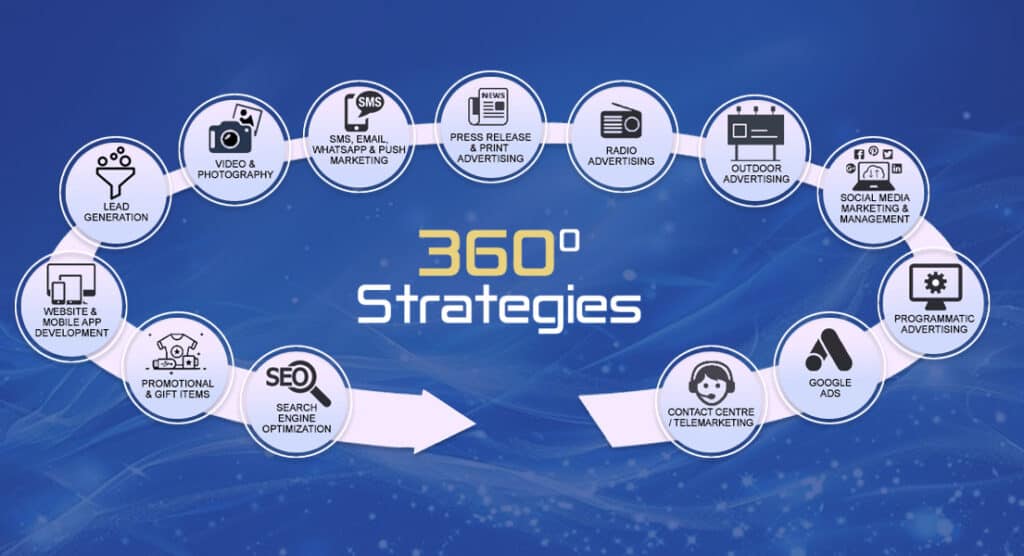
In today’s highly competitive marketplace, customers interact with brands across dozens of touchpoints before making a purchase. They may discover your business on Google, see your billboard while driving on Sheikh Zayed Road, hear your advertisement on the radio during their commute, read a press release online, and finally engage with your brand on social media before becoming a customer.
The businesses that succeed are no longer relying on a single marketing channel—they are embracing a 360° marketing strategy that delivers a consistent brand experience wherever their audience is.
At EDS, we’ve spent nearly two decades helping businesses across the UAE and GCC integrate advertising, digital marketing, media buying, creative production, and technology into unified campaigns that generate measurable business outcomes.
What Is a 360° Marketing Strategy?
A 360° marketing strategy is an integrated approach where every marketing channel works together to support a common business objective.
Rather than treating digital marketing, outdoor advertising, public relations, social media, email campaigns, and creative production as separate activities, they become interconnected components of a single customer journey.
The goal is simple:
Deliver the right message to the right audience through the right channel at the right time.
When every touchpoint reinforces the same message, customers are more likely to remember your brand, engage with your business, and ultimately convert.
Why Businesses Need an Integrated Marketing Approach
Modern consumers rarely make purchasing decisions after a single interaction.
A typical customer journey may look like this:
- Searches Google for a product or service.
- Sees your sponsored search result.
- Notices your billboard on the way to work.
- Encounters your brand on Instagram.
- Reads a positive news article or press release.
- Visits your website.
- Receives a remarketing advertisement.
- Contacts your sales team.
Every interaction builds familiarity and trust.
When these channels operate independently, opportunities are lost. When they operate together, they reinforce one another and significantly improve campaign effectiveness.
The Core Components of a 360° Marketing Strategy
Digital marketing enables businesses to reach highly targeted audiences through measurable campaigns.
This includes:
- Google Ads
- Search Engine Optimization (SEO)
- Programmatic Advertising
- Display Advertising
- Remarketing
- Analytics and Conversion Optimization
Digital channels provide real-time performance data that helps marketers continuously improve campaign results.
Social media has become one of the most influential channels for customer engagement.
An effective strategy combines:
- Content creation
- Community management
- Paid social campaigns
- Influencer collaborations
- Video marketing
- Brand storytelling
Rather than simply posting regularly, successful brands create meaningful conversations that build long-term relationships.
Despite rapid digital growth, outdoor advertising remains one of the most powerful brand awareness tools available.
Billboards, digital screens, bridge banners, metro advertising, airport media, taxis, buses, and retail displays provide:
- Massive reach
- High visibility
- Continuous exposure
- Strong brand recall
When integrated with digital campaigns, outdoor advertising significantly increases campaign effectiveness.
Selecting the right media mix is as important as creating compelling creative.
Strategic media buying involves:
- Audience research
- Budget optimization
- Media planning
- Negotiation
- Campaign scheduling
- Performance monitoring
An integrated media strategy ensures every marketing dollar works harder.
Advertising builds visibility.
Public relations builds credibility.
Media coverage, thought leadership articles, interviews, and press releases strengthen brand reputation and create trust among customers, investors, and stakeholders.
Every marketing campaign ultimately directs customers to a destination.
Your website must convert visitors into enquiries or customers through:
- Fast loading speed
- Mobile responsiveness
- Clear messaging
- Strong calls-to-action
- Conversion-focused design
A beautiful website without conversions is simply an online brochure.
Creative assets influence every stage of the customer journey.
Professional branding, photography, videography, motion graphics, and compelling copywriting ensure consistent messaging across every platform.
Strong creative transforms attention into action.
The Benefits of a 360° Marketing Strategy
Businesses that adopt an integrated marketing approach typically experience:
- Stronger brand recognition
- Higher customer trust
- Improved lead quality
- Better campaign performance
- Consistent customer experiences
- More efficient marketing budgets
- Higher return on investment (ROI)
Most importantly, every marketing activity contributes toward a common business objective rather than operating in isolation.
Why Integration Matters More Than Ever
Consumers no longer distinguish between “online” and “offline” marketing.
They simply experience your brand.
Whether they encounter your business through Google, a billboard, LinkedIn, radio, YouTube, or a news article, they expect a consistent experience.
This consistency builds confidence—and confidence drives purchasing decisions.
Common Mistakes Businesses Make
Many organizations still approach marketing as separate departments or disconnected campaigns.
Some focus exclusively on digital advertising while neglecting brand awareness.
Others invest heavily in outdoor media without measuring online engagement.
Common mistakes include:
- Inconsistent messaging
- Poor audience targeting
- Disconnected creative assets
- Lack of campaign measurement
- Short-term thinking
- Channel silos
A successful 360° strategy eliminates these gaps by aligning every activity around shared goals and measurable outcomes.
Measuring Success
Modern marketing should always be accountable.
Key performance indicators may include:
- Website traffic
- Lead generation
- Cost per acquisition
- Brand awareness
- Search volume growth
- Social engagement
- Media reach
- Conversion rate
- Return on advertising spend (ROAS)
Regular analysis allows campaigns to evolve and improve continuously.
The Future of Integrated Marketing
Artificial intelligence, automation, first-party data, and advanced analytics are transforming how businesses communicate with customers.
However, technology alone does not guarantee success.
The brands that will lead tomorrow are those that combine:
- Strategic thinking
- Creativity
- Data
- Technology
- Human insight
into a seamless customer experience.
Conclusion
A successful marketing strategy is no longer defined by one exceptional campaign or one effective channel.
It is defined by how well every channel works together.
A 360° marketing strategy enables businesses to create consistent experiences, maximize marketing investments, and build stronger, more valuable relationships with customers.
Whether you’re launching a new product, expanding into new markets, or strengthening an established brand, an integrated approach provides the foundation for sustainable growth in an increasingly connected world.
About EDS
EDS FZCO is a Dubai-based integrated advertising, media buying, and digital marketing agency with nearly two decades of experience helping businesses grow across the UAE and GCC. From digital marketing and social media to outdoor advertising, public relations, media buying, creative production, and lead generation, EDS delivers end-to-end marketing solutions that connect brands with the right audience through the right channels.