
DIGITAL MARKETING


Truck Advertising in Dubai, Sharjah and UAE
Truck advertising turns commercial and campaign vehicles into mobile outdoor advertising displays, allowing brands to build visibility while vehicles travel, make deliveries, operate between commercial areas or participate in promotional campaigns.
Advertising options can include full truck wraps, partial wraps, side-panel branding, rear advertising, box-truck branding, delivery-truck advertising and specially arranged promotional trucks, depending on the vehicle, operator and applicable approvals.
For campaigns covering Dubai and Sharjah, truck advertising can provide a particularly useful combination of large-format creative space and geographic mobility, with actual coverage determined by the vehicle’s operating routes or the agreed campaign plan.
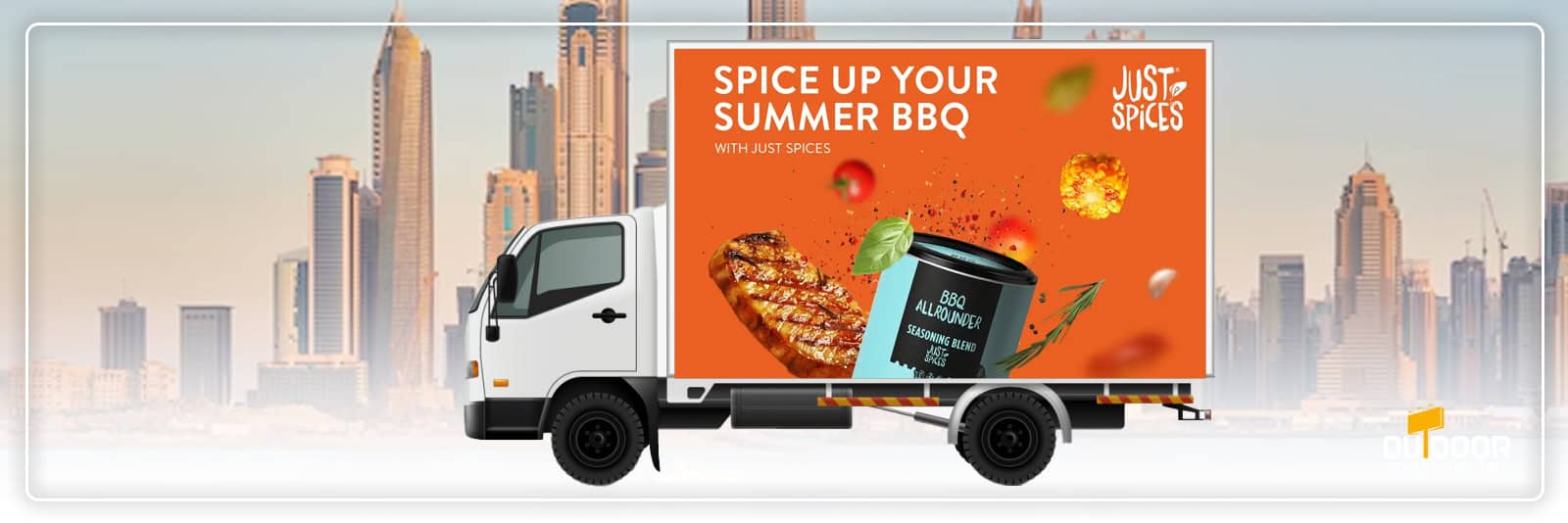
WHAT IS TRUCK ADVERTISING?
Truck advertising uses approved advertising graphics, wraps or media installations on commercial trucks and other suitable vehicles.
Depending on the vehicle and campaign arrangement, formats can include:
Full Truck Wraps • Partial Truck Wraps • Side-Panel Advertising • Rear-Panel Advertising • Box-Truck Branding • Delivery-Truck Advertising • Event & Promotional Trucks • Digital Truck Displays Where Specifically Available and Approved
Unlike a fixed billboard, a branded truck can potentially be seen across multiple areas as the vehicle moves.
Truck advertising therefore combines:
Large Creative Area • Mobility • Geographic Coverage • Repeated Exposure
Actual routes and geographic coverage should always be based on the vehicle’s operating pattern or contracted campaign route, rather than assumed.
TRUCK ADVERTISING COSTS & RATES IN DUBAI & UAE
How much does truck advertising cost in Dubai and the UAE? Costs vary according to the truck type, branding coverage, number of vehicles, campaign duration, operating routes, production and installation requirements and current vehicle availability.
Options such as side and rear branding, full truck wraps, delivery-truck advertising and multi-vehicle fleet campaigns are priced differently according to the selected vehicles and campaign requirements.
| Truck Advertising Format | Coverage / Usage | Estimated Cost (AED) | Typical Application |
|---|---|---|---|
| Small Branded Truck Advertising | Local routes & community areas | AED 30,000 – 50,000 per truck/month | Local businesses & promotions |
| Standard Truck Side Branding | Truck body panels & rear branding | AED 40,000 – 55,000 per truck/month | Brand-awareness campaigns |
| Full Truck Wrap Advertising | Complete vehicle branding | AED 40,000 – 55,000 per truck/month | Large-format mobile visibility |
| Delivery Truck Advertising | Logistics & commercial fleet branding | AED 3,000 – 8,000 per truck/month | FMCG, retail & service brands |
| Event Advertising Truck | Fixed location + route activation | AED 40,000 – 55,000 per truck/month | Exhibitions, festivals & activations |
| Truck Fleet Branding – 10+ Trucks | Multiple routes across UAE | AED 40,000 – 55,000 per truck/month | Large-scale campaigns |
Rate Note: Truck advertising rates are indicative estimates and vary according to the truck type, branding coverage, number of vehicles, operating routes, campaign duration, production and installation requirements and current availability. Exact rates, vehicle specifications and route requirements should be confirmed for the selected campaign.
What Affects Truck Advertising Costs?
The main cost variables include:
Vehicle Type: Small delivery vehicles, box trucks and larger commercial vehicles have different branding areas and commercial terms.
Branding Coverage: Rear-only, side-panel, partial-wrap and full-wrap campaigns require different amounts of material and production.
Number of Trucks: A single vehicle and a multi-truck campaign have different commercial structures.
Campaign Duration: Media, vehicle and production requirements vary according to the campaign period.
Operating Routes: Route requirements and geographic coverage can affect campaign planning and vehicle selection.
Production Material: Vinyl specification, printing and finishing affect production costs.
Installation & Removal: Vehicle preparation, application and removal requirements vary according to vehicle size and branding coverage.
Special Campaign Requirements: Promotional vehicles, event installations and digital displays can involve additional technical requirements.
For accurate budgeting, the main information required is:
Campaign Dates • Target Audience • Preferred Geographic Coverage • Number of Trucks • Advertising Format • Campaign Objective • Approximate Budget
TYPES OF TRUCK ADVERTISING
Full Truck Wrap Advertising
A full truck wrap uses a substantial portion of the approved exterior vehicle surfaces to create a large-format mobile advertising display.
It can provide:
Large Creative Space • Strong Brand Presence • Consistent Branding Across the Vehicle • Visibility From Multiple Viewing Angles
Full wraps can be particularly suitable for major brand campaigns, retail, FMCG, automotive, property launches, events and e-commerce campaigns.
The creative should be developed using the actual vehicle template, rather than simply enlarging an existing billboard design.
Partial Truck Wrap Advertising
Partial wraps use selected areas of the vehicle instead of covering most of the truck.
These can include:
Side Panels • Rear Panels • Selected Box-Body Areas • Approved Decals
Partial branding can provide a practical balance between available creative area and production requirements.
Truck Side Advertising
The large side surface of box trucks and delivery vehicles can provide a substantial mobile advertising canvas.
Side-panel creative generally works best with:
Large Typography • Strong Brand Identity • High Contrast • One Main Visual • Short Messaging
Because audiences may see the truck while it is moving, detailed copy should be avoided.
Rear Truck Advertising
Rear-facing advertising is primarily visible to motorists travelling behind the vehicle.
Creative should therefore prioritise:
Short Headlines • Prominent Brand Logos • Simple Calls to Action • Memorable Web Addresses • Strong Product or Campaign Visuals
The message should be understandable quickly and should not depend on small text.
Delivery Truck Advertising
Delivery and distribution vehicles can provide advertising exposure while carrying out their normal commercial operations.
This format can be relevant for:
Retail • FMCG • Food & Beverage • E-commerce • Logistics • Consumer Products • Home Services
Where a business already operates its own delivery fleet, consistent vehicle branding can also reinforce its corporate identity across operating areas.
Event & Promotional Trucks
Specially arranged vehicles may be used for events, exhibitions, product launches, roadshows or promotional activations, where suitable and permitted.
Potential formats can include:
Branded Display Vehicles • Mobile Promotional Units • Product Display Trucks • Sampling Vehicles • Event Support Vehicles
These should be treated as project-specific activations, rather than standard truck advertising inventory.
Technical feasibility, parking/location permissions and event requirements should be assessed for each campaign.
TRUCK ADVERTISING IN DUBAI
Dubai provides a varied operating environment covering commercial districts, residential communities, industrial areas, logistics corridors and retail destinations.
Depending on the vehicle operator and actual route, truck advertising may potentially gain visibility around areas such as:
Sheikh Zayed Road Corridors • Al Khail Road • Sheikh Mohammed Bin Zayed Road / E311 • Business Bay • Deira • Bur Dubai • Al Quoz • Dubai Investment Park • Dubai South • Jebel Ali • Dubai Silicon Oasis • Residential Communities • Commercial Districts • Industrial Areas
However, these should not be interpreted as guaranteed advertising routes.
Truck movement should always be described according to the actual operating route or agreed campaign coverage.
TRUCK ADVERTISING IN SHARJAH
Sharjah combines residential, commercial and industrial areas with significant daily movement between Sharjah and Dubai.
Depending on the selected vehicle and operating arrangement, truck advertising can potentially support campaigns across:
Industrial Areas • Residential Districts • Retail Zones • Commercial Areas • Major Connecting Roads • Dubai–Sharjah Commuter Corridors
This can make truck branding relevant for advertisers seeking visibility among audiences moving between commercial, residential and industrial areas.
Actual routes must be confirmed against the selected vehicles and campaign agreement.
DUBAI–SHARJAH CROSS-EMIRATE TRUCK ADVERTISING
One of the distinguishing characteristics of mobile OOH is the potential to generate exposure across more than one emirate.
Where the selected vehicle operates or is contracted to operate between Dubai and Sharjah, a campaign can potentially reach:
Cross-Emirate Commuters • Retail Customers • Industrial Audiences • Logistics Businesses • Residents Living in Sharjah and Working in Dubai • Businesses Operating Across Both Emirates
Cross-emirate exposure should only be presented as part of a campaign where the relevant routes are confirmed.
For advertisers specifically seeking both markets, actual geographic coverage is more important than simply the number of branded trucks.
TRUCK ADVERTISING ROUTES & GEOGRAPHIC COVERAGE
Truck advertising differs from conventional fixed OOH because the advertising location can change throughout the day.
There are generally three types of movement to consider:
Operational Routes
Vehicles follow their normal commercial, logistics or delivery routes.
Campaign-Specific Routes
Where available and contractually agreed, vehicles can operate according to specified campaign coverage.
Event-Based Movement
Promotional vehicles can be positioned or routed around events, exhibitions or activation locations, subject to permissions.
Before booking a campaign, advertisers should therefore establish:
Where will the trucks operate? • How frequently will they cover those areas? • Are routes fixed or variable? • Is cross-emirate movement included? • Are there restrictions on where the vehicles can operate or stop?
A truck should not be promoted as covering a particular road or district unless that coverage is supported by the operating arrangement.
TRUCK WRAP ADVERTISING VS BILLBOARD ADVERTISING
Truck advertising and billboards are both forms of OOH media, but they perform different roles.
| Feature | Truck Advertising | Billboard Advertising |
|---|---|---|
| Location | Mobile | Fixed |
| Creative Area | Vehicle-dependent | Usually large |
| Geographic Coverage | Variable | Specific location |
| Primary Strength | Mobility | Location presence |
| Route Targeting | Possible where specifically arranged | Not applicable |
| Repetition | Route-dependent | Traffic-dependent |
| Best For | Multi-area exposure | High-visibility fixed-location presence |
A campaign can also combine both formats where the objective requires fixed-location presence plus mobile geographic coverage.
TRUCK ADVERTISING CREATIVE BEST PRACTICES
Truck advertising creative needs to work when the vehicle is parked, travelling slowly or moving in traffic.
Keep the Main Message Short
The audience may have only a few seconds to understand the advertisement.
Make the Brand Prominent
The advertiser or product should be identifiable immediately.
Use Large Typography
Small text is difficult to read on a moving vehicle.
Use Strong Contrast
The creative should remain distinguishable from both the vehicle and surrounding road environment.
Use One Main Visual
Avoid combining too many products, photographs or messages.
Design Different Vehicle Surfaces Strategically
A truck has several viewing surfaces, and each can serve a different role.
For example:
Side: Main visual + campaign message
Rear: Brand + short CTA
Opposite Side: Supporting creative
Use the Exact Vehicle Template
Truck dimensions and body configurations vary substantially.
Artwork should account for:
Doors • Handles • Hinges • Lights • Registration Plates • Ventilation • Mechanical Areas • Mandatory Vehicle Markings
A truck wrap should therefore be designed specifically for the selected vehicle rather than simply resizing billboard artwork.
TRUCK ADVERTISING AVAILABILITY & CAMPAIGN DURATION
Truck advertising availability depends on the required vehicle type, number of trucks, campaign dates, branding format, operating coverage and production schedule.
For fleet campaigns, advertisers should confirm whether all vehicles:
- Are the same model and dimensions
- Operate across the required geographic areas
- Can be branded for the complete campaign period
- Have suitable surfaces for the proposed creative
Production and installation schedules should also be considered before confirming the campaign launch date.
Where trucks remain operational commercial vehicles, branding must be coordinated around their operational requirements.
DIGITAL TRUCK ADVERTISING
Digital displays mounted on vehicles may be available for selected campaigns where the vehicle, display technology, operating arrangement and applicable approvals permit.
Potential capabilities can include:
Motion Content • Multiple Advertisements • Scheduled Messaging • Creative Changes
However, digital truck advertising should not be treated as a standard format available on every commercial truck.
Before considering a digital advertising truck, advertisers should verify:
Vehicle Type • Display System • Screen Specifications • Operating Route • Content Requirements • Location Restrictions • Applicable Permissions
TRUCK ADVERTISING RULES, PERMITS & APPROVALS IN DUBAI & UAE
Truck advertising must comply with applicable vehicle, advertising, road-safety and authority requirements in the emirate where the vehicle is registered or operated.
Requirements can vary according to the vehicle type, branding format, operating area and nature of the campaign.
Vehicle Advertising Approval
Commercial vehicle branding may require approval from the relevant authority or licensing body before installation.
Advertising Content
Artwork and advertising content must comply with applicable UAE advertising requirements.
Vehicle Identification & Safety
Advertising graphics must not obstruct:
Registration Plates • Required Vehicle Markings • Lights • Indicators • Windows or Driver Visibility Where Restricted • Safety Equipment
Vehicle Dimensions
Advertising installations must not create unsafe projections or interfere with the vehicle’s permitted dimensions and operation.
Reflective & Illuminated Materials
Any reflective, illuminated or digital components may be subject to additional requirements because of their potential effect on road users.
Route & Location Permissions
Branding a truck does not automatically provide permission to park, stop, display or conduct promotional activity at any desired location.
Event and promotional trucks can require separate permissions for specific locations or activations.
Installation & Removal
Advertising materials should be professionally installed and removed without compromising vehicle safety, mandatory markings or operational requirements.
Cross-Emirate Campaigns
Campaigns operating across Dubai, Sharjah or other emirates should be checked against the requirements applicable to the selected vehicles and operating areas.
EDS works as an advertising and media-buying agency and coordinates truck advertising requirements with the relevant vehicle operators, production partners and other stakeholders, subject to current availability and applicable approvals. truck
This version is substantially tighter than the current 21-page page while retaining the strongest truck-specific information and eliminating the generic sections that don’t add enough SEO/AI-search value. It also keeps the page focused specifically on truck advertising, rather than padding it with generic industry and media-integration content.
Truck Advertising in Dubai and Sharjah FAQ
What is truck advertising in Dubai and Sharjah?
Truck advertising is a mobile Out-of-Home (OOH) format that uses branded trucks or commercial vehicles to display advertising while travelling or operating in approved locations. Formats can include truck-side branding, full vehicle wraps, delivery-truck branding and selected promotional or event vehicles.
How much does truck advertising cost in Dubai and the UAE?
Truck advertising costs depend on the vehicle type, branding format, number of trucks and campaign duration. Indicative rates can range from approximately AED 30,000–50,000 per month for smaller branded trucks and AED 40,000–55,000 per month for standard truck-side advertising or full truck wraps. Event and promotional trucks can also range from approximately AED 40,000–55,000, depending on the campaign requirements.
What types of truck advertising are available?
Depending on the campaign and available vehicles, options can include full truck wraps, truck-side advertising, delivery-truck branding, partial vehicle branding, event trucks and multi-vehicle fleet campaigns. The available advertising area and specifications depend on the individual vehicle.
Can truck advertising run in both Dubai and Sharjah?
Campaigns may be planned for Dubai, Sharjah or wider UAE coverage depending on the vehicle operation, campaign requirements and applicable permissions. The permitted operating areas and campaign arrangements should be confirmed before the campaign is booked.
How is truck advertising different from billboard advertising?
Truck advertising is mobile and can create visibility across different locations as the vehicle moves, while a billboard provides a fixed advertising presence at one specific site. Truck advertising is therefore suited to campaigns seeking mobile brand presence, while billboards provide consistent visibility at a selected location.
Can I choose the areas or routes for a truck advertising campaign?
Campaigns can be planned around desired geographic areas where operationally and legally permitted. However, specific routes, stopping points, parking locations or exposure at particular roads should not be assumed unless they form part of the confirmed campaign arrangement and comply with applicable requirements.
Can I advertise on a fleet of trucks?
Yes. Multi-vehicle campaigns can create a broader mobile advertising presence. For fleets of 10 or more trucks, indicative planning rates can be approximately AED 40,000–55,000 per truck per month, although final pricing depends on vehicle specifications, fleet size, branding requirements and campaign duration.
What is the difference between a truck-side advertisement and a full truck wrap?
Truck-side advertising concentrates the creative on the main side advertising surfaces, while a full wrap uses a larger proportion of the approved vehicle exterior. The appropriate format depends on the truck design, available branding surfaces, campaign objective and applicable vehicle-advertising requirements.
What makes an effective truck advertisement?
Truck advertising is often viewed while both the branded vehicle and surrounding traffic are moving. Creative should therefore use prominent branding, a strong visual, limited text and an immediately understandable message. Artwork must also be adapted to the dimensions and structural features of the selected truck.
Can truck advertising artwork be changed during a campaign?
Yes, but changing static truck branding normally requires new artwork production and replacement or reinstallation of the advertising material. The feasibility, additional production cost and downtime depend on the vehicle and branding format.
Does truck advertising in Dubai and Sharjah require approvals?
Yes. Advertising on trucks and commercial vehicles is subject to applicable vehicle, advertising, content, safety and operating requirements. Requirements can differ according to the vehicle, advertising format and emirate, so the relevant approvals and technical specifications should be confirmed before production and operation.
Can EDS arrange truck advertising in Dubai and Sharjah?
Yes. EDS can help advertisers evaluate and coordinate available truck advertising opportunities in Dubai, Sharjah and other parts of the UAE through relevant vehicle operators and campaign partners. This can include reviewing vehicle formats, fleet options, branding specifications, campaign areas and availability, subject to applicable approvals.